
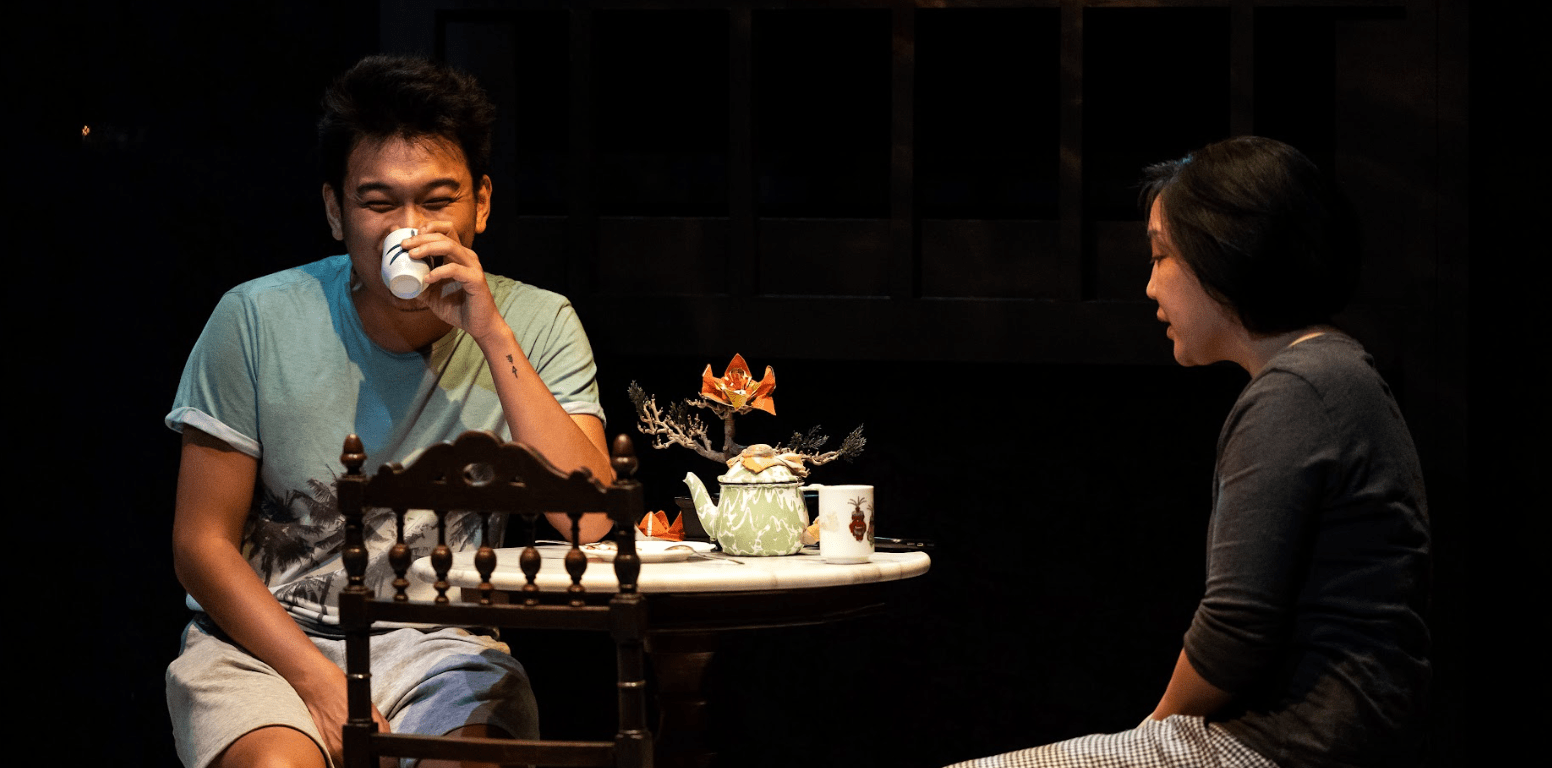

A closer look at ordinary life that carries on in spite of the extraordinary.
Thai writer-director Wichaya Artamat claims that his play This Song Father Used To Sing (Three Days In May) is an unpolitical play. But can any play truly be completely devoid of any political attachment? Rounding off the Esplanade’s 2024 season of The Studios, This Song Father Used To Sing (Three Days In May) follows a pair of siblings who meet in the wake of their father’s death, celebrating the anniversary of his passing over three days in May, over three separate years. The date is never consistent, because they no longer remember the precise day he died.
Though the years go by, their lives remain mostly the same, the conversations still circling back to what they’re doing. The brother (Jaturachai Srichanwanpen) initially attends an arts management course in Singapore, before becoming an academic, only occasionally returning to Thailand. The sister (Parnrut Kritchanchai) takes on a cooking course in the hopes of opening her own restaurant, before attempting to become a reviewer and social media personality instead. They always meet in their father’s house, his presence still felt as we see his portrait atop a shelf, lit by candlelight.

As mundane as it all sounds, there is something oddly arresting about their conversations, oftentimes peppered with some sibling rivalry, playful jabs at each other, and nostalgia for how things used to be. They try to remember what their father’s favourite cake was, or how he wanted his ashes to be dispersed. Each time, they perform a Chinese ceremony in remembrance of him, from laying out food offerings, to burning paper money for him. While most Singaporeans may be used to seeing these rituals, it is still quite something to see them performed onstage, from boiling water to cooking rice. This is educational for those who may be less familiar with them, and we always feel included; each audience member’s seat even has a single sheet of hell money waiting for us, perhaps to better make us feel part of this process of remembrance.

There is a careful balance of the sacred and the silly, where they end up giving up on performing some of these rituals properly – hell money gets folded into paper planes and thrown across the room, while they use suspicious looking leaves to boil tea. These moments and exchanges are often laugh-out-loud ridiculous in the span of an otherwise deadpan play, and that offers some degree of healing from being given the space to just be silly. Perhaps most significant of all, they recall songs of significance that their father used to sing, often tunes by Teresa Teng, from ‘Ye Lai Xiang’ to ‘Subaru’. When this happens, we hear the corresponding songs, and then see projections on the front door, not of their father, but of famous stars already long dead, from Leslie Cheung (who they discuss in detail) to Western singers.

Often, what this leads to is pondering over death. The siblings never outright voice it out, but from their conversations of how much progress they’re making in life, we think of how we should be making the most of our present, wondering about what people will remember of us when we pass, or if they even will. Some of the most beautiful moments in the play occur during the long silences between the siblings, with Rueangrith Suntisuk’s long living room allowing for us to feel the emotional gulf between the siblings when seated far apart, or how the repeated ‘mmms’ they simply utter to each other at times seems to reveal surprising moments of connection and understanding only two people who grew up together share.

As unpolitical as it is, in the programme notes, it is revealed how each of the dates chosen are specific, each taking place several years after a major demonstration or protest, relating to military crackdowns or fault lines that emerged in society. Yet with the play never making explicit reference to these events, we are left to form our own interpretations of what the elements onstage symbolise. Perhaps what these siblings are commemorating is both their own father’s death, as well as feeling the loss of something resonant across all of Thailand, never vocalised, but sitting somewhere deep in their soul. They do not need to say it because everyone knows it, and instead, focuses on trying to live their best lives, carrying on in spite of these upheavals.

What This Song Father Used To Sing (Three Days In May) does then, is bring significance to the ordinary, offering a moment of peace amidst the chaos outside and in one’s own hearts. Life itself is absurd, but that is why we need something to anchor us and hold onto, whether it is family or the act of performing our own rituals. There is something immensely comforting in watching the siblings go out to the balcony to simply watch fireworks go off, or how they end up having a ‘meal’ with their father’s portrait seated at the dining table with them. But beyond the comfort, it often feels as if they are stuck, frozen in time, always concerned with paying tribute to their father and trapped in this cycle. It is only in May in an unnamed year, when they decide on what lies beyond all this, that the play finally comes to a close, allowing them to move on and live their lives fully, against the weight of memory and the past.
Featured Image Credit: Nada Žgank
This Song Father Used To Sing (Three Days In May) played from 6th to 7th September 2024 at the Esplanade Studio Theatre. More information available here
The Studios 2024 – Fault Lines ran from July to September 2024 at the Esplanade. Full programme available here
Production Credits:
| Director Wichaya Artamat Script Wichaya Artamat, Jaturachai Srichanwanpen, Parnrut Kritchanchai Cast Jaturachai Srichanwanpen, Parnrut Kritchanchai Scenographer Rueangrith Suntisuk English Surtitle Translation Sasapin Siriwanij, Olan Kiatsomphol Technical Director / Lighting Designer Pornpan Arayaveerasid Scenographic and Technical Assistant Piti Boonsom Music Video Atikhun Adulpocatorn Stage Manager Pathipon Adsavamahapong, Surat Kaewseekram Producer / Touring Manager Sasapin Siriwanij Production For What Theatre |
 Bakchormeeboy