
Finding beauty in horror and grief, as we make meaning against the inevitable.
The name of Japanese dance form butoh originates from ‘ankoku butō’, or ‘dance of darkness’. While never conforming to any specific definition, the spirit of butoh is precisely couched in the idea of resistance and counterculture, an avant garde movement that refused to use formal dance techniques, and often dealing with taboo or traumatic subject matter expressing the grotesque and perverse aspects of humanity.
Among the most renowned of butoh dance troupes is Japan’s Sankai Juku, who performed their work TOTEM – Void and Height over the weekend as part of the Esplanade’s Connect Asia Now (CAN) programme. Earlier in the year, the company faced a massive loss – the death of founding member Ushio Amagatsu, who passed at the age of 74 in March, and was not only a key performer, but also directed, conceptualised and choreographed this work. And while the work itself feels abstract enough that one can find various interpretations of it, it is the spectre of Amagatsu’s death that looms large and casts its shadow over the production.
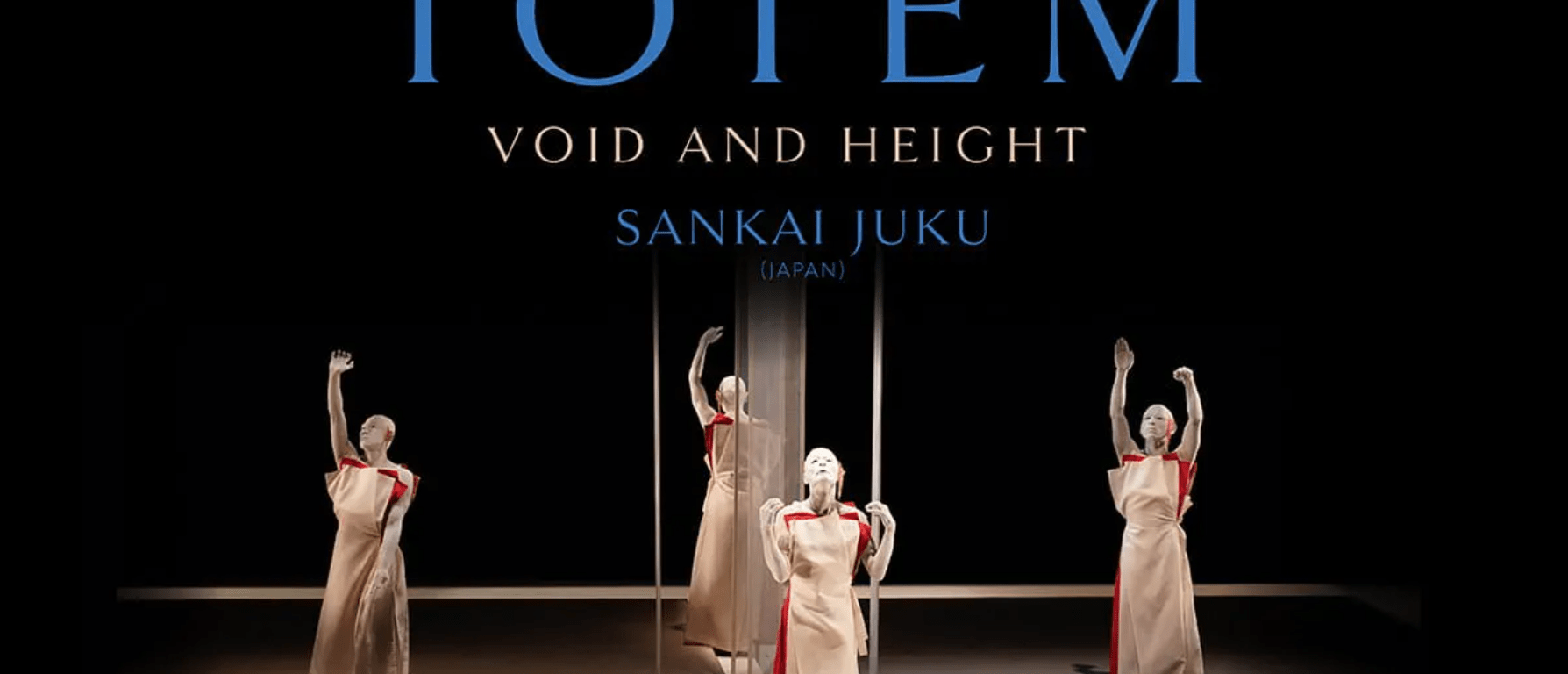
Central this production is its set design by Natsuyuki Nakanishi, which features its titular totem dead centre of the stage, in the middle of four rectangular segments, each containing a layer of white sand or dust. This central totem is tall, perhaps triple the height of the dancers, and comprises three ‘pillars’, with the central one containing a small, three-dimensional pyramid suspended and spinning slowly, its reflective surface casting a shifting light around the theatre. Behind, two massive metallic rings traverse the length of the stage over the course of the performance, so slow that it’s impossible to follow, eventually crossing each other’s paths, like an eclipse of two celestial bodies.

What all this adds up to is the sense that there is some kind of cataclysmic, cosmic event that is occurring, an inevitable apocalypse that hangs over the performance. The performers, shaved bald and mostly topless, their torsos and face completely white and dressed in white skirts or robes, there is the sense that they belong to some kind of cult or religion, with the structure linked to some kind of spirituality or worship sacred to them. What TOTEM then seems to be presenting to us is how individuals might react or express themselves in the face of a world-ending event, from grief to crazed euphoria, as one lives out their last days before succumbing to certain doom.
Performed by Semimaru, Sho Takeuchi, Akihito Ichihara, Dai Matsuoka, Norihito Ishii, Taiki Iwamoto, Makoto Takase and Sotaro Ito, TOTEM comprises a series of scenes that sees the dancers reacting and expressing a range of emotions as time goes by. Initially, it is ritualistic and controlled, with four dancers walking the perimeter of the space while maintaining equal distance from each other, meditative as they pace around the structure. From one ear, a red accessory is worn, resembling some kind of injury where the dancers are bleeding.

There is a similar feeling that emerges during select points in the performance, often when they come together to perform a ritual worship of the totem itself. These moments are more synchronised, choreographed to ensure that their arms and poses match up to the music, with Takashi Kako and Yoicihro Yoshikawa’s strings-driven track giving the sense of harmony and peace when they partake in such worship.
But not all is peaceful, as in between, there are more introspective, reactionary performances that breaks the individual from the group. While they appear almost identical with their costumes and makeup, each dancer is differentiated by a different coloured motif on their ‘skirt’. In one scene, we see two dancers, one with a red motif and the other with a grey-blue one, maintain a sense of tension as they mirror each other onstage, as if considering the strife they’re experiencing when it comes to opposing approaches to the end of the world.

A large component of butoh also comprises the contrast of control and lack thereof, where the body is presented in often extreme positions, stretched to limits and while requiring strength and flexibility, is made to appear as if one is not in control, but instead, moved by forces beyond them. This idea fits in perfectly with the idea of cataclysm, where the movement of the rings brings to mind gravitational change and tidal disaster, where the world is no longer as we know it and these performers are thus also pushed into unexpected, new poses and positions. There is often the sense of frustration, sand kicked up by their sweeping motions, or the feeling of being blown across the stage by invisible winds.
But these forces aren’t just external, but internal as well. There is an almost depressive air as the dancers grapple with their existence, unsure of what to do when in such a panic, the classical music undercut by jarring, sharp sounds that disrupt the flow, as if these are the same interrupting thoughts and fears that permeate routine and ritual meant to calm. On the flipside, one scene sees a dancer, with a yellow motif on his skirt, seemingly overcome by euphoria, perhaps delusion even, as he lets go of everything, his movements completely free as he moves about the stage completely in his own world, simply living his best life against the horror of approaching death.

By its end however, the closer we get to its final scene, the dancers are finally overcome with grief. This is where we see their faces contort into portraits of anguish, silent screams as their mouths open wide, falling to the floor and their arms shaking. They fall on their backs, and recover from it, no peace, only suffering as they mill around the stage, no longer able to hold back or suppress it with a guise of performance. They feel it all at once, a slow chaos as they realise it truly is the end, where nothing they have done matters, no way of stopping that which has long announced its arrival.
TOTEM is at once universal and personal, representing both the end of the world and the quiet grief one experiences at the passing of a significant figure in one’s life. It is about communal mourning, and individual pain, where one cannot reverse or resist such an overpowering force. Yet despite knowing this, there is comfort it offers – in the act of resistance, no matter how futile, allows one to discover true identity. It is a representation of the human spirit in all its brokenness and its beauty, as expressed through extremes, that tension between being saved or falling into the void, and that final choice, that decision to attend to the former, that leaves us knowing that we have tried, and that we have lived as best as we can.
Photo Credit: Sankai Juku
TOTEM – Void and Height played from 4th to 6th October 2024 at the Singtel Waterfront Theatre. More information available here
da:ns focus – Connect Asia Now (CAN) 2024 runs from 4th to 6th October 2024 at the Esplanade. Tickets and full programme available here
Production Credits:
| Direction, Choreography and Conception Ushio Amagatsu Set Design Natsuyuki Nakanishi from Quartet — Series X of Touching Down on Land and Touching Down on Water Music Takashi Kako and Yoicihro Yoshikawa Performers Semimaru, Sho Takeuchi, Akihito Ichihara, Dai Matsuoka, Norihito Ishii, Taiki Iwamoto, Makoto Takase and Sotaro Ito Co-produced by Kitakyusu Performing Arts Center, Japan and Sankai Juku |
 Bakchormeeboy