
A spiritual connection to the lingering ghost in the music and the machine.
There has always been something immensely timeless about the compositions of the late Japanese pianist Ryuichi Sakamoto, with avant garde works that capture listeners from their opening notes filled with emotion, to more sparse, esoteric pieces that evoke entire landscapes in the journey they take us through, connecting the individual to the world to the greater universe out there. Those privileged enough to see him live have spoken of the relationship he has with the piano, a tribute to life itself with his performance uplifting and comforting, such as the last time he was in Singapore, during the 2019 Singapore International Festival of Arts. But with his passing, as with all temporal art forms, no longer will anyone have the chance to witness this maestro at work, our experiences with him relegated to studio recordings streamed online or vinyls.
But thanks to Todd Eckert and his team at technologically-driven production studio Tin Drum, Ryuichi Sakamoto has found a life after life, his likeness captured in a ‘full dimensional film’ titled KAGAMI. Presented on the Esplanade stage, KAGAMI seems to be a concert of the future, made in collaboration with Sakamoto himself over the course of four years, where cameras filmed him from all angles, attempting to re-create his performance via mixed reality technology. With how such new technology defies mainstream vocabulary and explanation, it works best if the experience itself is described. Led through the Esplanade Theatre, audience members find themselves behind the Esplanade Theatre stage, where those wearing glasses are prompted by Esplanade staff to tell them or test their myopia, such that they can be provided with goggles that allow them to see the vision of Sakamoto later on.

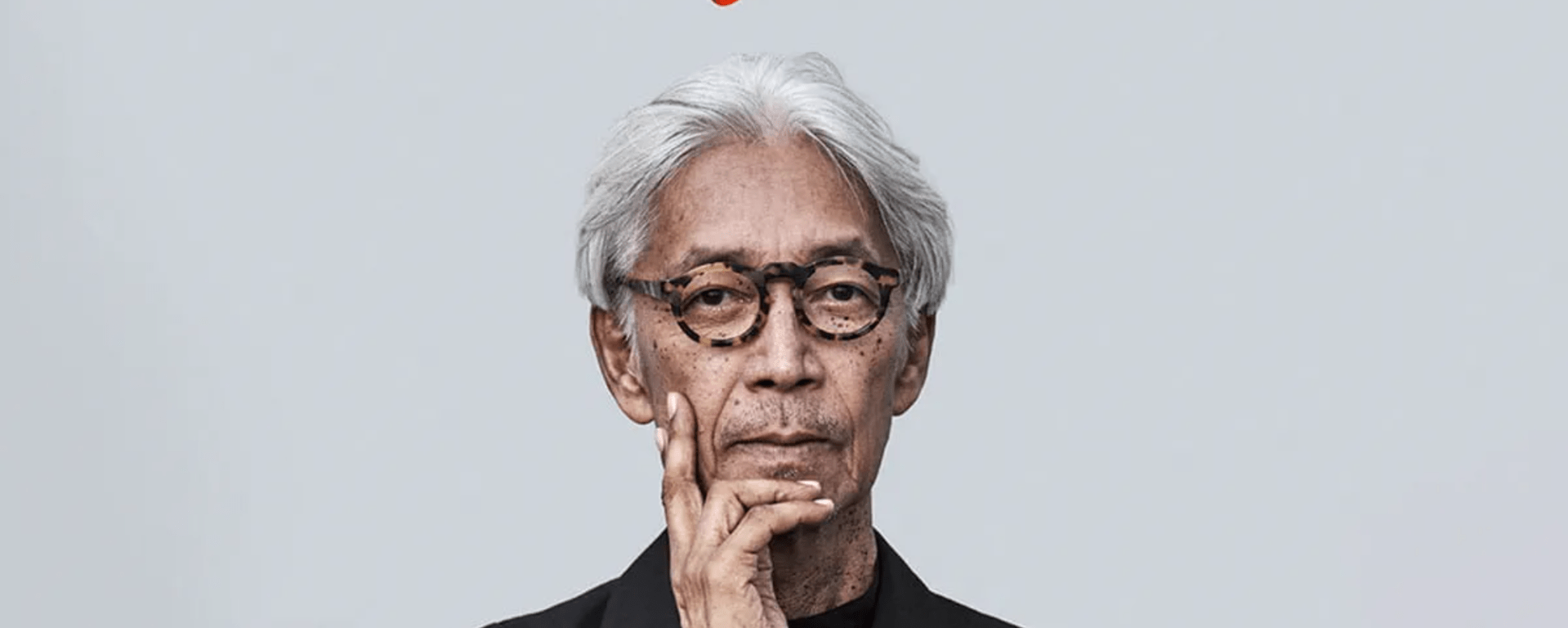
Prior to the actual experience itself however, audience members are led into a waiting room of a sorts, walking through a series of doorways fringed by gauzy white frames, as if entering a different space and dimension. The room acts as a gallery that showcases large, blown-up portraits of Sakamoto in monochrome, many of them from his youth. There is an intensity to his gaze, while contrastingly, we see a documentary video of Sakamoto visiting Antarctica onscreen, a child-like joy as he touches ice and looks on in wonder at the white landscape all around him, seemingly a perfect match for the kind of music he produces. On the ground, a quote from Sakamoto ponders about the existence of a virtual, immortal version of himself that will continue to play the piano for all eternity, and the hope that his music continues to inspire empathy and connection among listeners.
Finally onstage, there is an orientation process where we are provided with our devices. These goggles are somewhat adjustable, fitted over our heads with a cooling fan attached that hangs from our necks, the whirring clearly audible even when we take our seats in a circle around the ‘performance’ space. To know if our goggles are calibrated properly, we see a spinning red cube in the middle, and we await all audience members to complete their adjustments and calibration before the experience itself begins.

Over the sound system, we hear the voice of Tin Drum founder Todd Eckert, as he explains and adds the disclaimer that KAGAMI is in no way a perfect work, limited in part by the technology being used, but with the focus instead being on the art, beauty, and the emotional response such a production generates in us. With that in mind, one is more inclined to suspend our disbelief, and allow Tin Drum to let us believe for a moment in the presence of Sakamoto before our eyes, as KAGAMI begins.
As its title suggests, KAGAMI (which means ‘mirror’ in Japanese) is about creating a digital mirror of Sakamoto, and the result is fascinating. Through our goggles, what seems like a vision of Sakamoto is generated in the performance space, with a Yamaha piano and details that go right down to minor blemishes, the movement of his hair, and how his fingers and feet move across the keys and pedals. Audience members are allowed to move about during the experience, taking care to avoid bumping into others and not to cross over into the performance space itself. Circling the performance, nothing is left out, and with an unassuming glance, it does indeed feel almost like a doppelganger of Sakamoto playing for us.

Going in with the knowledge that this is digital however, one cannot fully avoid looking for little details that make us keenly aware that this isn’t real. If one looks long enough, one can see that tiny movements such as the bobbing of his head, or the smoothness of the textures make this ‘Sakamoto’ just uncanny enough to take us out of the illusion. Alongside the whirring of the fan, or the temporary blackout between each track, we found ourselves removing our goggles often to see the difference between what was happening virtually, and what was happening in real life – a bunch of audience members in goggles staring at empty space. It’s all a rather bizarre experience, and it is clear that audiences aren’t entirely sure how they should be reacting at times, with tentative applause after each number – but for who exactly are we clapping for when the computer does not hear it?
Perhaps then, it is to Tin Drum’s credit that they lean into the potential that mixed reality offers such an experience, and beyond just presenting ‘Sakamoto’ as he is, enhances each song with virtual landscapes that add to the mood as well. At times there are tiny flickers of light that float all around Sakamoto, at others, a cyclone of photographs depicting the urban landscape of Tokyo, as if Sakamoto is commanding these images himself. Some of the most memorable moments include an open square ‘window’ above, a world of white that lies beyond as snow drifts into the performance area, or the immensely powerful ‘Merry Christmas Mr Lawrence’, where colourful roots begin to sprout beneath Sakamoto’s piano and above into branches, seemingly expanding the space beyond the physical.

But most of all, it is the few times when Sakamoto ‘speaks’ that makes us feel as if he is with us still. He talks about the surprising success of ‘Energy flow’ in Japan, and at the very end, about how he composed the track ‘BB’ after learning of the death of Italian filmmaker Bernardo Bertolucci. It is the personal, human touch that connects these epic visions of the universe or the promise of a cybernetic future, and allows us to almost think maybe, just maybe – there is a flash of life in this version of Sakamoto that has been preserved.
Make no mistake, KAGAMI is a piece that is limited by technology, but has a beating heart that will move you with Sakamoto’s music, whether or not you’re a fan. It is a fleeting performance that takes a while to immerse you in its world, but if you commit to the dream it conjures for you, and choose to believe, then yes, KAGAMI will indeed reward you with a momentary revival of the great Japanese composer himself, and connect, if not with the people around you, then the line that is drawn between your heart and the eternal sound of Sakamoto.
KAGAMI plays from 24th October to 3rd November 2024 at the Esplanade Theatre Stage. Tickets available here
 Bakchormeeboy
One thought on “★★★☆☆ Review: KAGAMI by Tin Drum and Ryuichi Sakamoto”