
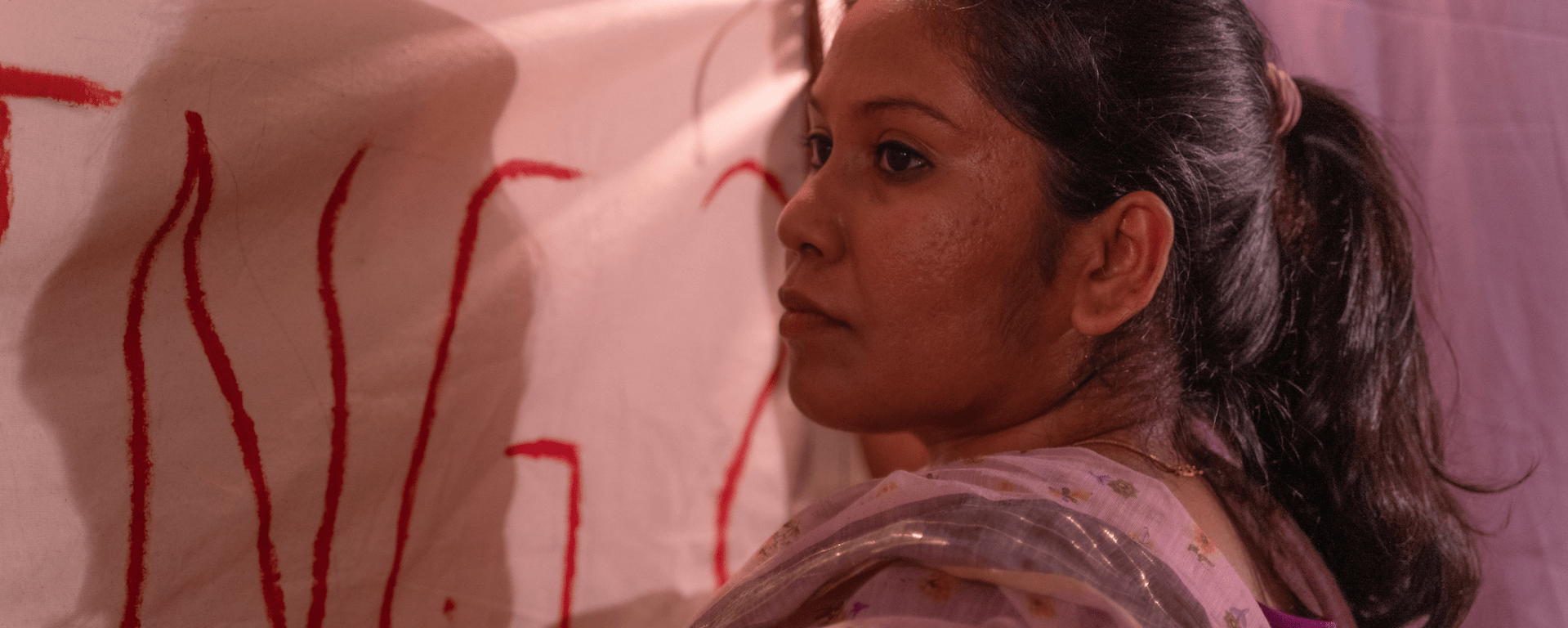
Friends are and have always been a key part of our lives – no man is an island after all, and more than ever, rather than seeking out tribes where we simply see the similarities, it becomes more important to make space for differences, expand our mindsets and welcome others with open arms and nuance. That is what Indian company Qabilah is doing with WePushTheSky, an interactive solo performance that’s all about storytelling, and considers the urgent social reality of our present times, and the political upheaval we see all the time.
Written and performed by Nisha Abdulla and directed by Ujwala Rao, WePushTheSky centres friendship and feminist solidarities as an antidote to the politics of hate, receiving warm responses in India, Jenin, and Bangkok, Thailand. Before it comes to Singapore as part of the M1 Singapore Fringe Festival 2025, read our interview with Nisha and Ujwala in full to find out more about the creation process, and the power of friendship:

Bakchormeeboy: WePushTheSky originated as an audio play hosted on a website – what made you decide to adapt it for live performance, and how different is it from the original?
Nisha: the play was originally developed during the Covid-19 pandemic when I was exploring audio as a medium. But even then I knew I wanted to take this to stage. The only question was who would perform it. Ujwala had been on board the audio play from the beginning as the literary dramaturg and while discussing the possibilities we recognised that the autoethnographic material is the strength of the text and must be retained. Soon Ujwala came on board as director and that’s what you’ll be watching!
Ujwala: When I came on board as the director, it was clear early on that the live performance needed a very different dramatic setting. The audio play is set in a house, where the protagonist is in an intimate, private conversation with a friend. For the stage version, we wanted something more communal and participatory. We reimagined the setting as a public protest site, where the audience is no longer just observing—they become part of the space, the story, and even the protagonist’s allies. It shifts the dynamic completely, creating a shared, collective experience that feels urgent and alive in a way that’s unique to live performance.

Bakchormeeboy: You’ve once mentioned that “the listening body is a site of active political resistance in a world that incentivises hate and polarisation” – how does WePushTheSky invite listening, and what is it trying to resist?
Nisha: We are living through a crisis of connection in the world today. We are living through the weaponisation of smart phones and social media into instruments that actively cultivate hate politics. Certainly this is a cultivated crisis. It is no longer enough to merely recognise this, it is critical that we actively counter the hate politics with our most powerful weapon – our attention. We are what we pay attention to – paying our full attention to lives and experiences wholly different from ours would allow us to get back in touch with our fractured selves and our fractured sense of community and collective.
Ujwala: In WePushTheSky, the craft of play-building is central to how we invite listening. Right from the start, the audience is drawn in with a medley of pop-resistance music—it’s lively, familiar, and immediately creates a shared atmosphere. The protagonist then greets the audience, offering to share her food and passing it around the room. Sharing food is such a simple yet powerful way to build bonds—it sets the tone for connection.
The protagonist goes on to directly interact with the audience throughout the play, turning the audience into active participants rather than passive observers. By creating this space of shared stories and collective engagement, of laughter and playfulness with each other, the play resists the isolation and divisiveness of our polarized world.

Bakchormeeboy: WePushTheSky is based on your own experiences and is a deeply personal work. How has the process of creating this work affected you and your relationship with your self and memories?
Nisha: There is repetition that is inherent both in live performance and in the experience of marginalisation. This repetition sits in the body as memory. I feel vulnerable on stage in the performance of this intense material time and yet I’ve also often observed that I’m kinder to myself as a result of this. That’s a good place to be! I often articulate my anti-oppressive arts practice as a pursuit of alignment between my artistic and healing self. This process of developing and performing this play has come closest to experiencing this alignment in my body.
Ujwala: Creating WePushTheSky with Nisha has been transformative in so many ways. It really made me believe in the incredible political potential of listening. There’s something so profound about sharing your story in a space filled with people who might have completely different lives than you. It’s not just about telling the story—it’s about that moment when it lands with someone, and creates a meaningful connection with them.
Bakchormeeboy: Why do you think it’s so difficult to maintain friendships nowadays, especially when as kids, it seemed so easy to make new friends, and so many of us have more in common than things that divide us as people?
Ujwala: I’m not entirely sure it was easier to make friends as kids than it is now. In a socially segregated society like India, many of us, even as children, often ended up forming friendships with people who were similar to us—whether that was in terms of caste, class, or language. It wasn’t necessarily because kids don’t want to connect beyond those boundaries, but because the structures around us subtly or otherwise actively encourages those divisions. WePushTheSky reminds you that friendships, like stories, aren’t just about what’s similar. They’re about being curious and making space for differences.

Bakchormeeboy: You’ve performed this show in places like Occupied Palestine and Bangkok. Is there a difference in the way audiences from different countries have received the work? Is there a universal response that audiences have?
Ujwala: What’s been fascinating, performing this piece in places like Occupied Palestine, Bangkok, and different settings within India, is how friendship becomes a universal entry point for audiences everywhere to enter these very specific stories that are shared by Nisha. Almost everyone has experienced the complexities of friendship—whether it’s losing friends to political polarization or feeling tension with loved ones over deeply held differences. So love, laughter and longing is the undeniable universality that we explore.
Bakchormeeboy: In a world that is constantly clamouring for their voice to be heard, especially with social media creating an increasingly polarised world, how do we convince people of the importance of listening?
Ujwala: In WePushTheSky, we’re not really trying to convince anyone about the importance of listening—listening is actually the natural consequence of the form. Theatre allows us to engage with challenging contexts or questions.
The larger question, though, is about the role of the politically engaged artist. In a world of deep polarisation,, where voices are constantly shouting to be heard, it raises the question—can an artist really afford not to be politically engaged? I don’t think it’s possible at this point in history. Art doesn’t exist in a vacuum. It’s a reflection of the world around us, and today, that world is charged with political and social tension. The stories we tell, the choices we make as artists, they are a reflection of our politics..
Nisha: As politically engaged artists this is the labour that we offer the world – creating playful ways to come together, the task of truth telling, the invitation into different possibilities – this is our way of creating spaces to connect and dialogue.

Bakchormeeboy: How do you personally relate to the theme of displacement, and how do you hope audiences might consider that, or the kinds of issues and questions they might think about after watching this production?
Nisha: I’m extremely fortunate to not have experienced physical displacement. Unlike so many marginalised minority communities of India I have not had to flee my home because of targeted violence or had my home bulldozed with impunity. This is the desperate reality of so many people who face religious or caste violence and often there is no hope for justice, especially those who are also caste and class marginalised. Yet there is the constant violence one experiences on the psyche when living in an authoritarian ethno-nationalist state. We cannot afford to forget this just because it isn’t as visible as much as the physical violence. A lot of what allows us to thrive as human beings is violently snatched away – our agency, our sense of self, our spaces of cultural expression, our ways of dreaming and imagining. The physical and emotional violence of othering, the fragmenting and fracturing of our communities these leave deep scars that deepen for generations. So perhaps I’d like for the audience to reflect on what is the cost of living in a world that only cares for lives that are well-capitaled, that incentivises living only amongst echo chambers, that constantly enables rampant militarization and surveillance.
Featured Photo Credit: Noorhanaz
All other photo credit: Ujwala Rao
WePushTheSky plays from 11th to 12th January 2025 at the Esplanade Studio Theatre. Tickets available from Book My Show
The 2025 M1 Singapore Fringe Festival will run from 8th to 19th January 2025. More information and full line-up available here
To contribute towards the Fringe Festival Fund, visit donate.necessary.org or Giving.sg.
 Bakchormeeboy
One thought on “M1 Singapore Fringe 2025: An Interview with Qabilah on ‘WePushTheSky’”