
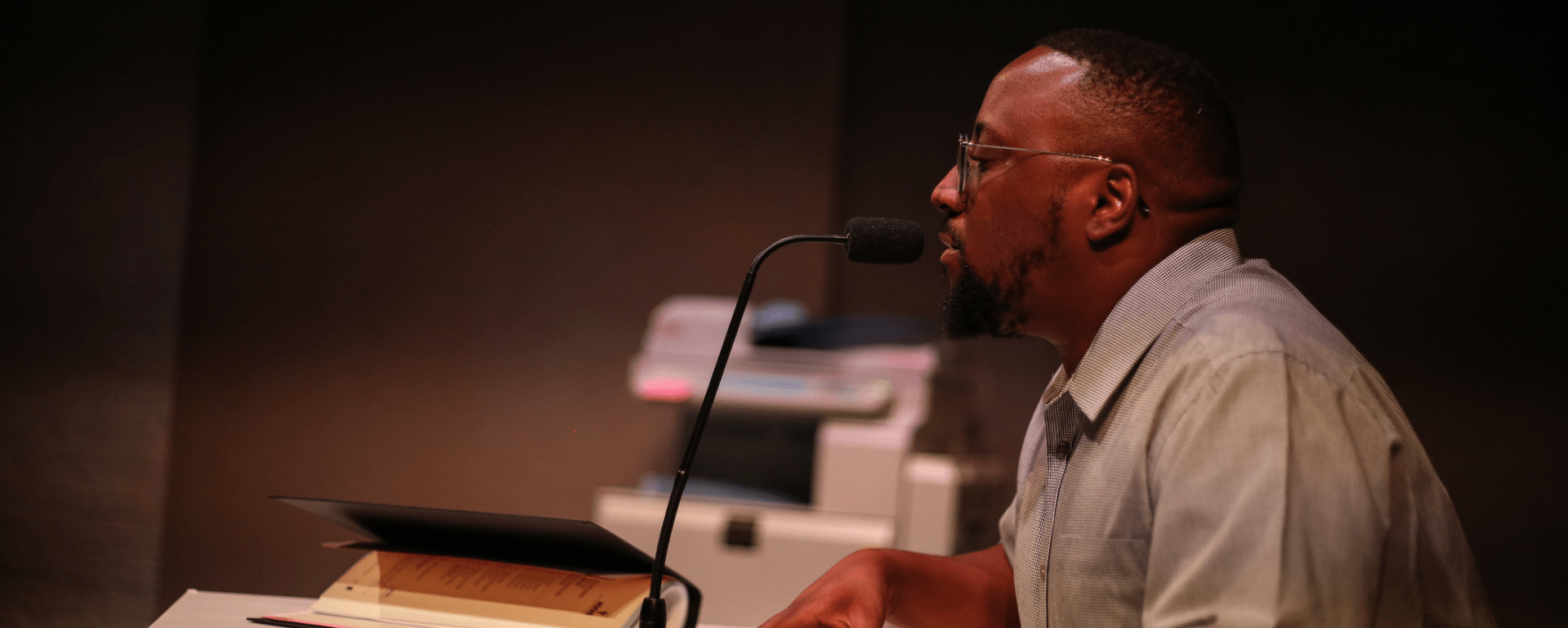
Everyone knows that bureaucracy and paperwork is the bane of any civil servant. But look hard enough into the abyss of red tape and jargon, and you’ll start to uncover darkness like never before. Investigating the depths of paperwork and commissions of inquiries is South Africa’s Noma Yini Pty Ltd with their work Commission Continua, which makes its Singapore premiere at the M1 Singapore Fringe Festival 2025, in January.
Last in Singapore in 2023 with their work Kafka’s Ape, also by director Phala O Phala and writer/performer Tony Bonani Miyambo, the two man-creative force return with this odd new piece about an ordinary employee who copies and archives official documents from the commissions. He does his best just to stick to his brief and ignore the content of the files—but this proves difficult when faced with all these pages giving an account of the most critical and catastrophic moments in South Africa’s history. All alone onstage, he begins to vent his annoyance with South African society’s struggle for real change and reconciliation.

Speaking to both Tony and Phala, we talked about the creative process behind the work, and its significance within a South African context and landscape. “This was a work that came many years after Kafka’s Ape, mostly because we don’t conform to the idea that we need to be constantly producing work. At the same time, we had a mutual admiration and respect for each other, and would make work together again if there was an idea that necessitated it,” says Tony. “In the years that followed, I developed a fascination with crime and investigation, particularly with commissions of inquiry, where so many of these commissions began to sound the same, and how one can start to reflect and think of the really graphic and serious nature of some of these commissions of enquiry, set against the mechanism of commission of enquiry, diluted in bureaucracy and routine. How useful were these commissions really, and how much did they really answer? We wanted to put all these under the microscope and question them.”
Bouncing that idea off Phala, the two brainstormed and eventually began working on what would become Commission Continua. “Interestingly when Tony brought it up to me, I had recently done an adaptation of Agnes of God, and incorporated ideas of the commission of inquiry, thinking about how it was said some NGOs were taking away people who were mentally ill and there were people who suddenly disappeared or died without their families even knowing,” says Phala. “There were ongoing commissions of inquiry into state capture and corruption, and while watching it, I began to wonder who exactly these commissions really served – after all, it was officials asking questions on behalf of victims, where it was all jargon and seemed to sideline the victim in all of this. Was there any accountability? Where were the victim’s own accounts? There is so much fatigue and fear that surrounds these commissions, and we began our deep dive into the history of commissions in South Africa.”

Some of these inquiries sound utterly odd – a commission into the pasteurisation of milk, or even about the legality of hot dog street vendors. But a dark truth seemed to undercut all of it. “There are bigger issues out there that are not being questioned, like Transatlantic slavery. There is so much that is lost in these thousand page reports that no one pores over and reads, and buries all the suffering people have gone through, and for what?” says Phala. “These commissions also cost millions of dollars, and you begin to wonder why so much money is going into these, while there are people fighting to be paid fairly. How much lies beneath that we do not know about?”
In terms of the treatment, compared to Kafka’s Ape, which was both physically and textually demanding, Commission Continua is set to adopt a more minimalist, more design-centric approach. “Tony once spent a night writing about 40 pages of text, and the next morning when I read through it, I cut about 2/3 of it. That made him angry of course, but when he read it, he sighed and admitted that it worked a lot better,” says Phala. “We are authors of the work, yet the story and the material and the soul of the piece is what we need to do justice to. There is a rigour that goes into our creative process where we do fight, and are very hard on ourselves in order for the work to reach its best version and form.”

And so, Commission Continua takes on a more sonic approach, where in the silence of this office, it is the photocopier, a microphone, and a loop station that is creating a soundscape and giving voice. “We thought a lot about sonic brutality, where the sound would lead this production, and felt like its own character, such as the sound of the photocopier printing things. In a way, it’s like setting up an exhibition during the performance, to depict the deaths and injustices that have occured, so that we honour them, but in a more abstract way without victimizing them,” says Phala.
“Also, we’re very careful not to be seduced by the traumatic experiences that exist from people and careful not to use those things, the same thing that happens in commissions of inquiry where the strength of testimony is diluted,” adds Tony. “There’s so many events that have happened, and we want to stay clear of the danger of talking about the trauma of the victims. A lot of work in South Africa uses traumatic events that mark them. We made a conscious choice to avoid that, and to use an interesting way of entering the world through this unlikely character as we start to make sense of the commission of inquiry as a process.”

In fact, Phala and Tony only found the character a day before their first, 15-minute iteration of the piece. “This was a character who was modeled after an archivist archetype, someone who deals with paper down in the basement. This is the guy who makes photocopies, who stores the commission of inquiry, lonely, always having his trousers up to his navel and the kind that would not let you fix the photocopy machine, the kind that always asks ‘have you switched off the photocopy machine?’ at the end of the day,” says Phala. “It is much more heavy orally on Tony to perform this character, a person who is not the victim who embarks on this journey to discover the truth behind these commissions, and to consider whose voice is prioritised in the archiving of facts. Who do we choose to elevate and remember – is it the perpetrator, or the victims who are silenced into non-existence?”

What then is the role of art in the face of such corruption, of an issue that seems to plague the entirety of South Africa for years and years? “We don’t dictate the social change that happens, we simply create a shared experience in the theatre in order to add to or complicate the dialogue and ways of thinking, using the device of theatre as a medium of communication,” says Tony. “The beautiful thing that happens from that is the ability to initiate a dialogue that can lead us to find a sense of collective change. But also, too often there is a sheep leading sheep kind of thinking, and that’s why we need to acknowledge that we don’t have all the answers yet, but the space to start to unpack complicated subject matters such as this.”
“As creators, we aren’t trying to drive a deliberate point of social change, but find a creative expression for such controversial issues. We certainly wouldn’t be the first people to do a play around this, just in a different way, via our sonic approach. Our goal is not documentary, but to leave people feeling a certain way, and to think about the soul of the commission of inquiry, and its purpose, to allow them to begin to sift through the facade and the mess,” says Phala. “It allows us to deconstruct it, and see where it has and hasn’t worked, and perhaps how we as human beings, seeing ourselves as more intelligent than animals, need to learn to self-correct our mistakes where we have made them.”

“There’s a monologue in the show that talks about how butterflies can taste with their feet; if we were to apply the same thing to human beings, then think about how many corridors and passages we are walking on that taste of the blood of people? We cannot change or rewind people’s lives as the character rewinds a tape in Commission Continua, but we can try to reshape, reinterpret and make sense of it all,” adds Phala. “The Fringe Festival this year is about ‘displacement’, and in thinking about that, I think about ideas of place – and about how our show is trying to locate these displaced voices of victims. A commission of inquiry in itself is a tool meant to give an answer to the reason behind the displacement of something that has happened, of a feeling, a life taken. And when something has been displaced, something must have replaced it; the absence of love is the presence of pain. So in thinking about the displacement of victims, we must find a way to place them somewhere, which we have done in our own way via Commission Continua – a work that was born out of necessity, and that we hope will continue to find an audience wherever it goes, as long as it continues.”
Photo Credit: Zivanai Matangi
Commission Continua plays from 17th to 18th January 2025 at the Esplanade Studio Theatre. Tickets available from Book My Show
The 2025 M1 Singapore Fringe Festival will run from 8th to 19th January 2025. More information and full line-up available here
To contribute towards the Fringe Festival Fund, visit donate.necessary.org or Giving.sg.
 Bakchormeeboy
One thought on “M1 Singapore Fringe 2025: An Interview with Noma Yini Pty Ltd on ‘Commission Continua’”