
Choreography pushing the human body to its limits, in a work that once again emphasises T.H.E’s ethos of human connection through dance and movement.
If it is one thing the world seems to need more than ever, it’s to recognise the need for coexistence over conflict. That feels like the central theme of re:intertwining, the newest work by T.H.E Dance Company that pushes its dancers to the edge—not just physically, but emotionally and spatially too. Directed and choreographed by Kuik Swee Boon, this is a challenging piece that sees the removal of most seats from the Esplanade Theatre Studio, leaving it transformed into a space of endless possibilities, a playground of shifting proximities and charged glances.
Glancing at the wall of text, to seeing sound designer and composer Kent Lee all set up, to the massive wall of light by Adrian Tan, re:intertwining makes it abundantly clear from first entry that this is more than just a dance work. It’s an interdisciplinary one that involves the work of a myriad creative team that pays equal attention to theatricality, light and sound for a multi-sensory arts experience. Throughout the show, audience members are invited to move freely, though once most found their chosen corner, they settled there for the remainder of the performance, and prepared for an intimate encounter.

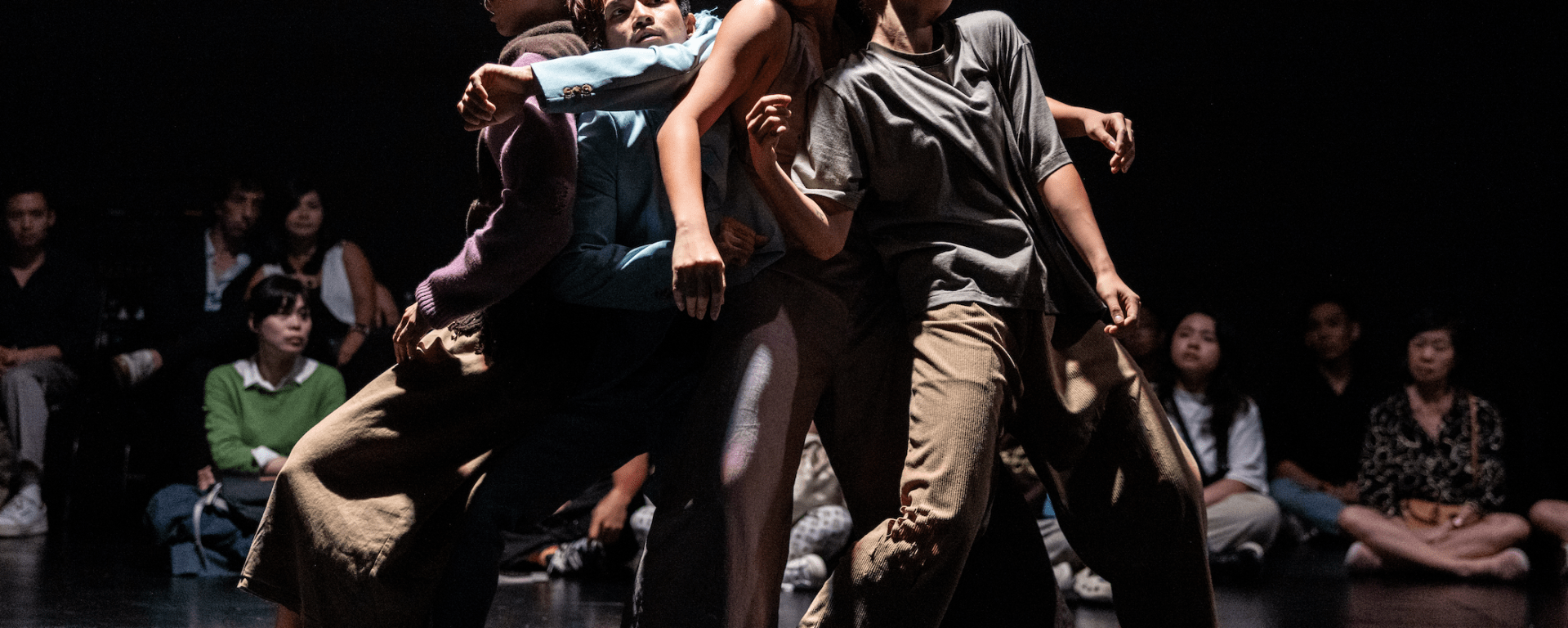
Choreographed by Kuik Swee Boon in collaboration with the dancers (Klievert Jon Mendoza, Haruka Leilani Chan, Chang En, Carmelita Nuelle Buay), re:intertwining starts off slow, even tentatively, but grows into a meditation on connection—on how we reach toward and recoil from one another. Honed through Kuik’s signature hollow body technique, T.H.E’s movement language is clear, and being so up close with the action, we can literally see how much weight and pressure is placed on every step, every twist of the ankle, how they slide across the floor, or bend their bodies backwards, all the while maintaining grace and composure.
Clearly, navigating the space also adds a new dimension of complexity for the dancers, who always have to ensure that they maneuver around the seated audience members, sometimes coming dangerously close, but always aware of the little distance that lies between them. There is the sense that they are always in search of something, of someone, at times even tapping audience members on the shoulder, aching for human touch. And so it is that when the other dancers emerge, they come at each other with a ferocity that toes the line between fight and embrace, both primal rage and intense yearning.

All of this ties back to the show’s theme – of threading in and out of the audience members, and finding ways to weave into each other, connected at the seams. While all four dancers wear completely different outfits, from a pale pink halter neck jumpsuit to a baby blue suit, they’re connected by the same motif of frayed patches on their clothing, as if worn down by time. This is perhaps symbolic of their spirit, in search of something or someone to mend them and make them feel whole again, resulting in this search for community and togetherness with each other.
It is fascinating then to watch the dancers as they negotiate this idea of shared space, not just with the audience but also with each other. There are times we see them syncing up perfectly with each other, performing complex movements to the same beat, or physically supporting each other while they perform gravity defying steps. Sometimes, they hang back, preferring to watch the others while hidden among the audience, or they end up frustrated, with Klievert seemingly overstimulated when at some point he begins to run circles around the audience, relentless and strenuous, as if running away from such intimacy. Later on, he winds up in a single square of his own, bare chested and seemingly locked in a prison of light, as if the cause of his own isolation.

On the cross-disciplinary front, re:intertwining has the right idea in mind, utilising its other elements to layer on meaning and provide more access points than dance alone. Kent Lee, now a frequent collaborator with T.H.E, has a rich, reactive live soundscape that feels as if it evolves alongside the dancers’ movements, with surprising textures and pulses, while Adrian Tan’s wall of light shifts into an ombré to represent the passage of time with the dancers silhouetted dramatically against it, with orange tones for sunset and even plunging the stage into near darkness at times, with fleeting illumination to showcase dancers still moving in spite of it.
The abstract nature of Seren Chen’s script is more of a headscratcher; Seren herself takes to the mic at times, acting as a kind of narrator or conduit, speaking and questioning herself and her links to others, echoing the projections of ‘why?’. Still, all these elements feel like disparate elements that don’t always gel, sharing the room but not necessarily the same language, not so much in dialogue with each other so much as each doing their own thing.

That said, the work still clearly resonates. These themes are foundational to T.H.E’s repertoire: contact, coexistence, conflict, and the fraught negotiations between self and other. And in its final scenes, the dancers even break one more barrier – the invisible wall between dancer and audience, as they invite a single audience member to join them onstage, easing her into the movements, and holding her hand as she moves alongside them, slow and steady. It’s a gesture that represents the universality of dance and the ability for it to cut through differences, as we feel these bodies in tandem with each other, no matter how distinct, and finding the shared humanity. There is power in this bold and beautiful new work, thriving in its movement vocabulary, and a reminder that coexistence isn’t tidy—it’s messy, electric, and always in motion.
Photo Credit: Crispian Chan
re:intertwining plays from 4th to 6th April 2025 at the Esplanade Theatre Studio. Tickets available here
Production Credits:
| Concept/Direction Kuik Swee Boon Choreography Kuik Swee Boon in collaboration with the performers, with solos choreographed by individual dance artists Lighting Design Adrian Tan Sound Design/Music Composition Kent Lee Dramaturgy Neo Hai Bin Script Seren Chen Audiovisual Design Lynette Quek Rehearsal Supervision Billy Keohavong Performers Klievert Jon Mendoza, Haruka Leilani Chan, Chang En, Carmelita Nuelle Buay, Kent Lee, Seren Chen |
 Bakchormeeboy
One thought on “★★★★☆ Review: re:intertwining by T.H.E Dance Company”