
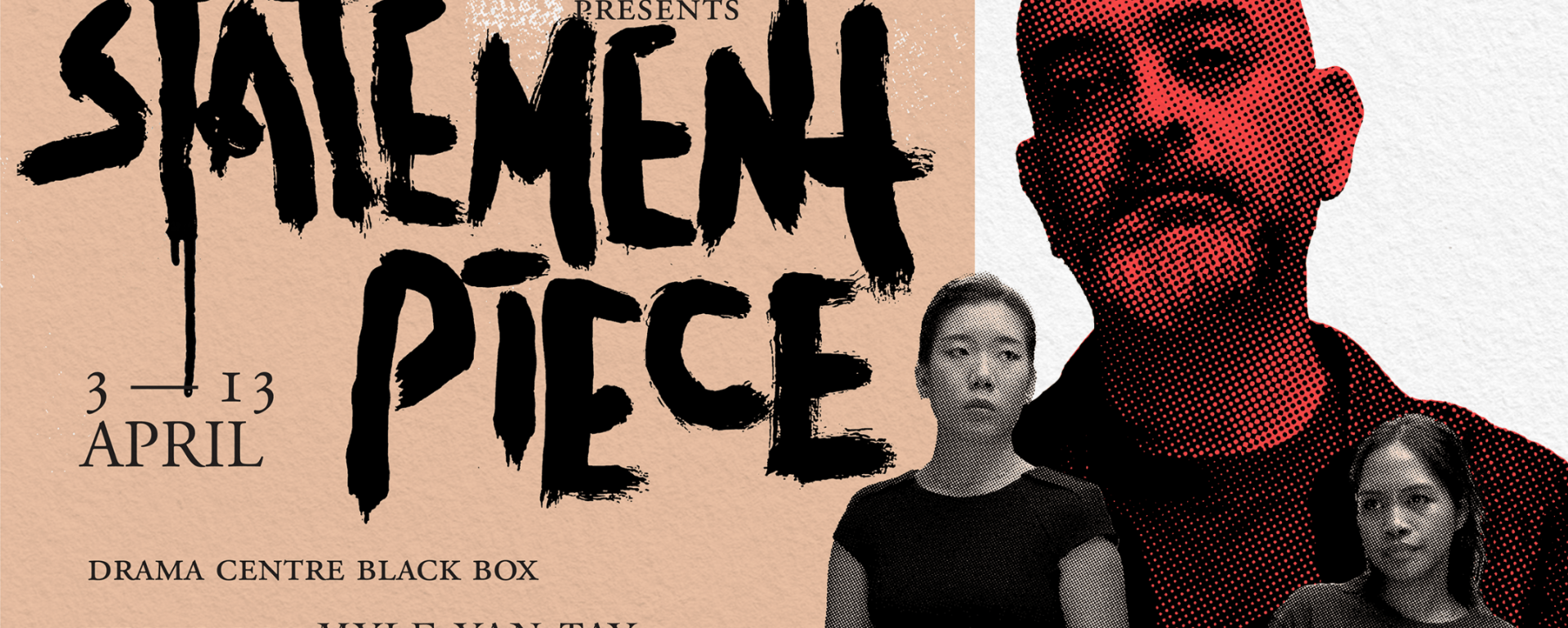
A statement on the universal idea of ambition and the lengths we’re willing to go to achieve it, but plot holes and lack of character depth leave us wanting.
To become lost to history is to have lived a life insignificant, leading to so many people’s desperate climb up the ladder to ‘success’. But what happens when a member of the art world, in hot pursuit of such a legacy, is met with all the pressures and complexities of fame, approval, and survival? In Statement Piece, Checkpoint Theatre’s latest work, the clash between personal ambition and artistic integrity is laid bare—but at the cost of losing the very soul of the characters themselves.
Directed by Claire Wong, Statement Piece is the newest script from playwright Myle Yan Tay, and is set against the backdrop of a nation in mourning—two weeks after the passing of a founding father. We are introduced to Lily (Tricia Tan), a personal assistant to an influential gallery owner, as she prepares for an exhibition featuring the work of the reclusive artist Gopal Rangaraj. The show is meant to be a grand affair, a retrospective of Rangaraj’s work, positioned alongside another major exhibition. Lily, desperate for validation and a promotion, is determined to make the exhibition a success, especially given that her absentee boss, a minister’s wife, has little faith in her abilities and would do anything to put her down.
Enter the reclusive Rangaraj himself (Huzir Sulaiman), making a dramatic return after a decade of artistic silence. Dressed like a true bohemian, he brings with him a brand new piece—one that was initially meant to cap off the exhibition on a high, but instead turns it on its head. The painting, a grotesque and hypersexualized depiction of the nation’s founding father, is intended to shock and disgust, and forces Lily into a moral and professional crisis, knowing full well that her boss will never approve of the work and the repercussions of showing such a piece.
Things are complicated further when Lily’s artist girlfriend Marjia (Rusydina Afiqah) drops by the gallery for a surprise visit and reacts to Rangaraj’s work with casual indifference, dismissing it as unoriginal and derivative of shock art they’d covered early on in art school. With Rangaraj aghast (but quietly admiring her audacity), this exchange sets off a tense debate between the three, touching on issues of artistic intent and responsibility.
The play is structured neatly, alternating between group interactions and intimate moments between different pairs of characters. This allows the audience to see the nuances in their relationships and shifting power dynamics, which Yan explores with gusto—even if the developments feel somewhat predictable. Initially, Lily appears to be at the mercy of Rangaraj’s antics, but as the story unfolds, we see that she is the true puppet master, always angling for a way to twist the narrative to her advantage, claiming to be an ally of the arts, though her actions suggest otherwise.
Rangaraj, meanwhile, is not just a bitter artist trolling the gallery—he is a man grappling with his own legacy, desperate not to be forgotten. His relationship with Marjia offers the play’s most compelling moments, as he warns her against falling into the same traps he did, entangling her artistic career with her personal life. This pseudo-mentorship dynamic is fascinating, but the play never quite gives it the space it deserves, only ever hinting at it through a single exchange.
Yan is clearly experimenting with his writing here with these new character archetypes, where Statement Piece follows hot in the footsteps of his critically acclaimed Brown Boys Don’t Tell Jokes (2023). The beats feel deliberate, with each of his three characters ending up as sharp stereotypes of familiar figures in the art scene: Lily as the hapless, anxiety-ridden rich girl who wants to prove herself; Rangaraj as the cantankerous, once all-important artist producing work of national importance now faded from memory; and Marjia, the bright-eyed young artist who graduated art school on a scholarship, struggling to carve out a ‘story’ for herself and rattling off her art school knowledge and references in a bid to belong in this elite scene.
Within the absurdity of the entire situation, one does end up seeing Yan’s intent for what it is: for the play to raise larger questions about the role of art in society and its value. Does art have to be provocative to be valuable? What happens when artists find themselves forced to cater to institutional approval? How much does the general public even care, until there’s something to snap for social media? These are pertinent questions within the realm of the arts scene, and they give rise to other issues plaguing the sector—privilege, legacy, capitalism, and even the queer couple’s need to keep their relationship discreet.
But while Yan’s ambition is admirable, Statement Piece often feels like it falls into the exact same trap that Rangaraj himself has in creating his offensive new work: the script is all about stirring chaos and controversy, filled with lengthy monologues that feel more like ideological debates than organic conversation. While the script is laser-focused on examining what people are willing to do to succeed—whether through desperate attempts to shock, sleeping with the right people, or making ethically dubious choices—it loses sight of crafting compelling characters to make us care for their otherwise inconsequential arguments, fighting over the presence of a work of art amidst the national mourning for a man who truly did build a nation from the ground up. These characters feel like they’re living in silos, having completely lost sight of the bigger picture, and sound more like they’re whining and engaging in petty politics than actually doing anything meaningful.
At some point, it begins to feel like plot twists are introduced simply to stretch the story. Lily’s antics, in particular, often inspire laughter not necessarily because they are intentionally funny, but because of their sheer audacity, and how many plot holes Yan can fit— from outright lying to her boss to claiming the security cameras can capture something she never did—and one wonders how she has managed to keep her job at all. Lily’s increasingly desperate attempts to spin the controversy surrounding the painting become so exaggerated that her worried face borders on comedic hysteria, and at some point, the audience simply detaches from the world because of all the flaws.
Claire Wong’s direction seems more focused on the big picture and steering the play toward its climactic hysterics rather than grounding the characters’ emotions in a believable way. She is far more adept at pushing the plot forward and emphasising the arguments than drawing out the play’s emotional core. Perhaps this might be a script issue – the play builds well enough, but it is frequently distracted by side moments and lengthy anecdotes that almost make us forget—or even care—about the significance (or lack thereof) of the controversial painting. Rarely do we really take a moment to invest in these characters, who are, at their core, unlikeable: Lily is manipulative and self-serving, Rangaraj is pompous and condescending, and Marjia, while the most sympathetic, is often passive or unwilling to see the truth around her.
It doesn’t help that the romance between Lily and Marjia is underdeveloped. Both actors have little chemistry with each other, making their relationship difficult to believe or feel conflicted about. There are simply no real stakes or debate over whether they break up or not, because Lily is clearly the worst. The strongest scene perhaps belongs to Rangaraj’s backstory monologue, where for once, the performance cuts through the play’s intellectual posturing and offers genuine emotional depth, with Huzir letting go of his condescending tone and making the story feel real and lived. But by the end, every character’s motivations are extremely clouded, and it is unclear what any of them hope to do with the mess left behind.
The production itself is also hampered by its design choices. While theatre allows for suspension of disbelief, the choice to showcase blank canvases is uninspired. While one can forgive the basic arrangement of smaller works lined up in neat rows—perhaps representative of how galleries need to conform to rules to sell commercially viable work—it is egregious and frustrating that the infamous painting at the centre of the plot, after all the buildup, is simply another blank canvas. One understands how difficult it is to actually produce a painting of the standards described in the script, but instead of being provocative by asking the audience to project their own imagination onto it, this feels like a cop-out, erasing any believability in the reactions the actors have towards it.
Ultimately, Statement Piece aims to interrogate the purpose and limits of art, and the compromises artists must make to survive within the system that craves it—by their rules. If anything, Statement Piece circles back to the idea of making a name for oneself, the lengths people will go to carve out a sellable identity, and whether that pursuit inevitably leads to selling out. But in trying to say everything, it ends up muddled, lacking the emotional payoff that could have made it truly resonate, and still requires a far finer process of refinement. Yan is undoubtedly a playwright with important things to say, but this particular piece feels more like an intellectual exercise than a fully realised drama. There is something in Statement Piece worth discussing, but whether its execution results in a statement that actually says anything one will remember remains up for debate.
Statement Piece plays from 3rd to 13th April 2025 at the Drama Centre Black Box. Tickets available from SISTIC
Production Credits:
| Director Claire Wong Playwright Myle Yan Tay Dramaturg Huzir Sulaiman Cast Huzir Sulaiman, Rusydina Afiqah, Tricia Tan Set & Lighting Designer Elizabeth Mak Sound Designer Jackson Tobin Make-up & Hair Artist Bobbie Ng, The Make Up Room Costumer Designer Sheryl Teo |
 Bakchormeeboy
4 thoughts on “★★★☆☆ Review: Statement Piece by Checkpoint Theatre”