
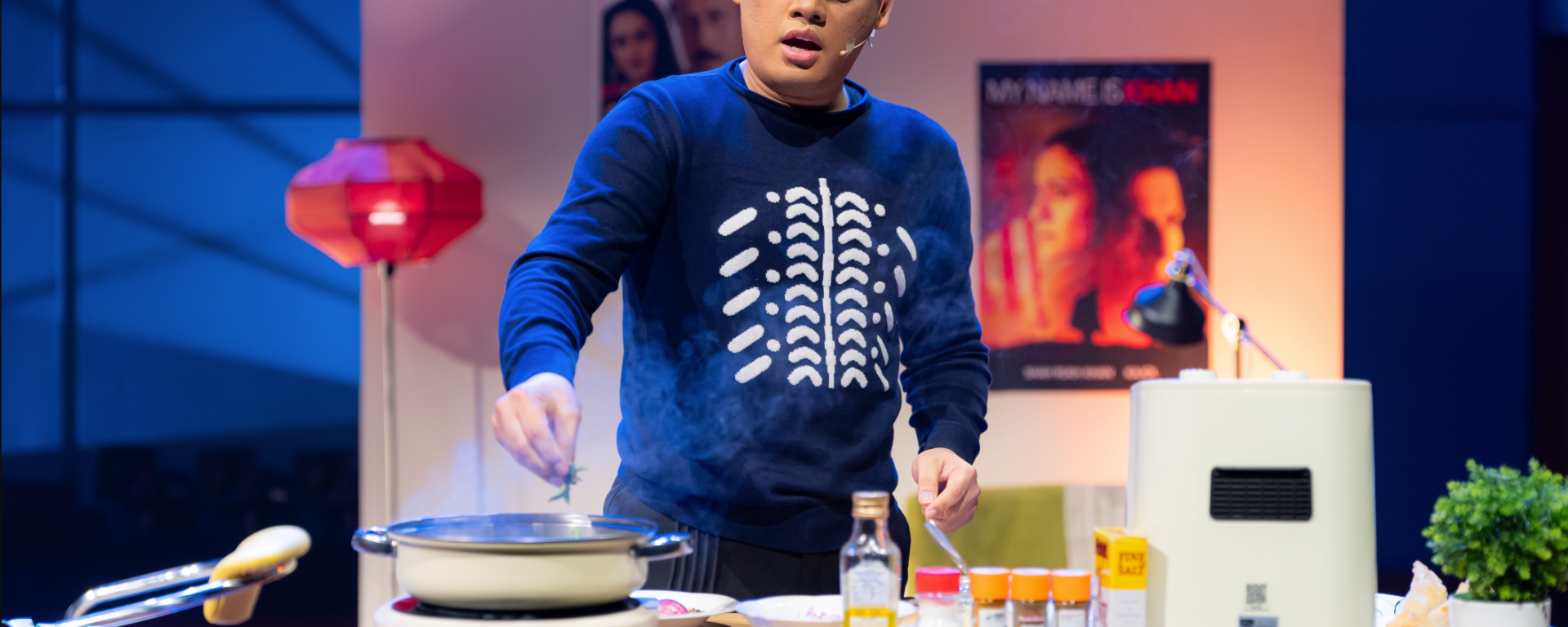

Whether a Khan or a Rahman, this is a show that calls for the unabashed celebration and embrace of one’s own multicultural identity.
Over the last few years, theatremaker Hafidz Rahman has shot to fame for his viral videos he’s posted on social media, whether as a lovable tudung makcik, or for sharing creepy ghost stories. But how many people out there know the real Hafidz? An opportunity to do just that presents itself with his first ever solo show – My Name Is (Not) Khan.
Commissioned by the Esplanade for their 2025 edition of Pesta Raya – Malay Festival of Arts, My Name Is (Not) Khan sees Hafidz take on a new persona that’s more than a little based on his real life. Directed by Rizman Putra, we are introduced to Hafidz as Harith, a diehard fan of Bollywood who’s watched over 300 films, can memorise both the lyrics and dance moves to more than a few item numbers, knows the entire family history of pretty much every Bollywood great, and more. But if there’s one thing Harith is 100% sure of, is that he’s not India – he’s Malay.

My Name Is (Not) Khan thus uses the idea of multiculturalism as an entry point into a hugely entertaining, at times emotional, and strangely urgent show about the identity and place of a brown person living in Singapore. The Esplanade Recital Studio is transformed into a shoebox apartment, where set designer Russell Goh has made it feel like a real, lived in-space. It’s not just a studio, but a home, with plenty of Bollywood film posters across the walls and furniture, and for older audience members, evokes a deep sense of nostalgia with the clunky desktop computer perched on a table, and even a working tiny box-like television set playing grainy clips from old films, fortressed by VCDs and DVDs, complete with white lace dust cover.
This is a multisensory show that aims to put audiences exactly in the mindset of Harith, and even before the show begins, he is in the kitchen, chopping onions and blending spices, before popping some samosas into an air fryer, with all these aromas filling the air and transporting us to a home environment. Hafidz as Harith is unabashed for his love of Bollywood, singing along to hit songs he plays out loud on his phone, and before we know it, he goes into performance mode, taking us on a rather unexpected journey down the history of his life as an eternal lover of the world’s biggest film industry.

Accentuated by Alberta Wileo’s lighting for dramatic effect, Hafidz has a clear knack for comedy and comic timing, and with his warm personality, the audience always feels comfortable in his presence, whether he’s cracking a joke or shooting a question to us, regardless of how much Bollywood knowledge we have. One of the earliest segments of the show eases us in with Harith telling us how many songs it takes to travel from Yishun (his home) to elsewhere in the country, longer if there happens to be a jam. Throughout, we also get glimpses of Hafidz’s strong character work, such as how he imitates an ex-classmate’s faux Chinese accent, or calls upon his skills at telling ‘cerita hantu’, a delight for his fans.
But this is a show that quickly establishes its modus operandi is not as straightforward as we might think, as it finds itself in a slightly frantic chaos, flitting from anecdote to discussion to lesson. Beyond friendly jibes at Yishun, Harith is happy to educate us about Bollywood and engage in what feels like a very insightful class on the legendary Kapoor family tree, or tracing the most beautiful stars gracing the covers of magazines through the decades (and even throwing in an interactive Menti poll). These segments are well-supported by multimedia designer Zaki Zainudin’s visuals, which provide classy slides and smooth transitions that perfectly match Harith’s lines.

But where the show shines brightest is when Harith/Hafidz allows himself to be vulnerable, and share the most personal parts of himself with us. In recalling a trip to Genting (with a hard ‘G’) where he spent all the allowance his mother gave him on VCDs, there is a sparkle of joy and relief in his eyes when she simply shakes her head, and tells him ‘you couldn’t even buy back some dodol?’ Elsewhere, he recalls his primary school days, where a first-generation Indian student was bullied for the idli and dal she brought for recess, and his shock at how he did nothing to stop it, feeding into the weight in his voice as he explains his atonement, ensuring that as a school drama instructor, he punishes the racists, and props up and helps the minorities recognise their worth.
There are even times where the line between actor and character becomes incredibly blurred. In recalling his late grandmother’s last words to him, the same grandmother with her baby talcum and lemongrass scented hands, who held him in her arms while he first fell in love with Sridevi onscreen, he lets slip and says ‘Fiz’ instead of ‘Harith’. All this speaks of how much of himself Hafidz has poured into this work, and allows his own emotions, to the point of tears, to lead him, and in so doing, allow us to relate to his story and struggle.

It is this vulnerability that allows the issues that all these stories feed into feel all the more stronger. Harith’s fiery segues make sense, as this initial confrontation of the seemingly-simple debate on whether it’s ok to be a Bollywood-loving Malay man leads into issues of national importance. From the slippery slope beauty preferences can lead us down to the systemic racism that presents itself in the way problems are reported in the news, to the idea of self-hating brown people to the inequalities exacerbating social ills in certain communities that call the very idea of meritocracy into question.
By the end of the show, Harith makes his thesis clear – be a fan of whatever you like, as long as you stay true to your roots as well. And why shouldn’t he be a fan of Bollywood, considering how there are so many influences and similarities between both Malay and Indian culture, from word etymology to parallels in dance, or even the decision to use mononyms for female stars during the Golden Age of Malay cinema? Naturally, no Bollywood-inspired show would be complete with a final dance number, and donning a reflective kurta that shimmers in the light, Harith is joined by fellow dancers and ends off with both a Bollywood and Malay dance-inspired piece to bring the show to a close, drawing praise and applause from the audience.

It is clear that in creating this, Hafidz is a very talented performer and theatremaker with a plethora of skills, in comedy, entertainment and storytelling. While there can still be some tightening and streamlining of its content, My Name Is (Not) Khan is a show that absolutely resonates with its audience, provoking laughter from its humour, gasps at the audacity, moments of silence while pondering its themes and message, and of course, applause for a job well done. This is Hafidz wearing his heart on his sleeve for the world to see, an act of unburdening that results in catharsis for the audience, and if anything, inspires us to find joy in a Bollywood film when we return home.
Photos Courtesy of Esplanade – Theatres on the Bay
My Name Is (Not) Khan plays from 1st to 4th May 2025 at the Esplanade Recital Studio. Tickets available here
Pesta Raya – Malay Festival of Arts 2025 runs from 1st to 4th May 2025 at the Esplanade. Full programme and tickets available here
Production Credits:
| Playwright/Performer Hafidz Rahman Director Rizman Putra Choreographer Zairin Abdul Latiff Set Designer Russell Goh Lighting Designer Alberta Wileo Sound and Multimedia Designer Zaki Zainudin Stage Manager Giovanni Harris Assistant Stage Manager Efhirddauus Hair and Makeup Hambali (Am) |
 Bakchormeeboy
One thought on “★★★★☆ Review: My Name Is (Not) Khan by Hafidz Rahman”