
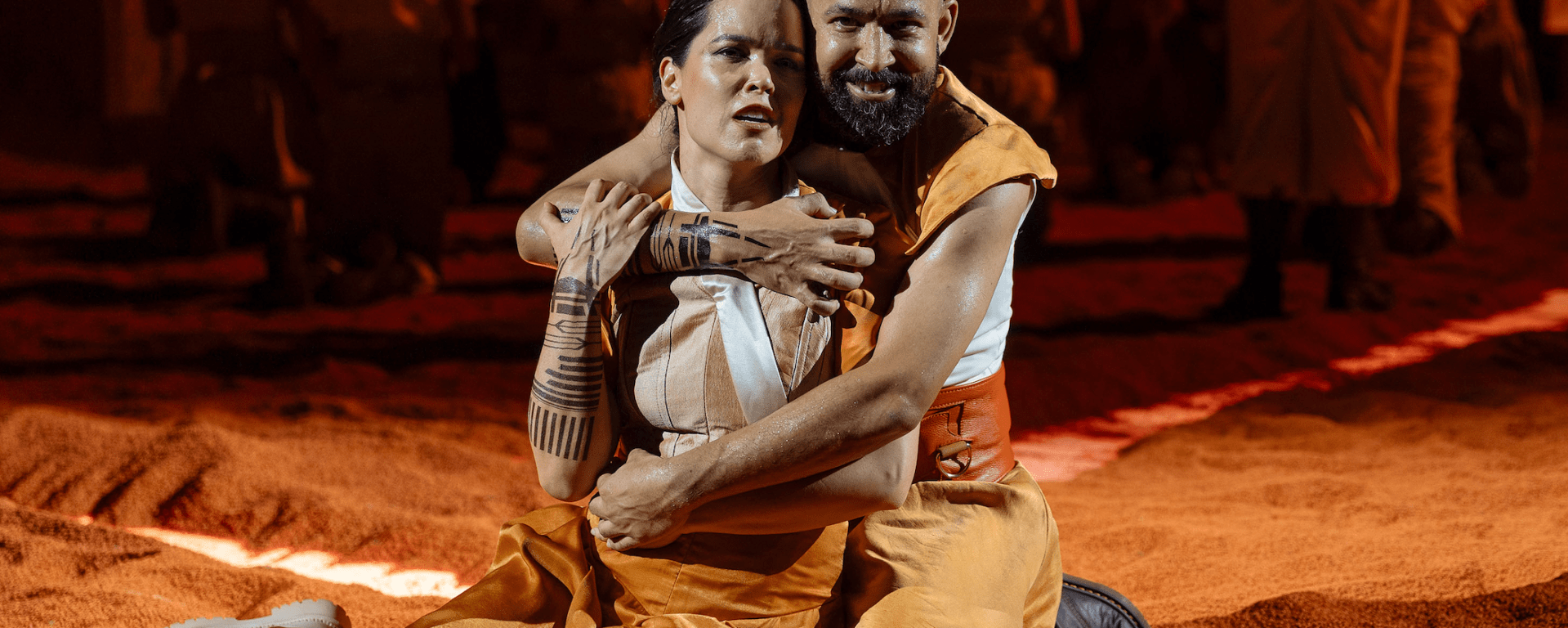

A multi-universal tale of blood and sand emerges at Fort Canning Park, in SRT’s space opera adaptation of the Scottish Play.
Grand in ambition, breathtaking in design, and conceptually riveting Singapore Repertory Theatre (SRT) makes a triumphant return with a new edition of their iconic Shakespeare in the Park, this time tackling the dark tragedy of Shakespeare’s Macbeth. Director Guy Unsworth, who also helmed Shakespeare in the Park – Julius Caesar (2018) and A Midsummer Night’s Dream (2023), reimagines the iconic tale not as a bleak, blood-soaked tragedy in medieval Scotland, but as a sprawling, otherworldly fable set in the desert world of ‘Scoalan’, a speculative, sci-fi parallel universe brimming with mysticism and danger. Inspired heavily by the aesthetics of grand space operas like Dune and Star Wars, this production is a sensory feat that boldly reframes Shakespeare’s work through a futuristic lens. Within this mythic landscape, Macbeth becomes a parable of tyranny and the cyclical nature of power, proving that Shakespeare is both timeless and (multi)universal.
From the moment the lights rise on Richard Kent’s magnificent set, the audience is transported. The ground is carpeted in rust-red sand and gravel, immediately conjuring an alien desert realm, while towering, geometric columns rise from the earth like ancient monoliths, evoking the otherworldly scale of the Giant’s Causeway in Ireland. The sheer magnitude of the set creates a powerful illusion: that this world stretches far beyond the boundaries of the stage. In a single sweep of design, Kent conjures a sense of a world with history, spirituality, and unrelenting heat. Yet amidst its grandeur, there’s a looming sense of danger, with some areas are cloaked in shadow, the darker corners of the set evoking the feeling that someone with ill-intent is always lurking just out of sight. And indeed, on the opening night, the weather’s oppressive humidity only amplified this atmosphere, with the warmth of the evening immersing us even more fully into the harsh, sand-drenched world of the play. Kent achieves total immersion, drawing theatregoers into a fully-realised world that feels both foreign and strangely familiar.

Costume and culture also play a significant role in enhancing this version of Macbeth. In keeping with the sci-fi reinterpretation, Unsworth leans into a diverse mix of cultural influences to shape the visual language of Scoalan. The witches, portrayed with eerie grace by Melissa May Garcia, Vanessa Kee, and Inch Chua, appear like supernatural seers born of the sand—draped in golden veils and copper-toned robes, their presence less cauldron and cackle, more algorithmic and all-seeing. They are ethereal, elemental figures, always hovering on the edge of reality, watching and shaping destiny. They are never absent for long and ever present, be it at a coronation, a celebration, or a murder, silently observing and reminding us that fate is always watching. The rest of the ensemble is clad in a pan-Asian mix of aesthetics: robes reminiscent of Japanese samurai-inspired robes, hints of Southeast Asian warrior motifs, metallic cummerbunds, and desert-ready boots, all infusing the costumes with cultural richness. It is a world where spiritualism meets militarism, focusing on opulence and ritual.
With its sci-fi palette, director Guy Unsworth borrows liberally and inventively from a tapestry of cultures. Characters in Scoalan don’t belong to any singular time or place, hybridising a mix of Southeast Asian and Japanese silhouettes with futuristic detailing into their costumes, ranging from samurai-style robes, metallic cummerbunds, and desert-worn boots. The witches (Melissa May Garcia, Vanessa Kee, and Inch Chua), emerge like spiritual beings from the sand, draped in copper and gold, veiled and otherworldly. They sing, cry out, and haunt the stage as spectral forces, less menacing and more like divine algorithms who watch the chaos unfold with knowing detachment. They float through the production like living prophecies, always present, always listening.

The story of Macbeth is well-trodden, a noble general led astray by ambition and the supernatural, urged by his formidable wife to kill his king and seize the throne. But this production breathes new life into the familiar. At its core, it remains a tale of how unchecked ambition corrupts and consumes. Ghafir Akbar’s portrayal of Macbeth is layered and compelling, initially a righteous force for good, with the quiet nobility of a battle-hardened general, before slowly descending into paranoia and madness. Ghafir evokes the air of heroism, and so his initial hesitation and what lies within him feels palpable, afraid of the dark, of the dagger he sees before him, of the inconceivable horror of killing the man he has pledged his life to. When the deed is done, he stands with bloodied hands, stunned, and is riveted in horror by what can never be undone. But as his ambition spirals, so does his sense of self; his mind unravels, and his hallucinations, particularly the appearance of Banquo’s ghost, are viscerally disturbing, made even more so by the haunting soundscape and clever lighting cues.
Julie Wee’s Lady Macbeth is equally magnetic, commanding in early scenes, but increasingly fractured as guilt erodes her steel exterior. From the outset, she is strong-willed, with her steely resolve and psychological dominance, ripping off a drip attached to her arm and confidently taking a swig from her vial, suggesting her almost demonic possession by ambition gives her temporary immortality and a high. Her manipulation of Macbeth is physical as much as it is verbal; you can see how she leans into him, exerts control, and dominates their shared scenes with remarkable force. When she seizes the daggers from Macbeth’s bloodied hands, she is dominant, knows that she is the superior of the couple. Yet, as the cracks begin to show, her transformation is just as captivating, a hint of desperation in her voice when she fails to calm Macbeth down from his visions, as if she can see the power and control she once wielded over him slipping away. Her own unraveling is masterfully done, her guilt manifesting in her movements and expressions until her famous “out, damned spot” scene, where with clean hands, she seems to claw at her own skin, desperately trying to purge her conscience, her tormented scrabbling at invisible stains feels like a woman physically battling the ghosts she once welcomed.

The supporting cast is equally deserving of praise. Daniel Jenkins brings quiet strength and integrity to Banquo, embodying a man bound to moral clarity even as the world crumbles around him, still grounded and dignified. Even the younger actors prove their mettle even with limited time onstage. Gaby Rae’s brief but impactful performance as Lady Macduff is haunting, where she brings a sense of realism to the Shakespearean verse, her terror and defiance vividly conveyed when she’s captured and murdered. Benjamin Koh, as Angus, speaks clearly, confidently and with gusto. And Arielle Jasmine offers a refreshingly grounded Malcolm, who is not just a foil to Macbeth but a beacon of potential renewal, suggesting a new chapter for Scoalan that is neither cynical nor vengeful.
What sets this Macbeth apart is not just its reinterpretation of setting, but the clarity and accessibility Unsworth achieves through dramaturgy and design. Visual storytelling carries immense weight here, where Banquo’s ghost, for instance, returns more than once, becoming a recurring spectre of guilt that dogs Macbeth’s descent into madness. Gabriel Chan’s lighting is magnificent;when Ghafir ascends the throne, it divides the space like a moral battleground, like heaven and hell on either side of his crown, while also transforming the red desert into an oasis of blue during Malcolm and Macduff’s flight to the safety of “England”, creating a visual metaphor for hope and reprieve. Matt Hutchinson’s puppets, particularly the large silver raven representing Macbeth, as well as the birds of prey circling above, bring haunting symbolism to the skies, where birds play the roles of omens, scavengers, or spiritual messengers.

Ritual and ceremony play a defining role in this production, and Unsworth ensures that each moment of pageantry is carefully choreographed and visually striking. When King Duncan arrives at Macbeth’s fortress, an elaborate welcoming ritual unfolds: the mist of dry ice flows, sand is kicked in sync with the rhythm, folk dances are performed with drama and precision (choreographed by Tan Rui Shan), and a regal yet ominous atmosphere takes hold. Macbeth’s coronation is an equally stunning sequence, featuring banners, a ceremonial staff, and a slow, god-like ascent up the monumental set begins, while chaos, suffering and pain unfold below. The witches’ satanic summoning scene conjures apparitions via swirling fabric and coordinated movement from the ensemble, an ingenious and fresh form of puppetry that mesmerises and unsettles. Even the famous porter scene is reimagined, done away with and replaced by a mournful ritual of song and movement, led by the witches as they perform a lamentation for the fallen king, while seemingly inviting the devil to play his part.
Even more so than in an enclosed space, every technical aspect is important for fighting against the elements, and in this production, are fine-tuned to perfection. Mervin Wong’s evocative score underpins key moments with cinematic grandeur, and Lee Yew Jin’s sound design is excellent, crisp, textured, and immersive, and always ensuring clarity of speech and texture of environment, no matter where one sits in the park. The final battle between Macbeth and Macduff’s forces is not only emotionally charged but stunning to behold, with Peps Goh’s fight choreography balancing intensity with precision; every soldier’s fall, each swing of the blade is deliberate, impactful, and fluid. With characters frequently moving onto the runway that stretches into the audience, the action literally comes face-to-face with spectators, collapsing the space between audience and myth.

At the heart of it all lies the crown: crudely carved, sharp, and foreboding. It stands as a totem of ambition, of cursed, ruinous power, and its presence is a constant reminder that Macbeth’s rise to power comes at the cost of nature, morality, and peace. Yet, the ending of this production resists total despair. The final battle itself is gripping, with Macbeth and Macduff’s duel staged with rising fury, until Macbeth is slain and his crown physically removed. Then, as if something demonic calls, magma-red lighting suggests hell itself yawning beneath them. It is a conclusive end; when Malcolm finally ascends, and Scoalan begins its healing, the monolithic pillars no longer seem like tombstones of a broken world, but foundations of a building, representing the ability to build something stronger, better and new atop the ruins left by our forebears. A stray raven descends to feed on Macbeth’s corpse after the conclusive duel, as though ensuring his soul cannot return, damning him from even reincarnation. We do not have to continue these senseless wars; hope lingers, just enough to suggest the cycle of violence might finally be broken.
As always, Shakespeare in the Park remains more than just theatre. It is a work of both heart and art that SRT commits to, a testament to what live performance can be when done with ambition, craft, and care. SRT spares no effort in bringing Shakespeare to life, making it not only accessible and invigorating, but an epic, communal experience, something to look forward to with excitement, like a festival or pilgrimage. Even in the humid night, surrounded by buzzing insects and swaying trees, we remain captivated by the world built in Fort Canning Park, where Macbeth is no longer just a play, but an event and experience.
Photo Credit: Singapore Repertory Theatre
Shakespeare in the Park – Macbeth plays from 7th May to 1st June 2025 at Fort Canning Park. Tickets available here
Production Credits:
| Director/Script Adaptation Guy Unsworth Cast Ghafir Akbar, Julie Wee, Daniel Jenkins, Andy Tear, Shane Mardjuki, Gaby Rae, Melissa May Garcia, Vanessa Kee, Inch Chua, Arielle Jasmine, Victoria Mintey, Selma Alkaff, Benjamin Koh, Feroz J. Malik, Charlotte Elizabeth, Adrina Bang, Priyanka Darshini, Charlotte Greenall, Amir Haziq, Alysha Kaisah, Sim Kee Joo, Audrian Tan, Jeoshua Wang Music Mervin Wong Production Design Richard Kent Choreography Tan Rui Shan Lighting Design Gabriel Chan Puppets, Puppetry Design and Direction Matt Hutchinson Sound Design Lee Yew Jin Fight Choreography Peps Goh Hair Design Ashley Lim Makeup Design Bobbie Ng – The Makeup Room Co-Lighting Designer Genevieve Peck Associate Sound Designer Jean Yap Assistant Director Eric Larrea Assistant Fight Choreographer Danish Dasuki Vocal Coach Jingyun Ng (Jyn) Intimacy Director Rayan Condy |


Here’s a polished version, combining your thoughts into a cohesive and impactful review, aiming for a smoother flow and more refined language:Macbeth at Fort Canning Park: A Masterclass in Power and Paranoia
Having just witnessed the production of Macbeth at Fort Canning Park, I can attest it was an exceptionally well-done rendition of Shakespeare’s chilling tragedy—nothing short of a triumph. Visually compelling, impeccably acted, and atmospherically rich, it masterfully fuses Shakespeare’s psychological horror with Southeast Asia’s lush nocturnal backdrop. The dark canopy of trees, the looming fort walls, and the open night sky formed a stage where ambition, murder, and madness unfurled with primal intensity, amplifying the play’s supernatural themes and deepening its impact.
Beyond the compelling staging, the performance sparked several intriguing reflections that lingered long after the final curtain call.
Echoes of Usurpation and the Price of Power
The play immediately brought to mind striking historical parallels. One couldn’t help but wonder if Shakespeare was, in part, drawing on the twisted succession drama of Henry VII and the disappearance of Edward V. Macbeth’s usurpation and the ominous silence that follows powerfully echoed the Tudor myth of a stolen crown built on the fate of vanished heirs. This production brilliantly highlighted the brutal and often morally compromised path taken by those who seize power. It’s a pattern as old as monarchy itself—ambition masked as legitimacy, a cycle that continues to repeat throughout history.
The Psychological Toll of Treachery
The production also poignantly illustrated the profound psychological toll of such actions. Macbeth’s famous line, “Sleep no more,” resonated deeply, prompting reflection on how many rulers throughout history have likely lived Macbeth’s fate. Once power is grasped through violence and treachery, peace becomes elusive. They, too, might have found themselves similarly haunted by their deeds, losing the very peace they sought. This compelling performance powerfully conveyed that inner turmoil, reminding us that power seized through fear ultimately breeds only more fear, until it consumes its wielder entirely.
The Inner Landscape of Madness
Furthermore, the portrayal of the witches and Lady Macbeth felt particularly nuanced and unsettling. One couldn’t dismiss the interpretation that they could represent Macbeth’s own inner voices—his deepest, darkest desires made manifest. They whisper, taunt, seduce, yet they may simply be manifestations of a man split open by unchecked ambition. Shakespeare’s genius in externalizing these internal conflicts through such vivid characters allowed the audience to vividly witness Macbeth’s character disintegration, truly visualizing the protagonist’s descent into moral decay.
A Lingering Exploration of Power
Ultimately, this production of Macbeth at Fort Canning Park was far more than just a theatrical experience. It served as a potent exploration of the nature of power and the relentless struggle to obtain and maintain it. It provided a powerful lens through which to study power’s allure, its immense cost, and its corrosive aftermath. The play leaves one contemplating the psychological cost of ambition and the blurred lines between fate and free will, long after the performance concludes.
I’d like to say thank you for bring this production to us.
Vicky
LikeLike