

The birth, merger, separation, independence and future of Singapore are told through immersive video, sound and absurdly arresting performance.
The title Umbilical brings to mind the most primal of bonds: a baby’s connection to its mother before the cord is cut. And in this multi-sensory, deeply symbolic performance by artists Rizman Putra, Zul Mahmod, and thesupersystem, that connection becomes a potent metaphor for Singapore’s own complex birth; where we were once joined with Malaysia, then separated, then forged into a nation of its own, Umbilical utilises abstract imagery and technology to turn our history into an experiential performance that is equal parts poetic and unsettling.

Held at the SOTA Studio Theatre, the space was configured into a long, U-shaped space with audiences flanking a central, rectangular runway. In a way, the set design of Umbilical places us inside a kind of living organism, where nets drape above us like connective tissue, while IV bags hang in the centre like feeding lines or suspended futures; in the middle is also the control panel, where thesupersystem and Zul Mahmod control the video and sound. Around and above, screens immerse us in cellular visuals, where we are both viewers and participants, allowed to roam and absorb the environment freely.

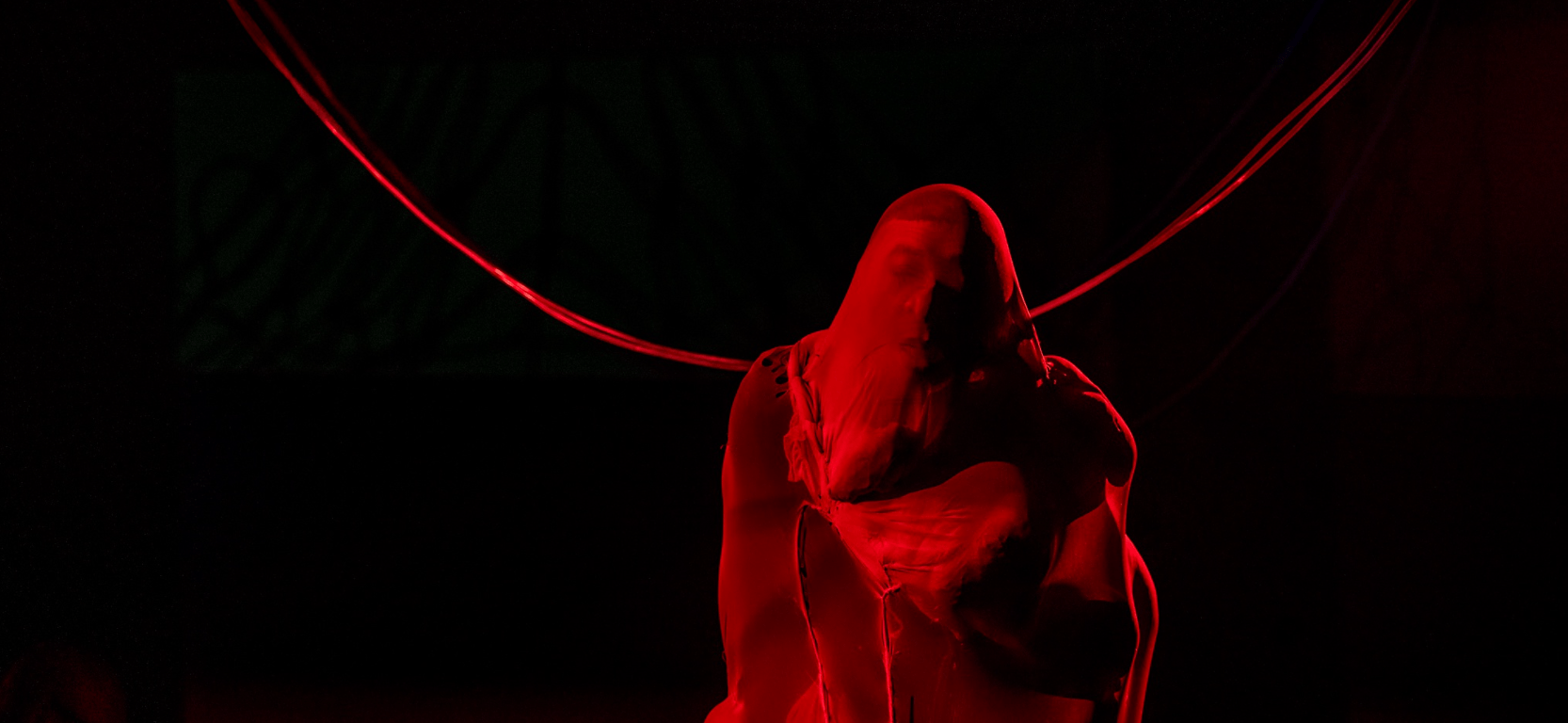
The performance begins with Rizman Putra emerging in a blobby form, as if newly formed from the primordial soup. Tentative and blind, he fumbles his way around the runway. When he begins to tear off his first layer, with some difficulty, it feels like witnessing a creature discovering its own body. What lies beneath is grotesque, visceral; a body of limbs and membrane, lumbering into consciousness. Even when Rizman visibly struggles with his costume, it feels almost intentional. It reminds us that change and evolution aren’t elegant processes; they are awkward, raw, and painful, contributing to this sense of struggle that becomes central to the performance’s emotional core.

There are moments when the absurdity of his physical transformation teeters on the edge of comedy, yet the production never lets it tip into parody, and somehow, what could have been camp becomes oddly poignant. The audience is challenged to make sense of what they’re watching, but even in its abstraction, there is unmistakable emotion. Often, it’s as if we are witnessing a child grow up, go through struggle after struggle, constantly remade by the conditions of their environment. We feel almost paternal, we want the best for it. And as Rizman ascends, we feel both hope and apprehension for what lies ahead. What is the Singaporean identity, after all? By the end, no one knows — but the work assures us that we ride the waves of time and change, whether we like it or not.

As Rizman continues his transformation, the metaphor expands. In one sequence, he dons concrete-like blocks over his limbs and head, becoming a living building, or perhaps a monstrous embodiment of Singapore’s own rapid urbanisation, even toddling like a kaiju born from infrastructure while 3D landscapes and grey blueprints load up on the screens, promising a fully-realised city. This metamorphoses further as he sheds these costume parts, picks up a giant metallic structure, and wears it like a grotesque protrusion, clearly burdened by its weight. This feels like a direct reference to the Causeway and its changing face over the years, itself an umbilical cord that connects Singapore to Johor Bahru, with grainy images of archival footage of the Causeway zoomed large behind him; later on, it almost feels like it references the Japanese blowing up the Causeway during the Occupation, a pained expression on his face as a giant red circle of light expands out. It seems to indicate pain, but perhaps the pain is necessary as a step towards evolution.

The visual storytelling by thesupersystem and the immersive sonic landscape by Zul Mahmod are critical here. Zul’s sound design is immersive, textured, and propulsive, with thumping industrial beats alternating with quieter, contemplative phases. It surrounds us, keeping pace with Rizman’s transformation, drawing us deeper into this abstract evolution. These are especially felt in the next scene, where Rizman steps offstage, walking to a designated spot where a shimmering silver, ‘star’-studded garment descends from above, as though dressing himself in the cosmos. Is this transcendence? A future state? Or simply a return to some abstracted womb of potential again, all this while we are surrounded by star fields, perhaps launching us into a supernova future.

In many ways, what Rizman seems to be trying to do is to bring it all back to basics, where he too sheds this garment, and tries on the previously discarded skins. The original membrane, and then the mass of protrusions, the flesh returning to cell, to becoming something new and finding its potential, never satisfied to simply remain as things are, forced to find new ways of being in order to survive in the new age. And that is precisely the future Umbilical posits for us, as it introduces the controversial idea of AI-generated video content. On the screens, uncanny images of smiling Singaporeans play over a hopeful yet strangely melancholic song about Singapura – is it harkening back to our past ties with Malaysia, or is it reclaiming our history as we march into a bold new future? Is this a hopeful vision of the future, or a synthetic simulation of unity and progress? The tension between technology and identity lingers, and we are left to wonder how much of the future we hold in our hands, and how much we are being carried into it, no control.

While Rizman never interacts directly with the audience, there is a strong sense of spectacle and wonder throughout. It is testament to his skill in physicality and how he conveys emotion without a single word, his expression capturing our attention, his movements weird but wonderful, inviting awe, but also introspection. As visceral as it is, this isn’t a show about definitive answers, but one about process, rupture, and constant becoming. Splicing the concept and idea of the body politic, of physical land, structures and identity, Umbilical is less a celebration than a meditation on this momentous SG60 year, a production that resists nostalgia and forces us to face both the fragility and the potential of transformation. Sometimes all you have to do is take a breath, cut the cord, and surrender yourself to the waves of change pushing us ever forward.
Photo Credit: Moonrise Studio, courtesy of Arts House Limited
Umbilical played from 16th to 18th May at the SOTA Studio Theatre.
The 2025 Singapore International Festival of Arts runs from 16th May to 1st June 2025. Tickets and more available here
Production Credits:
| Zul Mahmod | Artist Rizman Putra | Artist thesupersystem | Artist Aiman Sunor Collective | Artist ARTFACTORY | Producer Aida Sa’ad | Costume Design Akbar Syadiq | Costume Design Andy Lim | Lighting & Technical Direction Gerald Teh | Lighting Associate ARTFACTORY – Yap Seok Hui | Technical Production Joel Fernandez | Sound System Engineer Scott Lee | Set Realisation Louis Bryan | Tracking Specialist Dianna Sa’ad | Costume Assistant Grace Baey | Documentation |
 Bakchormeeboy
One thought on “★★★★☆ Review: Umbilical by Rizman Putra, Zul Mahmod and thesupersystem”