
Death is a full-time job for the walking dead roaming Chile’s wind farms, exposed as the site of tragedy and exploitation.
While the world wakes up to the very real issues of climate change and makes efforts to combat it, selfish corporations continue to put themselves first and find ways to profit under the guise of saving the planet. That is the controversy at the heart of Manuela Infante’s Vampyr, which turns our attention to the wind farms of Chile, exposing them as a site of tragedy and exploitation that gives rise to the metaphorical, and potentially literal, living dead.
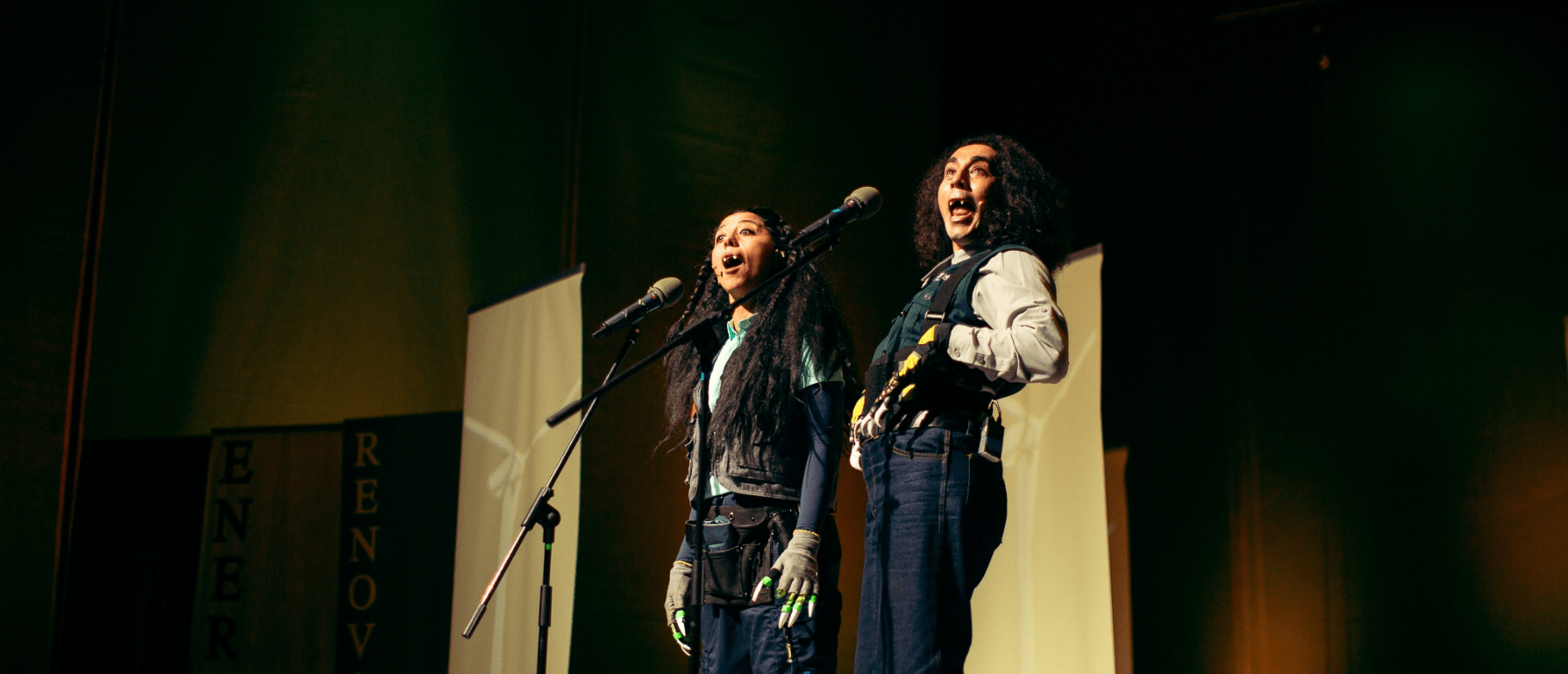
Marking the third part of her trilogy exploring the non-human realm, Vampyr takes the form of a mockumentary, where an unknown narrator, through voiceover, runs a report on a wind farm, a new green industry that takes over traditional agriculture, as he investigates the conditions and impact on the country have been like. His survey subjects? Two unnamed workers at the site, with long fangs, lethargic movements, a messy shock of hair, sharp claws, and hissing in their voice, bearing more than a passing resemblance to mythical vampires.

The crux of the show is simple – greenwashing is at the heart of the wind farms of Chile, where the promise of better employment opportunities instead results in overworked labourers roaming the night with risky jobs, and in an almost apocalyptic manner, countless bats mysteriously fall dead to the ground after the turbines are built, yet have no discernible injury, leading the owners to completely avoid any liability for the damage caused. Writer/director Manuela Infante has a wealth of innovative ideas on how to present this unusual subject matter, but as a result of trying to stick so closely to its vampire analogy, often feels both repetitive and like it’s struggling to stretch the parallels to the undead to its limits.
Firstly, the character work is strong, thanks to committed actors Marcela Salinas and David Gaete. Our first introduction to these ‘vampires’ are two boxes wheeled out onstage, each one vibrating ever so slightly, before Salinas and Gaete pop open the covers and emerge from them, as if awakening from coffins. They stretch, they lumber, they ache, their voices slow and measured, as if lacking in and hungering for energy. Throughout the show, they take their time, almost indulgently, as they play out these undead creatures to their fullest extents. This is admirable, but there are times where their physicality and antics overshadows the actual message they’re trying to bring across, less humorous than it is just plain weird or grotesque, nor serving to underscore and emphasise the facts.

This is made even more confusing with the actors playing multiple characters throughout the performance, from a woman named Betty whose mother ends up working for the wind farm, or eventually, how both vampires seem to represent the corporation themselves delivering the report. The changes are not always obviously differentiated, at most putting on a pair of glasses to show a shift, and in terms of the content, much of it ends up repeated, to the extent it feels like Infante is belabouring and harping on the same simple idea of overwork, exploitation and suffering over and over without adding anything particularly new to it with each rendition.
Perhaps then, the more visually interesting segments include creative use of projection, such as utilising pop-up stands as makeshift screens to project images of wind turbines onto them, and even an inflatable tube man to represent a makeshift scarecrow that the wind farms use to scare away pests; one of the vampires even pretends to sink its fangs into it, before we watch it deflate from a lack of air, before it comes back with a vengeance later on. A kabuki drop sees a literal green curtain fall away to reveal a vision of the night sky behind it, plunging the stage into dusk. The Drama Centre’s stage often proves rather overwhelming for just two performers to fill, and it is these additional elements that help to make it a little less daunting, even if they at times feel played for oddity rather than emotive effect.

Vampyr’s most affecting moments then, come from when it emphasises how innocents suffer at the hands of corporate greed. This comes out most strongly when the bats that spontaneously die are revealed to have been killed by barotrauma, where the installation of wind turbines causes a sudden, sharp difference in pressure between the outside atmosphere and their tiny bodies, causing their organs to collapse inside, despite appearing perfectly fine on the outside. It is the denial of responsibility for these creatures’ deaths that surprisingly, hit hardest, and drive home the idea that amidst the claim of doing good, these companies are in fact creating more problems for the natural world.
Vampyr has no actual plot, and serves instead as creatively presented information for the audience. As such, its pacing also ends up unsteady, with no real climax, and several false endings that drag out its conclusion, particularly with long-winded monologues that, even though are cleverly written, reiterate what has already long been established throughout the show. Perhaps, this sense of confusion, existing between the worlds of the living and dead, the realm of night, as half animals half humans half dirt, is precisely the point Vampyr ultimately serves to drive home – that these creatures are lost with no direction, at the mercy of forces beyond their knowledge and control.

When it finally reaches its ending, both vampires appear to have gone berserk, revealing their true forms as they put on billowing capes, letting go of all the pain and frustration that’s been building up throughout the performance. Annie Lennox’s very on-the-nose ‘Love Song For A Vampire’ plays, and exhausted, they retreat to their ‘coffins’, resting what little they can before the next slew of work. All this, while they use leaf blowers to blast strips of black plastic into the air, more and more until it looks like a sky full of bats, dying as they fall back onto the ground. It’s a powerful image that reminds us of the very real cost and cruel irony of greenwashing, and leaves us with plenty of food for thought about these sinister, mutant forms of neo-colonialism, that are oftentimes the biggest bloodsuckers of all.
Featured Photo Credit: Franco Barrios
Vampyr played from 23rd to 25th May 2025 at the Drama Centre Theatre.
The 2025 Singapore International Festival of Arts runs from 16th May to 1st June 2025. Tickets and more available here
Production Credits:
| Manuela Infante | Director & Playwright Marcela Salinas and David Gaete | Cast Carmina Infante Güell | Production Rocio Hernández | Design Pablo Mois | Director´s Assistant & Technical Manager Dian C. Guevara | Training & Choreography Manuela Infante | Sound Design Víctor Muñoz | Sound Technician Camila Valladares | Research & Dramaturg Elizabeth Pérez | Wardrobe |
 Bakchormeeboy