
Mesmerising live concept album that draws on ancient texts and a touch of the supernatural, elevating weish’s artistry to new heights.
Considering how we’ve always established Singapore’s identity as a multicultural city and ‘rojak’-like mix of ethnicities, it comes as no surprise that when we ask ourselves what Singaporean music is, we inevitably realise that no single local artist really encapsulates that idea perfectly well. But that’s certainly not without want of trying, and if it’s one artist that comes incredibly close to achieving that, it’s weish with her new work stray gods.

Coming hot on the heels of her successful 2024 work Secondary: The Musical, stray gods takes weish’s music into yet another new direction, as she dives deep into her family history, while grappling with her own personal struggles of mania, rootlessness, and self-destruction. To make sense of these, weish processes it through art, specifically, storytelling through music, as she draws from both Euripedes’ Bakkhai and Hakka mountain songs to result in a cross-cultural, East-meets-West rendition of new, original sounds that both pays tribute to her heritage, and forms a cathartic release of her darkest emotions in the form of a live concept album.

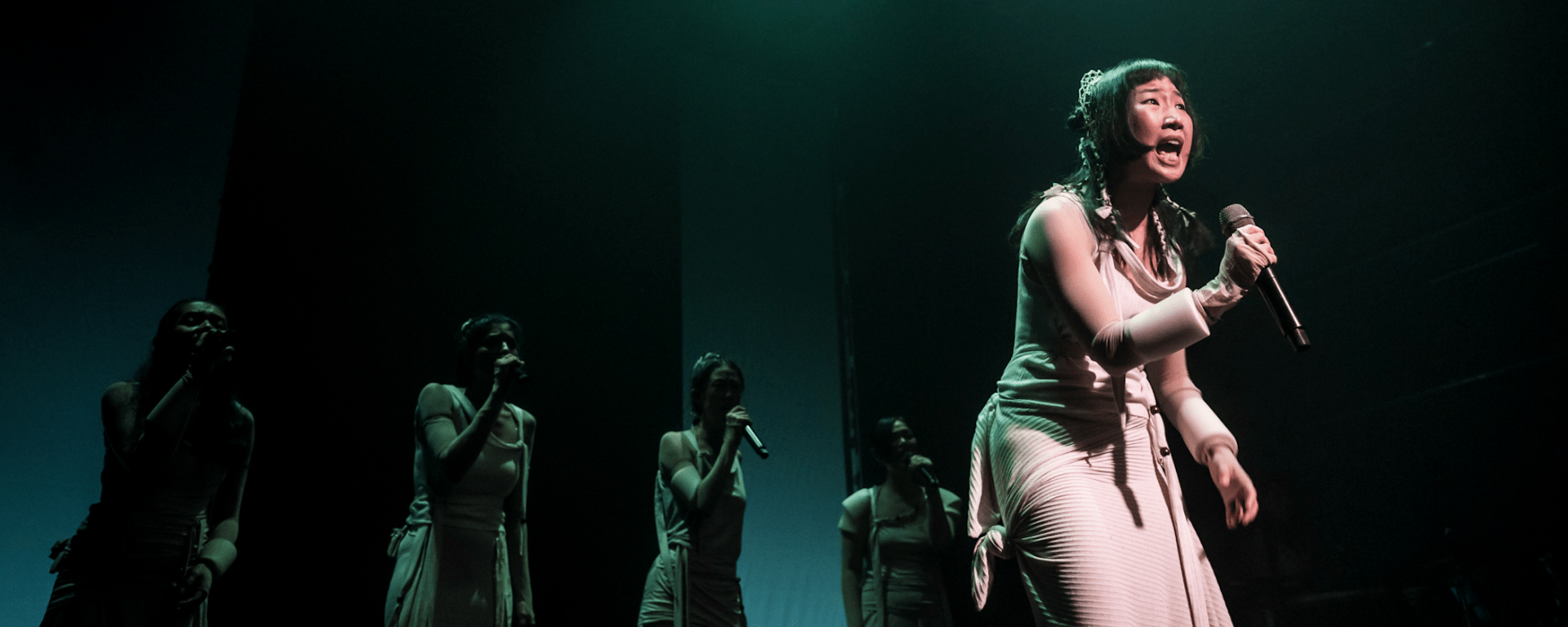
Onstage, styled by Josh Tirados, weish is a vision in white, a small tiara on her head and ribbons in her hair, while she is in a sleeveless dress, gloves that resemble a cast and strips of cloth that may also be bandages draped around her. Fog rolls in, so well-controlled that it seems to swirl only around her, and we see her as both ethereal and damaged, a lost soul wandering these lands on her own kind of odyssey – seeking repentance or revenge, who knows.

As she opens her mouth to sing, lyrics appear on the screen behind her in both Chinese and English – the words that come out of her mouth are Hakka. In her signature fae-like voice, otherworldly and almost eerie, she transforms fully into this stray god. Isolated and alone, her voice sounds forlorn as she makes a plea to the moon, recalling past lovers, the hint of regret and fear. It is then that the instrumentals start up, with instrumentalists Abdul Hakiim (deførmed), Cheryl Ong, Daniel Alex Chia, Ian Lee, and Syahadi Samad on either side of the stage, performing a mix of Western and Eastern instruments, and the result is to transform the stage into an atmospheric landscape from the wilderness of Asia, far from society where all are at the mercy of nature.

weish is joined onstage by the rest of her flock, supporting vocalists Hee Suhui (Anise), Joanna Dong, Rosemainy Buang and Sushma Soma, all dressed similarly to her, and together they seem to form a band of Furies, witchy and sorcerous as they twist and bend their way forward. Their onstage chemistry is incredible, singing in harmony and moving together, their minds in sync. We witness them in a state of ritual, always with weish taking the lead as their voices rise to wails and a chant, like casting a forbidden spell, all while the lyrics remain clear.

In many ways, this almost feels like weish’s most pop-adjacent work in her musical career, with many songs arranged and composed in familiar ways, while employing these mystical sounds. Each time they rise to the end of a verse, it almost feels like they’re on the verge of dropping into an earworm of a chorus, before deviating back and resisting the urge to play to expectations, particularly with the more bass-heavy numbers that would not be out of place at a rave. With Marc Gabriel Loh’s abstract visuals, plunging the stage into blood red or predatory blue, alongside both the trance-like movements and hypnotic voices, often repeating verses and phrases over and over, audiences stand transfixed, unable to look away from the animal ferocity they display.

weish also enters incredibly vulnerable territory with stray gods’ lyrical content, often entering the darker side of her mindscape and desires. Often, there is an expression of agony and spiritual torture, grappling with guilt and bloody imagery that underscores the entire performance with a streak of violence. Her supporting vocalists at times feel like echoes of her bigger fears, preying on her psyche as they reinforce these negative thoughts and ensnaring her in them, and it is here we wonder if the feminine divine is as wonderful as society makes it seem – does it also give rise to something far more primal we’ve been taught to suppress?

stray gods’ main drawback is its venue at the SOTA Studio Theatre. There’s something so clean, so detached about the way the stage was set up, where there was a clear divide, an invisible line between the performance onstage and the audience, as much as the singers tried their best to look into our eyes, to reach out. Perhaps this represents the impossible gap between gods and mortals, but what it resulted in is an enclosed work which almost but never quite reaches a resonant emotional high – we are witnessing weish in turmoil and agony, but never feeling it ourselves. In the darkness of the audience standing space, you witness a few audience members in the front getting into it, but the majority of us remain awkwardly bobbing about, never giving in to the madness contained in the piece to let loose and allow our bodies to let loose into the trance-like state the performers onstage enter.

In essence, stray gods is an accomplished and mesmerising new body of work from one of Singapore’s most interesting indie artists, and shows how much potential she has when she fully leans into her artistry and taps on her personal history and passions. This is a performance that exemplifies cultural fusion done well, updating these ancient songs and stories for a contemporary audience, a cathartic experience for weish as she reconnects to her ancestry and expunges her darker emotions onstage. Teetering on the verge of madness with effective staging, we can’t help but become bewitched by the strangeness and charm of weish’s siren call, a sincerity to her work that makes it all the more stronger, and channels the old gods back to life, if only for a weekend.
Photo Credit: Moonrise Studio, courtesy of Arts House limited
stray gods played from 30th May to 1st June 2025 at the SOTA Studio Theatre. Tickets are sold out, more information available here
The 2025 Singapore International Festival of Arts runs from 16th May to 1st June 2025. Tickets and more available here
Production Credits:
| weish | Lead Artist Hee Suhui (Anise) | Supporting Vocalist Joanna Dong | Supporting Vocalist Rosemainy Buang | Supporting Vocalist Sushma Soma | Supporting Vocalist Abdul Hakiim (deførmed) | Instrumentalist Cheryl Ong | Instrumentalist Daniel Alex Chia | Instrumentalist Ian Lee | Music Director & Instrumentalist Syahadi Samad | Instrumentalist Marc Gabriel Loh | Director, Set & Media Design Deanna Binte Dzulkifli | Producer Terence Lau | Technical Manager Uthaiyan Kumanan | Sound Engineer Andy Lim | Lighting Designer Hafeez Hassan | Movement Direction Josh Tirados | Stylist Xin Lee | Stylist Esther Goh | Stage Manager Pearlyn Tay | Production Assistant |
 Bakchormeeboy
2 thoughts on “★★★★☆ Review: stray gods by weish”