
During a 1961 National Day mass rally, a man by the name of Yusof Ishak stood before the nation and delivered a watershed speech that galvanised the nation towards unity and solidarity. It was a bold vision for a young country emerging from centuries of colonial rule and only beginning to imagine itself as independent, and four years on, that very gifted man would go on to become Singapore’s very first president.
More than sixty years on, his name and image is now everywhere, from schools to the face of every banknote, on plaques and historic photographs. But for many, the story of our first ever president has faded from memory. Who was he, beyond the official portraits and photos? What did he believe in? What kind of husband, brother, leader, and above all, human being was he when he was still alive?
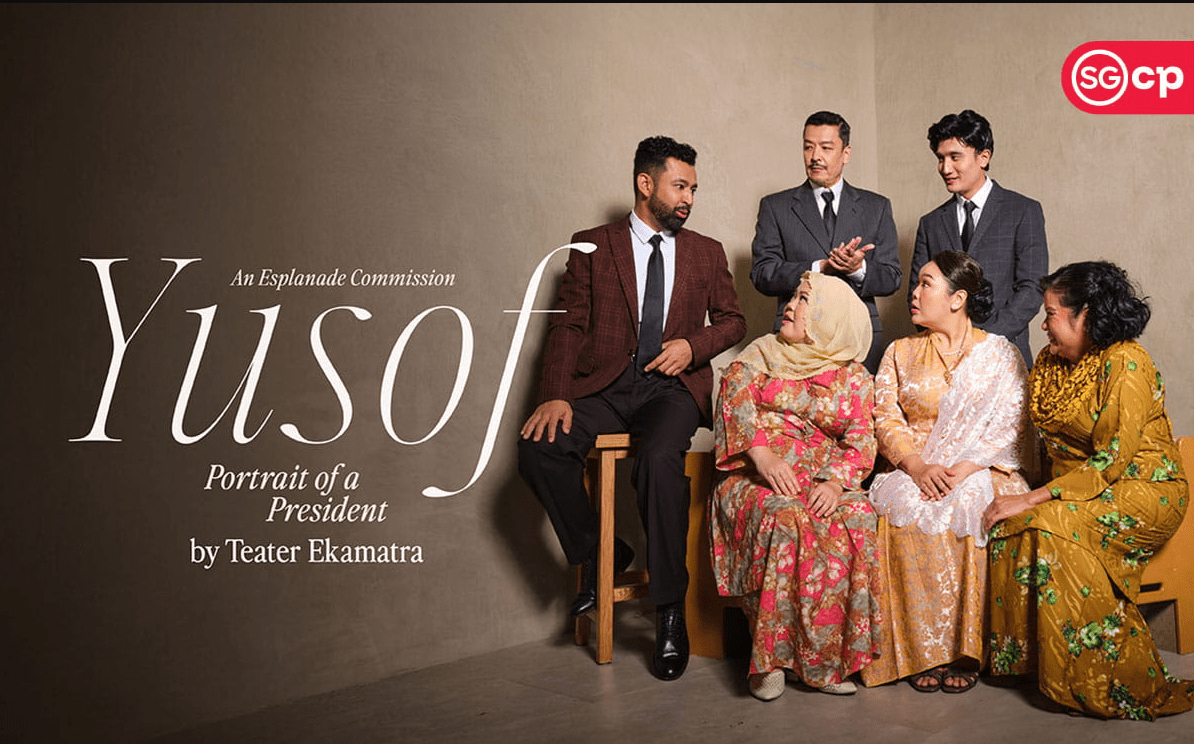
These are the questions at the heart of Yusof: Portrait of a President, a play first staged by Teater Ekamatra at Pesta Raya – Malay Festival of Arts back in 2015, and now revived for SG60. Written by acclaimed playwright Zizi Azah, who herself has familial ties to Yusof Ishak, Yusof is not just a straightforward biography. Instead, it seeks to embody the spirit of the man: his struggles, his convictions, his vulnerabilities, and his humanity, playing out onstage for all to see.
This new staging features veteran actor Sani Hussin returning to the title role, alongside an ensemble cast comprising the best actors in Malay theatre today, including Siti Khalijah Zainal, Ghafir Akbar, Dalifah Shahril, Farah Ong, and Fauzie Laily. The production is helmed by director and set designer Mohd Fared Jainal, with dramaturg Alfian Sa’at, costume designer Sufiyanto of Kebaya Societé, lighting designer Adrian Tan, and sound designer Syed Ahmad. Together, they aim not only to tell history, but to make it feel alive.

For director Mohd Fared Jainal, the revival is a return to a story he first encountered from the other side of the stage. “I was in the audience in 2015,” he recalls. “What I felt at that time was that Yusof’s voice was very clear, and that Zizi had really captured his personality while having so much intentionality in bringing across his words, his wisdom, and what he was pushing for.”
Ten years later, tasked with directing the work, Fared wanted to go further. “This time, it has to be the full embodiment. We see his arc: his emotions, his expressions, how he changes through life, with his wife, his friends, his brothers. We unpack more of him through voice, through physicality, through the full range of what theatre can do.”
That shift is also visible in the staging itself. “The last production was at the Esplanade’s Theatre Studio. Now we’re at the Waterfront Theatre, which is bigger, so the set is more vast. We pick and choose what to bring from the old production, and what to inject with our own creative license, bringing in something more contemporary, and resulting in a mix of both.”
Authenticity remains central, and Fared hopes his production draws audiences into the world of Yusof and old Singapore. “For costumes, we’ve kept it true to the period. Sufi, who designed them, is a family friend of Yusof’s family, and knows them well, so you’ll see a lot of authentic recreations and clothing. As for sound and set, we’ve allowed ourselves more room to create, and you can expect the world of Yusof to be both historical and theatrical; grounded in truth, but alive with imagination.”
So what exactly do we know of Yusof Ishak? Born in 1910 in Perak, Yusof grew up in a time of colonial rule. His father was a civil servant, his family humble but ambitious. As a boy he excelled in school and sports. He joined the police academy in Kuala Lumpur in 1932, but was expelled a year later under controversial circumstances: an early lesson in the unpredictability of colonial authority, and also where our story begins, before it continues chronologically.

In 1939, he co-founded Utusan Melayu, the first Malay-language newspaper owned and operated entirely by Malays. It became a crucial platform for nationalist voices and a training ground for writers, journalists, and activists who would shape post-war Malaya and Singapore. “Utusan was his weapon,” says actor Sani Hussin, who reprises the lead role from the 2015 production. “Through it, he gave the Malay community a voice. He had to steer it through leftist, rightist, nationalist movements, all of whom had so many conflicting interests. But he kept it focused on uplifting society. That was his gift.”
Those who knew him describe him as disciplined, even stern. “No means no, yes means yes,” Sani says. “My mother used to tell me stories. Once, a gardener picked a mango that had fallen from a tree in the Istana, and Yusof scolded him. That’s apparently how strict he was, in his personal life as much as his public one. But that sternness helped him hold his ground in politics, especially when his hands were tied as president and he had to stand strong.”
For Sani, returning to the role after nearly a decade has meant deepening his understanding of the man. “When I first worked with Zizi, I asked her: do you want me to play Yusof as a biopic character, like an impersonation, or do you want his voice? And she told me to capture his voice, but in all its complexity; his sadness, his vulnerability, his struggles. Obviously, I don’t look like him, but through his voice, we edge a little closer towards being able to show and re-present that.”
This time, under Fared’s direction, the expectations were higher. “Fared is…’greedier’ than Zizi,” he laughs. “He wants everything. The voice, the body, the character, the sadness. So now it’s not just the voice, but also the visual aspect of Yusof. It’s not just about impersonating him, but about embodying him. Not just the president you see on the front of your banknotes, but the man himself.”
That embodiment comes with challenges. “Whenever you’re portraying a public figure, it’s both complicated and sensitive. You’re playing a real person whose family is still around. There are things we can’t show. Yusof was a heavy smoker, and well, we can’t put that on stage. There were sibling fights, literal physical fights, that we had to cut. The family didn’t want that portrayed. So every tension scene has to end with resolution. It’s tricky, but within those limits, we still stretch. We still find the truth.”
As much as the play focuses on the life of Yusof, it also seeks to bring emphasis to the other people in his life who uplifted and supported him throughout, including the women. Actress Farah Ong, who plays the fictional female journalist Sri, explains: “We wanted to show how important women were in shaping these men too. We’re not trying to make it a feminist play, but to show women’s pivotal influence.”
Her character Sri is inspired by the lone woman who appears in a historic photograph of Utusan’s newsroom. “Back then, women weren’t really acknowledged in the media. In the photo, it’s all men, and this one woman parked in the corner. We wondered who she was, and that’s the space Sri fills. She was a teacher who turned to journalism after the Japanese invasion. It’s nice to play a woman who isn’t just a typist in the background, but part of the action.”
As for Yusof’s sister, almost nothing is known. “There’s practically zero information about her. The brothers were well-known, ending up as politicians and journalists, so we had to piece her character together from scraps and bits of his other siblings. For me, there’s satisfaction in exploring these women, even if history didn’t record their names. They mattered, and now we get to showcase their stories onstage.”

Even though the play is titled Yusof, the creative team insists it is about more than one man. “It’s about the community,” Fared says. “The people around him, the leaders of that time, his brothers who were politically active and nationalist. And of course, not just male figures. Within Utusan, he also brought women into the picture. It was a collective struggle.”
That collective spirit shapes the ensemble performance. Every actor has a strong-headed role, each with their own spotlight. “Especially post-war,” Sani notes. “Everyone wanted the British out, but each had different views. There was urgency, high tension. That’s part of what drives the play.”
Why tell this story now, for SG60? For the team, the answer lies in memory. “Actually, a lot of millennials and Gen Zs don’t know our first president was Malay,” Farah admits. “I’ve spoken to students who had no idea, even when they carry his face on banknotes, they just don’t make the connection. I find that quite sad, so I hope this play makes history human again, and it exposes them to their own heritage.”
“Our parents’ generation saw Yusof in schools and institutions,” Sani adds. “They can share stories. But for younger generations, the name doesn’t mean much. Without plays like this, we risk losing that connection.”
For Fared, there is also an educational responsibility. “Some stories need to be told, no matter how much time passes. History shapes who we are. It’s important for younger generations to know, and for storytellers to tell it truthfully.”
Each artist takes something different from Yusof’s legacy. For Fared, it is perseverance. “He believed in something and stuck with it. Today, with so many choices, people flip easily. But he stood firm, like our fathers who worked one job for decades. That’s something we can all learn from.”
For Farah, it is moral courage. “One revelation for me was his stance against Tunku Abdul Rahman. I thought it was Lee Kuan Yew who opposed the Sultanate system, but Yusof himself did too—for the people. That human element isn’t in the textbooks. That’s the kind of story we can share through theatre.”
For Sani, it is Yusof’s service. “People think presidents have no power, but actually, before becoming president, each one was excellent in their profession. You’ve got S.R. Nathan who was the Director of the Security and Intelligence Division and was involved in hostage negotiations, Ong Teng Cheong who was a top architect…and for Yusof, it was journalism. To think he started a whole Malay newspaper with no money, creating a voice for the community, that was huge. Through Utusan, people were pushed to read, to know what was happening around them, and really helped the Malay community become literate. That was the legacy he left behind.”

Yusof promises to go beyond biopic, and to present the striking portrait of a leader and a human being, drawn in broad strokes of history and intimate shades of family, idealism, and vulnerability. “You know, there are some stories that just ought to be told and known to all Singaporeans, and in the case of Yusof, it’s not just about a president,” says Fared. “It’s about the values we inherit, and the values we choose to carry forward and shape who we are.”
In showing us the man behind the name, Yusof reminds us that the nation’s founding was not inevitable, but built on conviction and sacrifice. It is the story of someone who believed, fiercely, that leadership was about service, and who embodied, in his life and in his presidency, the ideals of dignity, justice, and unity during Singapore’s most formative years.
Photo Credit: Teater Ekamatra
Yusof: Portrait of A President plays from 17th to 24th October 2025 at the Singtel Waterfront Theatre. Tickets and more information available here
 Bakchormeeboy