
A dignified and contemplative play honouring Singapore’s first president with quiet grace.
Playing as part of the Esplanade’s 60 Connections – At Home and Afar SG60 celebrations, the decision to restage Yusof: Portrait of a President marks an invitation to look deeper into the life story of our first president, alongside his enduring ideas and belief that dignity, unity, and justice should form the foundations of a nation. In Teater Ekamatra’s revival, the life of Yusof Ishak is reconstructed with quiet reverence and intellectual precision, drawing audiences into the moral and emotional journey that forged the path for him to become Singapore’s first president.
Originally written by Zizi Azah, and directed by Mohd Fared Jainal, for most Singaporeans, Yusof Ishak exists as the man on our banknotes, but in our education system, rarely mentioned or delved into. Yusof, the play then attempts to give that image breath and heartbeat. Set against the turmoil of the 1950s and 1960s, from the fight for press freedom at Utusan Melayu to the fraught politics of merger and independence, the production revisits the choices that defined Yusof’s life and, by extension, the country’s trajectory and struggles in becoming a young independent nation.

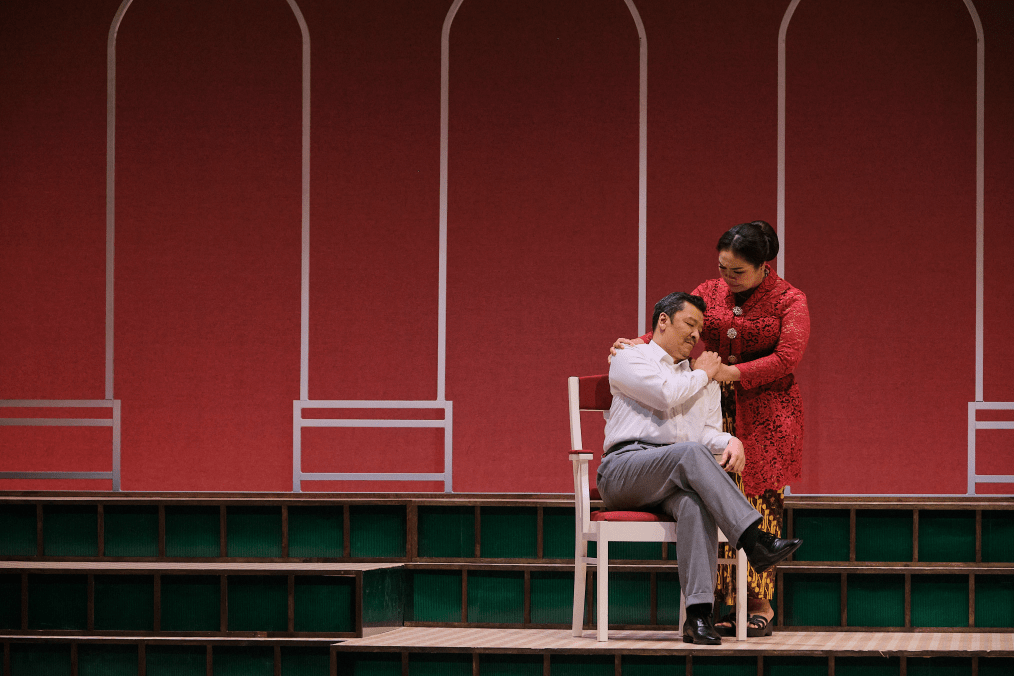
Starring as Yusof is veteran actor Sani Hussin, who reprises the role from 2015 and whose performance grounds the production with grace and restraint, and of course, sporting his signature moustache. He does not play Yusof as a distant icon but as a fully-realised man struggling to hold faith in the face of political disillusionment. Sani’s portrayal of Yusof is proud yet pensive, carrying a weight that never quite leaves his shoulders. When anger flashes, be it the temper we see when he argues with his brothers, or in his climactic confrontation with Tunku Abdul Rahman over the moral duty of the press, it is not performed theatrical rage, but a sincere presentation of the moral clarity of someone who has run out of patience with hypocrisy. It is in those brief, charged exchanges that the play reaches its emotional peaks.

The scenes set in Utusan Melayu are among the most compelling, offering a glimpse of Yusof beyond his presidential position, and instead as an educator and advocate. His commitment to uplifting the Malay community through literacy and access to information continues to resonate strongly today, and Sani’s passion shines through. We are reminded that before he was president, he was a man who believed in the transformative power of knowledge, that a community empowered to read, write, and question was essential to a nation’s progress. These moments, grounded in dialogue and conviction, lend Yusof both purpose and urgency, and it is clear how the other members of Utusan look upon him with respect and admiration each time he speaks, his joy when a paper successfully goes to print.

Fared’s direction is measured and deliberate. The staging often feels minimal, even austere, with the six actors navigating an open, spare space that emphasises words over movement. The set, comprising steep panelled steps, immediately remind us of iconic spaces such as the steps of the former City Hall and their association with politics and nation-building. At first, this feels somewhat threatening and even detached, as though the production holds us at arm’s length from these seemingly untouchable historic figures. But over time, this distance begins to feel purposeful. It mirrors the way we, as a nation, see Yusof himself: a figure elevated beyond reach, enshrined in our collective memory but seldom known in intimacy. By resisting sentimentality, the production invites contemplation rather than catharsis. We are not meant to feel immensely for Yusof, but to consider and remember him for the ideals he stood for, and what they mean to us now.

That emotional restraint is softened by the production’s aesthetic richness. The music, by Syed Ahmad, is subtle and evocative, lingering just beneath scenes like a quiet pulse of remembrance, nostalgic and reminiscent of films. Adrian Tan’s lighting carves the stage into zones of shadow and light, helping focus our attention on the actors in each scene rather than how they are often engulfed by the space, and emphasise the themes of Yusof’s belief confronting pragmatism, at times casting gorgeous silhouettes of frames and shadow to heighten the drama. And the costume design by Sufiyanto (Kebaya Societé) deserves special mention: the women’s sarong kebayas are exquisitely cut, their elegance lending the play a nostalgic texture. They speak of an era of grace and formality, where public poise often concealed private struggle.

There is a certain old-school quality to the whole production, the kind of earnest, text-driven theatre that dominated Singapore’s theatre in earlier years. It has that familiar rhythm of speech, debate, and stillness, resulting in dialogue that is both purposeful and reflective. That tone of nostalgia also becomes part of its appeal, and takes us back to a time when Singapore theatre was preoccupied more with meaning than spectacle, when the stage was a forum for civic and historical reckoning, a lineage that Yusof proudly takes after.

Yet for all its care and craft, the play never entirely escapes its biographical form. Its episodic structure, a sequence of scenes marking the milestones of Yusof’s life, can sometimes feel too neat, too historical, or even abrupt in the transitions between each scene. The family moments, while giving a degree of insight into Yusof’s personal life, rarely deepen into genuine emotional conflict. The secondary characters, despite the ensemble’s skill, exist largely in orbit around Yusof himself, and serve his narrative rather than find significance in and of themselves. But perhaps this, too, is fitting. The play’s very structure mirrors how history remembers him, as the central figure around whom others revolved, their lives and stories fading into the background of his legend.

As the play unfolds, one feels both admiration and melancholy. Admiration for the clarity of Yusof’s ideals: his insistence that democracy could bind a nation fractured by race and colonial legacy, and melancholy for how distant such conviction feels today. The production’s formality, its slight remove, might frustrate audiences craving intimacy, but it also communicates something profound: that Yusof, even in life, was a man apart. The distance we feel in the theatre may be the very distance that defined him, with solitude of principle.

Six decades on from our separation from Malaysia, Singapore has grown into a nation that has achieved much of what Yusof envisioned, the pinnacle of stability, prosperity, and a persistent sense of unity. Yet the questions that haunted him still linger: How do we balance idealism with pragmatism? How do we preserve integrity in public life? How do we remember those who built the foundation without turning them into lifeless symbols? In that sense, Yusof‘s themes linger on, inviting a conversation between past and present, and remind us that the values that shaped our beginnings must continue to guide our future.

If the play leaves us wanting more emotion, it also leaves us with something harder to find in theatre today – reverence without sentimentality. It asks us to look again at a man we think we know and recognize the humanity behind the myth. In an age obsessed with immediacy, Yusof dares to slow down, and to let dignity, silence, and reflection carry the weight of memory. Yusof stands as a fitting and appropriate tribute: stately, introspective, and quietly powerful. It may not razzle dazzle with theatrical fireworks, but it echoes an era when ideals still felt possible and exciting. For a nation at sixty, it’s a poignant reminder of where we came from, and the kind of grace we might still aspire to and continue to uphold.
Photo Credit: Akbar Syadiq
Yusof: Portrait of A President plays from 17th to 24th October 2025 at the Singtel Waterfront Theatre. Tickets and more information available here
Production Credits
| Playwright Zizi Azah Abdul Majid Director & Set Designer Mohd Fared Jainal Lighting Designer Adrian Tan Sound Designer Syed Ahmad Costume Designer Sufiyanto (Kebaya Societé) Dramaturg Alfian Sa’at Cast Sani Hussin, Siti Khalijah Zainal, Ghafir Akbar, Dalifah Shahril, Farah Ong, Fauzie Laily |
 Bakchormeeboy
One thought on “★★★★☆ Theatre Review: Yusof – Portrait of a President by Teater Ekamatra”