
Pooja Nansi and Shivram Gopinath’s tongue-in-cheek, electric verse meets sick beats to create a profoundly healing experience.
In tiny Singapore, it can be all too easy to feel a creeping sense of claustrophobia. Shared third spaces vanish, and opportunities for uninhibited self-expression grow scarce. For poet Pooja Nansi, the solution is not to wait for transformation, but to seize agency: to uncover beauty in the everyday, to build community and pride in one’s own identity, and to make spaces divine through sheer presence and intention.
Sharing its title with her 2021 poetry collection, We Make Spaces Divine sees Pooja performing selected texts at the Esplanade Annexe Studio as part of the 2025 Kalaa Utsavam Indian Festival of Arts. The result is a distinctly cultural and deeply personal encounter, where poems explore Indian identity in Singapore, from beloved hangouts to longing for cinematic icons who shaped childhoods and imaginations.
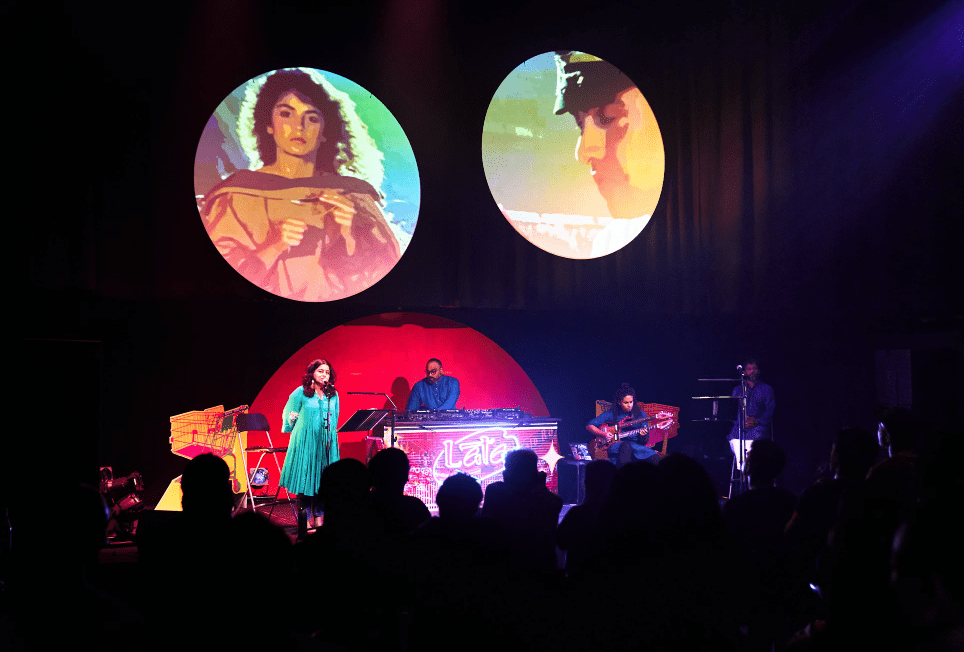
This is far more than a standard reading. Pooja collaborates with guitarist Isuru Wijesoma and DJ RAAJ, whose backing tracks and atmospheric soundscapes elevate the experience into something closer to ritual. Chennai spoken word poet Shivram Gopinath joins in, trading turns and textures with work from his collection Dey, offering a complementary voice and playful counterpoint.
The Annexe Studio itself has been transformed. Limited table seating turns the venue into an intimate, bar-like space, with most of the audience standing, a choice that encourages movement, connection, and a sense of shared energy. Before the performance begins, RAAJ warms the room with irresistible beats, loosening bodies and signalling that this is not an evening for passive observation.

Pooja’s poetry has always thrived in the spoken form. Her words demand breath and voice, layered with wit and emotional nuance that cannot be fully captured on the page. Early on, she performs The Year We All Watched TV and Saw Ourselves In Yamuna Sangarasivam, conjuring Lata Music Centre with loving detail. The act of browsing records becomes intimate and reverent, the walls and atmosphere imbued with memory and meaning.
RAAJ’s turntable setup reinforces the vision: a neon sign mimicking Lata’s logo glows, while road sign prints for Tekka Road and Buffalo Road anchor the setting. Even those unfamiliar with the space can vividly picture it, carried along by Pooja’s nostalgia and invited to inhabit her memories as if they were their own.
Much of We Make Spaces Divine radiates a firm but joyful pride in Indian-ness—not boastful, but rooted in belonging as a minority community. References to marginalisation appear, but often reframed through affection and reclamation. In Mustafa Centre Blues, Pooja begins with harsh online reviews of the shopping centre before countering them with her own lush, sensory tribute, turning its aisles into a living archive and sanctuary.
Here, words and music become tools of healing; reappropriating spaces, histories, and identities that have been dismissed or misunderstood. One of the most affecting moments comes with Songs of Exile, where Pooja reflects on her father renouncing his Indian citizenship for Singaporean nationality. The simple bureaucratic act becomes devastating: a severing from birthplace, layered with quiet grief and sacrifice.
Yet the evening is far from solemn. Lighter pieces spark laughter and applause. Pooja’s tributes to Bollywood superstars brim with desire and reverence: Amitabh Bachchan rendered as an object of sensual admiration, Sridevi elevated to goddess through her choreography. Her playful immersion is abruptly and hilariously punctured by the viral “Pooja What Is This Behaviour?” soundbite, grounding the moment in contemporary humour.
Shivram’s verses share this witty, tongue-in-cheek energy. He riffs on thosai with sensory imagery, impossibly macho Tamil superheroes on Vasantham, Health Promotion Board warnings about Deepavali snacks, and the ambiguities of celebrating SG60. His sharp observations both skewer and celebrate stereotypes, making the humour land precisely because of the truths it exposes.

The music is integral rather than merely supportive. Isuru’s guitar lines strike at just the right moments, a single sustained note amplifying the weight of a phrase. RAAJ’s beats shift from steady pulses to familiar samples, including Home, Munnaeru Vaalibaa, and even Yung Raja’s Mustafa, each enhancing the emotional landscape. Above them, thesupersystem’s projections ripple across two circular screens like planets or halos, looping Hindu-inspired imagery, headlines, and Bollywood scenes and, at one point, juxtaposing real footage of Singapore with AI-generated versions, subtly questioning what feels authentic in a rapidly changing city.
If anything, one wishes the mostly reserved audience had allowed themselves to move more freely during the dance break and closing moments. The performance invites abandon, and when embraced, it becomes profoundly cathartic, far beyond the typical poetry reading or music set. These are words that reach directly into lived experience and speak both personally and universally, celebrating cultural identity in all its complexity and splendour.
The evening ends on Madhuri Dixit Teaches Us About Feminist Autonomy – Khalnayak, 1993, a fiery finale that feels inevitable. It is ferocious, sensual, and primal, channelling a raw feminine power. In that moment, Pooja seems to invoke something divine, her presence and voice transforming the Annexe Studio into a sacred space, a place to dance, to release, and to revel in the beauty and resilience of Indian culture.
Photo Credit: Esplanade – Theatres on the Bay
We Make Spaces Divine ft. Dey played from 21st to 23rd November 2025 at the Esplanade Annexe Studio. More information available here
Kalaa Utsavam – Indian Festival of Arts 2025 plays from 21st to 30th November 2025 at Esplanade – Theatres on the Bay. Full lineup available here
 Bakchormeeboy