
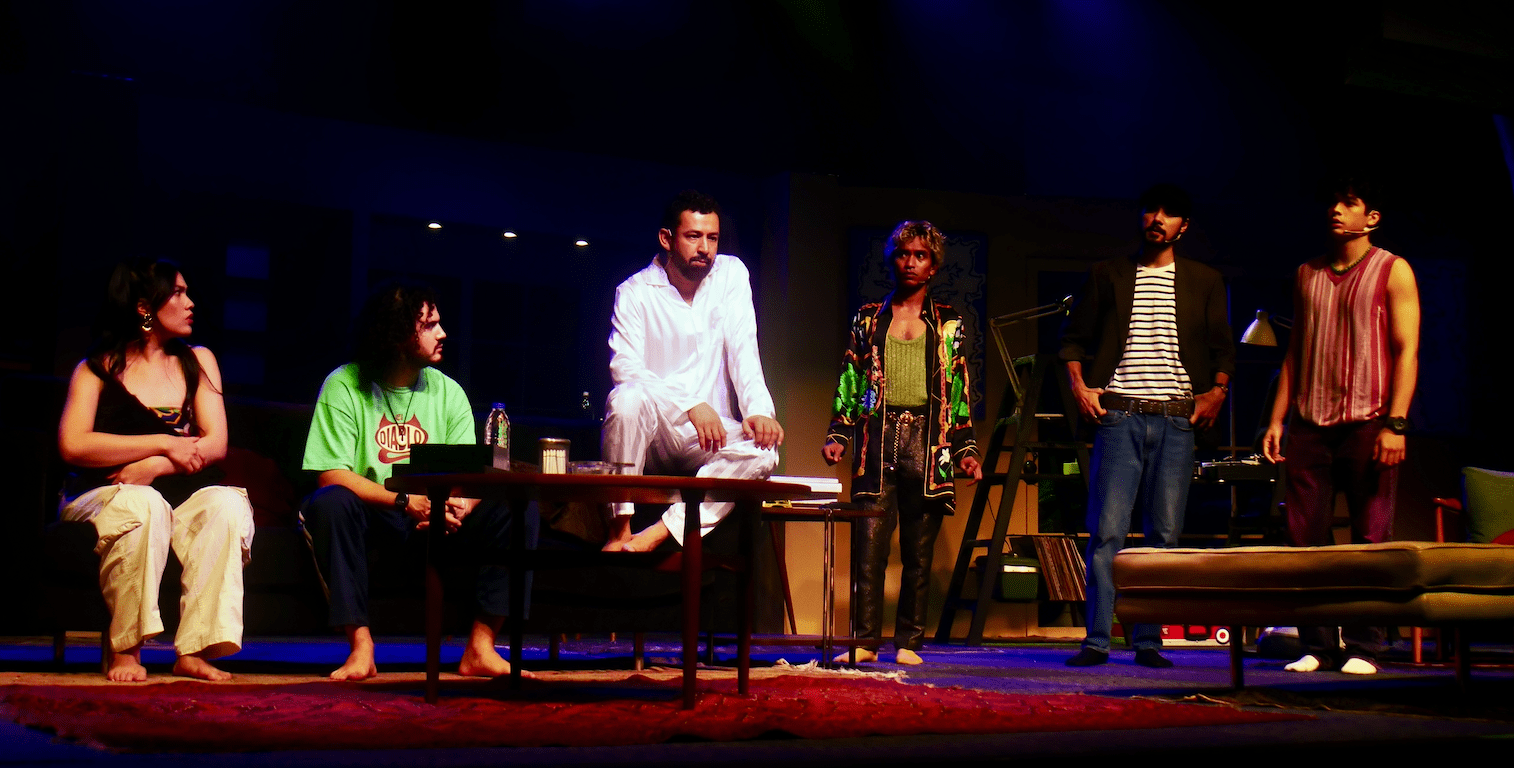
Jit Murad’s lost play transforms The Playhouse into a spiralling night of ’90s excess, nostalgia, and danger, resurrecting his voice with bold direction and an unforgettable ensemble.
KUALA LUMPUR – Stepping into The Playhouse, it begins as though the audience has stumbled into a party already in progress: a beautiful, artsy house with a bar, a living room, and the specific kind of lived-in aesthetic that makes you believe Ghani Madjid actually inhabits it. The scene is painted with such confidence that you can almost feel the climb up the hill into central KL to get there. The clubbing doesn’t end just because the characters have stepped indoors—the drinking, dancing, smoking, and chemical indulgence spill over into the early morning hours, creating the perfect storm for everything in ENTOURAGE – Murder Amongst Friends to unravel. The hum of danger beneath the music is irresistible, especially as a DJ arrives and shifts the room’s mood with an almost predatory drop.

Written by the late Jit Murad, one of Malaysia’s most celebrated contemporary playwrights, ENTOURAGE was only rediscovered years after his death and now staged for the first time as part of JitFest2025, adding another layer to the already heady mix. As Dramalab and director Dato’ Zahim Albakri resurrect this long-lost script—said to be a “well-crafted” draft completed in 2000 but deemed too taboo then for its mature themes—the production becomes something more than a murder mystery. It is a conversation between past and present, between a playwright whose voice shaped Malaysian theatre and a world still grappling with the questions he asked.

Set during Kuala Lumpur’s 1990s economic boom, the story follows Ghani, a magnetic but polarising artist whose barbed opinions and emotional volatility hold his mismatched circle of friends in a tense orbit. What begins as a night of drinking, dancing, and posturing among friends gradually curdles as rivalries flare, secrets slip, and loyalties shift. When a sudden murder fractures the group, the façade of camaraderie collapses, revealing the insecurities, resentments, and moral compromises each has been desperate to hide. Part dark comedy, part psychological thriller, the play digs into the fragile nature of friendship and the dangerous illusions we build around the people we choose to keep close.

Right from the start, the show drops us into Ghani’s stylish yet chaotic house-studio, an undeniably creative sanctuary somewhere in the heart of the capital, complete with scattered canvases and personal curios. Ghani, played by Ghafir Akbar with charisma and wounded brilliance, enthusiastically shows an attractive boy around the space, establishing himself as both ringleader and seducer. It’s particularly impressive how director Zahim and set designer Raja Malek have made the space work for them, seeing everything that’s going on with subtle sound design that creates a greater sense of immersion.

The early scenes, full of banter, flirtation, shifting alliances, establish the dizzying social architecture of this group. Lala (Sabrina Hassan), the long-time friend and maybe-more; Fash (Malik Taufiq), her quietly simmering fiancé, visibly uncomfortable around Ghani from the start; Sam (Harry Zain Verdan), the social-climbing PA who brought Ade to the gathering; Sonia (Mae Elliessa), once sleeping on other people’s couches until Ghani pulled her into his orbit; Mafuz (Engku Armand), the flamboyant fashion designer and later slippery producer; Wan (Nabil Zakaria), the young flirt peddling Xanax and working multiple angles just to provide for the two children he fathered by circumstance, not choice; Boy (Badrish Isdin), the pretty distraction; and Ade (Mia Sara Shauki), the streetwise outsider who sees more than she lets on.

The production’s design cleverly reinforces this chaotic intimacy. Projections and pre-recorded scenes fill in the moments we cannot see live: bedroom whispers, alleyway confessions, toilet-stall breakdowns, giving the impression that the camera is a silent accomplice. These filmed inserts work particularly well when Ade or Boy become the focus: the two-camera feed allows the audience to witness emotional truths from two angles simultaneously, revealing how perspective shapes reality. It is one of Zahim Albakri’s sharpest directorial choices, and the cast navigates this live–filmic interplay with ease.

As the night unfolds like a blurry flashback, Ghani’s vices sharpen into character study. With theatrical flourish he takes out a pestle, mortar, and batu kelik: “You don’t just use it, you earn it,” he teases. What follows is one of the production’s most striking sequences. The fibres of the chilis, the sighs of the onions, the turmeric leaking gold, this is where Jit’s language blooms, equal parts poetry and provocation. It feels unmistakably like his writing: witty, seductive, and dangerously self-aware. Ghani receives a package he hides away with trembling excitement, giving us an early hint of the ecstasy that laces the group’s night-long descent.

Meanwhile banter sharpens into conflict. The tension between Sonia and Lala simmers. Wan negotiates pills: as this entourage consumes, a quarter tablet? Half? One full tab for the adventurous? A chain of small decisions that lead, inevitably, to the “Rectum Room,” its logo and lurid promise recreated using a simple curtain that transforms the entire stage. The direction turns limited space into an imaginative nightclub, flooded with light, movement, and impulsivity. Mafuz grows increasingly excited about Ghani’s rare collection of krises, unfurled with almost erotic pride. And in a moment meant to unsettle, Ghani forces Ade to sit on Mafuz’ lap, a cruel play for power that makes Sam’s face visibly curdle.

The clubbing scene is one of the production’s triumphs. The visuals throb with 90s nostalgia; the dancing erupts with chaotic joy; the conversations turn confessional. Ade discovers Lala crying in a toilet cubicle. A filmed sequence shows Boy and Ghani in a moment charged with ambiguity. A triangle forms between Ghani, Boy, and Wan. And then the lights blaze on. A police raid. A moment ripped from KL folklore—the sort whispered among nightlife veterans with a shrug: this happened then, and it still happens now. Ade emerges before intermission, confused, watching the pieces misalign. We sense she is the narrator, or perhaps the chronicler, of this spiralling night, her “diary” of events forming the spine of the retelling.

After intermission, the production shifts into a different register, becoming quieter, sharper, and far more unsettling. The heady flashback of the night before before bursts when Wan announces Ghani’s death, and suddenly the play is no longer about the reckless joy of 90s nightlife, but about the consequences that hover in its shadow. The night’s chaos is over, yet the real unravelling begins the day after.

Ghani reappears not as the centre of attention but as a silent witness, dressed in white, gliding along the edges of scenes like a memory refusing to fade. Ghafir Akbar plays this transformation with startling delicacy, turning Ghani into both ghost and conscience.

What follows echoes classic detective theatre: Poirot by way of KL glamour and Jit Murad’s restless wit. Reenacted scenes projected as cctv footage become clues. Conversations between Sonia and Mafuz inside an actual old Porsche add a strange documentary realism. As truths surface, tensions thicken: Sonia jealous and exhausted, Fash piecing together timelines, Boy cracking under pressure, Mafuz twisting narratives with sleight-of-hand brilliance, lines deep and dazzling, a magician performing moral misdirection.

The group begins piecing together fragments of the night, snatches of conversations, moments of jealousy, fleeting betrayals, trying to hold their stories together as guilt and self-preservation quietly reshape their truths. The filmed sequences return, now reframed as half-memories, half-interrogations, amplifying the tension between what happened, what is claimed, and what each character needs to believe. As confessions surface, the atmosphere turns almost meditative. Sonia and Sam urge everyone to “keep it simple,” a phrase that lands with increasing weight as Ghani, now only a silent observer, listens from the edges of the scene. The play leans into ambiguity rather than resolution, allowing emotion to guide the narrative more than fact.

When the dust finally settles, each character exits the stage with a mix of resolve, regret, and unfinished business. Ade returns alone, stepping into a spotlight that sharpens her into narrator, witness, and survivor. Her final words reveal that everything we’ve seen has been her account, addressed not to us, but to the police. The play closes with the promise of possibility, leaving the audience suspended in an open-ended truth that feels true to Jit Murad’s fondness for ambiguity: endings that circle back to beginnings, friendships that collapse under their own weight, and a night that refuses to be fully understood.

If the show has imperfections, they are few: occasional dips in pacing, and an overabundance of narrative threads. But they do not diminish its force. What shines is the ensemble’s commitment: Nabil Zakaria’s Wan delivering punchy lines with aplomb, Sabrina Hassan’s Lala navigating torn loyalties with raw honesty, Mia Sara Shauki’s Ade grounding the story with disarming clarity, and the way Zahim Albakri draws deeply personal performances from every member of the cast. Above all, what endures is Jit’s writing: smart, poetic, funny, deeply human, capturing the contradictions of KL’s 90s social scene with both affection and bite.

It is no small thing to revive a lost work by Jit Murad. He remains one of Malaysia’s most beloved playwrights, a voice whose humour, empathy, and razor-sharp observation shaped a generation of theatre-makers. That ENTOURAGE was kept away from the stage for two decades for being too provocative, too mature, too dangerous, makes its debut during JitFest2025 feel both daring and overdue. For a play written so long ago, ENTOURAGE feels alarmingly present. It is messy, witty, stylish, uncomfortable, and undeniably alive, just like the city and era it evokes, and like Jit Murad’s legacy, still sparking, complicating, and challenging long after he’s gone.
Photo Credit: Keane De Netto
ENTOURAGE – Murder Amongst Friends runs from 5th to 11th December 2025 at The Playhouse @ The Campus Ampang Mall, Jalan Kolam Air Lama, Ukay Heights, Ampang Jaya, Selangor . Tickets are available on www.cloudjoi.com
Production Credits
| Playwright Jit Murad Director Dato’ Zahim Albakri Executive Producer Ida Nerina Associate Producer Wyn Hee Set Designer Raja Malek Lighting Designer Ee Chee Wei Multimedia Designer Fairuz Sulaiman Sound Designer Adyan Norzalahuddin Costume Stylist Birdy Lee Makeup Edmund Seow & Elisha Hair Stylist Tamo Beauty Lounge Production Management PH7 Productions | Pat Gui, Hamidon Abdul Hamid Stage Manager Syed Zalihafe Assistant Stage Manager Hana Nabilah Cast Ghafir Akbar, Mae Elliessa, Harry Verden, Sabrina Hassan, Malik Taufia, Engku Armand, Nabil Zakaria, Mia Sara Shauki, Badrish Isdin, Nicholas Augustin, Suhaimi Sulaiman |
 Bakchormeeboy
One thought on “★★★★☆ Review: ENTOURAGE – Murder Amongst Friends by Dramalab”