
by D.Y.
Faith Ng tears down the celebratory façade of childbirth, investigating the realities of post-partum parenthood.
‘The Fourth Trimester’ might not be a term every parent knows, but it’s an experience that they all eventually come to experience. Referring to the three months immediately after the birth of a child, it is a crucial time for parents to not only look after their newborn’s needs, but to form a bond with their child. In that sense, it is a time for both parent and child to become accustomed, where the parents adapt to an indelibly changed lifestyle and the child learns to live outside the comforts of their mother’s womb – an experience replicated in the revival of Faith Ng’s naturalistic drama by the humming of a lullaby muffled by amniotic fluid.
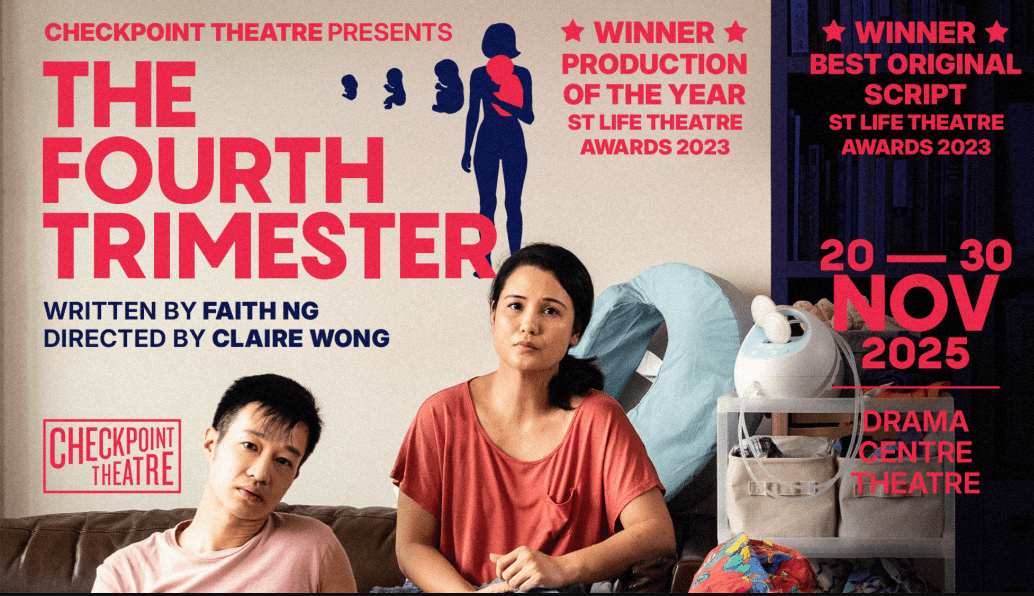
Directed by Checkpoint co-artistic director, Claire Wong, the nearly 3 hour-long play centres around young couple, Aaron (Joshua Lim) and Samantha (Isabella Chiam), spotlighting the multi-faceted struggles faced by modern-day parents immediately after childbirth. But Ng’s interpretation of ‘The Fourth Trimester’ does not end there. Accompanying Aaron and Samantha are the comparatively experienced couple, Daniel (Hang Qian Chou) and Lisa (Julie Wee), who initially appear as faultless parents, only to have their insecurities exposed in a series of uncomfortable altercations.

On the other hand, Aaron and Samantha’s newly-wed neighbours, Johan (Wan Ahmad) and Sofia (Rusydina Afiqah), wrestle against time, body and society in an attempt to conceive their first child. Completing the ensemble is Lisa’s sister, Ann (Liz Sergeant Tan), who is not only Samantha’s best friend but also confidently represents a kind of feminine independence distinct from the host of relationships surrounding her. Yet, she never fully escapes the entanglement of relationships as a chance encounter with Johan reignites a shared hurt from their romantic past. Together, the host of characters therefore represent the multi-dimensional nature of new parenthood that involves not only the parents of the newborn, but also an intertwined web of social networks many Singaporeans will be familiar with on our small island.
Together, the host of characters navigate their struggles on a two-part set designed by Petrina Dawn Tan. The main feature is Sam and Aaron’s messy but modern public housing flat, reflecting the manic of early parenthood. The second, neighbouring space is less specific, altering between being a public space to Johan and Sofia’s flat by flying in a window panel. Connecting these spaces is a central walkway that not only reflects the character’s travel but also highlights the intertwined web of social networks supporting a couple’s parenthood journey, something many Singaporeans would be familiar with. Despite its busyness, Darren Lee’s lighting design allows for the characters to find more private moments of interaction.

Arguably, the most conflicting creative component lies within the backbone of the production: Ng’s script. Admittedly, Ng understands the weight of her words: not only creating authentic scenes of tension and desperation but also allowing audiences to breathe by weaving in human moments of levity and comedy. Particularly, she writes Chiam’s character, Samantha, with the air of lived experience, demonstrating an almost autobiographical understanding of the tension between being guided by maternal instinct and being limited by a recovering mother’s body.
However, the rest of the script falls short of the nuances required to discuss such a complex issue at length. Besides the challenge of attacking such an issue from such varying perspectives, Ng’s lack of focus becomes glaringly apparent when it comes to the realisation of her characters. While the play houses an inherently feminist message, Ng’s female characters are only superficially complex, mistaking tangential rants for depth and brassy screaming for height of emotion. Even more egregiously-written are Ng’s male characters, like Daniel, who ultimately become caricatures of the modern Singaporean man. Furthermore, as a naturalistic play, Ng’s attempts to make her characters the beating heart of her story run amok, partially due to a lack of dramaturgical restraint, resulting in a restlessness thoroughly felt in tandem with the frustration invoked by her characters.

Thus, the brunt of the script is borne by the cast who manages to keep the performance afloat. Standout performances include Chiam’s Samantha who delivers both the desperation of a trying young mother and the maternal longings of a daughter. Together with Lim’s Aaron, the two pair share a believable chemistry that is no doubt fraught with emotional exhaustion, but tenacious in covert understanding. Wee’s Lisa is also a highlight; masterfully unravelling an inner hurt over the course of the first act and underlining the layers of pressure that is inflicted by both society, husband and self on the prototypical Singaporean Wife.
Opposite her, Hang’s Daniel is played with significantly less control. As a result of Ng’s writing, Hang already faces the challenge of playing to her idea of a stereotypically simple-minded Singaporean man. However, Hang never resists this interpretation – creating some moments of almost-satirical laughter but ultimately never allowing Daniel to resonate as a fully-fledged character with real masculine struggles. The last couple, Wan’s Johan and Rusydina’s Sofia, share a tender chemistry as they navigate the trying period of conceiving; which is unfortunate, given how their story is sidelined in favour of the other relationships.

Tying all the couples together is Tan’s Ann, who stands as the overt symbol of modern feminine independence, believing ‘she is always right’, steering clear of children but also finding time to embrace her womanhood with her best friend in the manic of early parenthood. While Tan plays this to an agreeable degree, Ann is written such that she often serves more of a narrative function to tie up loose ends, rather than provide a valuable insight into the conversations arising between her family and friends. As such, audiences are left desiring more from her character, especially given a bout of tension about her past with Johan that still feels unresolved.
While segregation and isolation still linger post-pandemic, the world as we know it, has attempted to evolve past its issues. However, the same cannot be said about Ng’s work, which continues to exist in its time of creation without further development. While the play offers a keen opportunity to delve into the realities of motherhood, given the evolving discourse surrounding both womanhood in families and the post-partum challenge, it never fully realises the depth of conversation they want to have and the focus it would require to have it. Yet, if anything, The Fourth Trimester still offers fleeting moments of well-written tension, superficial yet entertaining comedy and most importantly, a reminder to exercise patience – be it in nursing a newborn baby or in waiting for a play to awaken to its full potential.
Photos by Joseph Nair, courtesy of Checkpoint Theatre
The Fourth Trimester played from 20th to 30th November 2025 at the Drama Centre Theatre. More information available here
Production Credits
| Playwright Faith Ng Director Claire Wong Dramaturg Huzir Sulaiman Cast Isabella Chiam, Joshua Lim, Julie Wee, Hang Qian Chou, Rusydina Afiqah, Wan Ahmad, Liz Sergeant Tan Set Designer Petrina Dawn Tan Lighting Designer Darren Lee Sound Designer & Composer Shah Tahir Costume Designer Sheryl Teo Assistant Director Lauren Sim Hair Designer Ashley Lim Make-up Designer Bobbie Ng, The Make Up Room Creative Captioner Nur Shafiza bte Shafie (Shai), Natalie Linn Titus SgSL Interpreter Evelyn Chye, Azzam Akbar Deaf Consultant Yew Hau En Producers Claire Wong, Huzir Sulaiman Production Manager Lam Dan Fong Technical Manager Kailash Stage Manager Eunice Yap Assistant Stage Manager Nur Alya, Georgia Sim Props & Set Assistant Zy Ali Dresser Reece Liang Crew Chan Yan En, Wani Nadira |
 Bakchormeeboy