
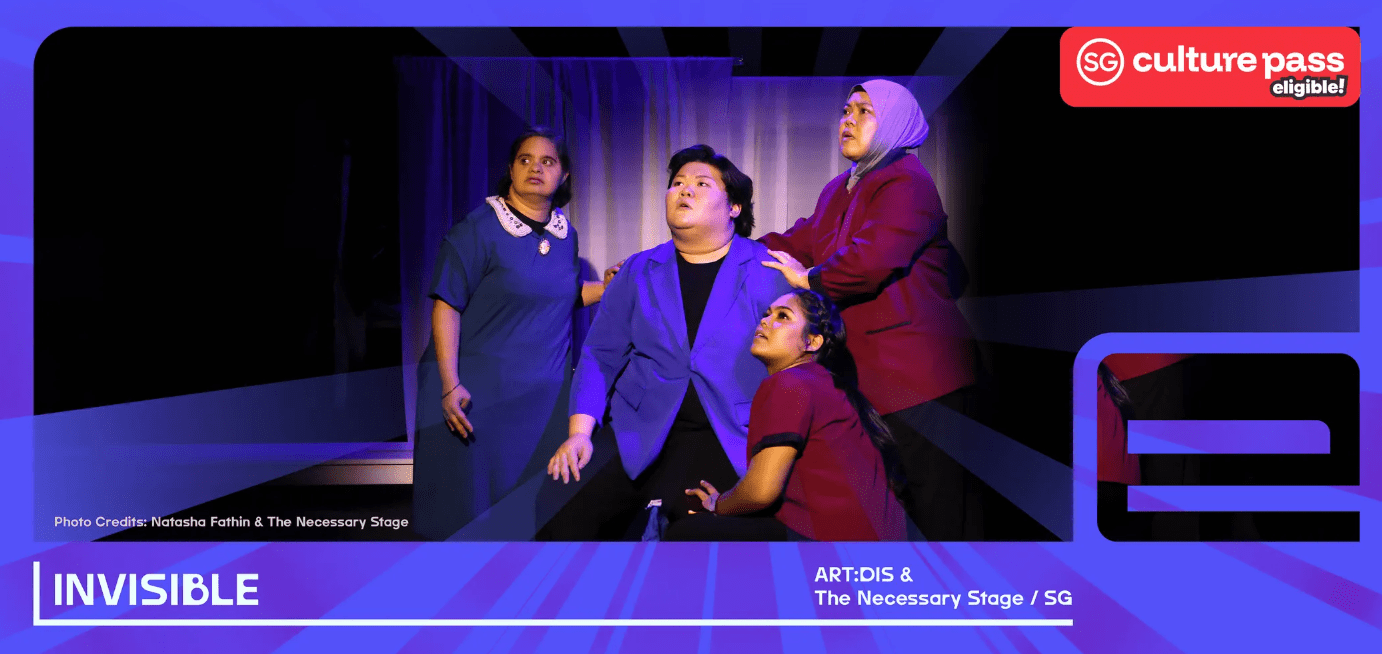
Set against the seemingly ordinary backdrop of a hotel workplace, Invisible begins with a simple premise: Malini, a young disabled woman, starts her new job as a cleaner determined to do well. When a guest’s prized possession goes missing, the incident sets off a chain of events that reveals the hidden struggles, quiet tensions, and unseen disabilities carried by those involved.
Written by award-winning playwright Haresh Sharma and co-directed by Sharma and Grace Kalaiselvi in collaboration with ART:DIS, Invisible is a nuanced exploration of disability, empathy, and the personal battles that often go unnoticed. Ahead of its presentation at Singapore Fringe Festival 2026, we spoke to co-directors Haresh and Grace, and star Jaspreet Kaur Sekhon about the play’s development, their collaborative process with disabled artists and communities, and the urgent questions the work raises about representation, access, and solidarity. Read the interview in full below:

Bakchormeeboy: How did this collaboration with ART:DIS begin, and why did TNS decide to stage it as part ofFringe 2026? What role did consultation or dialogue with disabled individuals and communities play in shaping the script or staging?
Haresh: The project began when ART:DIS invited Grace and I to stage a new work with Jaspreet. We have both worked with her on separate projects. In 2022, I created a work with her called My Life, My Story, based on Jaspreet’s life as a woman with down syndrome – her art and her activism.
For Invisible, I wanted to create a devised play where Jaspreet could perform with professional actors. At some point of the process, ART:DIS reached out to TNS to be a collaborator and co-presenter. We roped in Sindhu as Dramaturg and Deonn as performer, both of whom are our Associate Artists.
Bakchormeeboy: What were the sources of inspiration that brought out this story about disability within the context of a seemingly ordinary workplace like a hotel?
Haresh: I wanted to look at different types of disabilities, such as invisible disability. Amongst us, there are many people who struggle with issues without people around them knowing, such as friends and colleagues. How do they manage their day to day lives, especially at work?
I focused on certain issues including dyslexia and diabetes. I interviewed a woman whose struggle with diabetes affected her quality of life. During the process, I also discussed with Peter Sau, Grace, Jaspreet and Bindi (her mother) if the play should be just about issues related to down syndrome, and if Jaspreet should play a character with down syndrome. Because Jaspreet had already done that in our previous show, we decided to open up the narrative to include other types of disabilities.
Bakchormeeboy: Malini’s journey encapsulates both external conflict and internal struggle. How did you shape her character to reflect the experiences of disabled individuals without falling into cliché or pity narratives?
Grace: I believe the interviews conducted with people with disabilities in phase 1 helped in creating the narratives. And prior to our showing in May, we did check in with Peter Sau from ART:DIS on whether the way Malini’s character is shaped falls into the cliche or pity acting. He did share when it might cross the line and the way it was portrayed didn’t fall into such.
Haresh: One interesting aspect of this play is that the actors each play one main character and other supporting characters. The character of Malini is played by Roshini. Malini has some level of intellectual disability. She has been employed by a hotel to work in housekeeping but finds it difficult to adapt to the work culture. Jaspreet plays Anita, an affluent middle-aged woman whose inability to conceive has affected her mental health. She also runs a café that hires disabled people. We hope that the play will raise awareness of invisible disabilities and focus on the importance of solidarity.
Bakchormeeboy: For Jaspreet, how much input did you have?
Jaspreet: I felt very comfortable as the directors and fellow members of the cast treated me as an equal and not as someone who is differently abled.
Bakchormeeboy: How did co-directing influence the tone, sensitivity, and overall artistic approach of Invisible?
Grace: Interestingly, Haresh and I didn’t have many differences in the way we approached directing the play. We discussed along the way to involve Jaspreet in all aspects with the other actors in set and costume changes. Taking into consideration some of her limitations and also with a decision not to have her enabler, her mum Bindi on stage during the show, we ensured one actor is around her to guide her and still let her do the needful independently. Haresh and I also took turns to adjust the pacing of the rehearsal to ensure Jaspreet and her mum were able to follow the changes that took place like lines and blockings.
Bakchormeeboy: The play deals with “unseen battles.” What hidden struggles within society were most important for you to spotlight? What do you feel are the biggest issues society still is grappling with today?
Haresh: I feel that there are many unseen battles people struggle with. That was also the point of writing this play. I wanted a different entry point into how we can widen our view on disability. As I was writing the play, I googled ‘invisible disability’. I was shocked at the number of ailments that appeared in the search. It made me realise that many people may be struggling silently, unable to speak up or even get help because of society’s lack of understanding or awareness.
Grace: Not knowing how to respond and communicate with people with ‘unseen battles’. Some are still ignorant. Some are aware but unsure on how to empathise.
Bakchormeeboy:The tension between Malini and Anita is a catalyst for deeper revelations. What does their relationship reveal about societal expectations and misunderstandings around disability?
Grace: The play has changed slightly in terms of Malini and Anita’s relationship. Not so much of tension between the two of them. Anita is aware from the beginning about Malini’s condition.
Bakchormeeboy: For Jaspreet, how did you emotionally and physically prepare for portraying characters facing or embodying disability-related challenges?
Jaspreet: I used my lived experiences as a person with a learning disability.
As a self-advocate interacting with the community and addressing their attitudes helped.
My experience in the monologue My Life, My Story also helped to prepare for the emotions for my character Anita.
Bakchormeeboy: How do you hope this production contributes to ongoing conversations in Singapore about accessibility, stigma, and the rights of disabled people?
Grace: I hope this production allows audience to have a peek and understand people with difference aspects of struggles in life. And that in itself would contribute to ongoing conversations about accessibility, stigma and rights of people with disability.
Haresh: Discussions with Peter from ART:DIS were crucial in the way I decided to approach the play. Over the past few years, he has invited me to work with the ART:DIS artists – creating a play with Jaspreet, conducting devising workshops, speaking to disabled students and so on. I have had the opportunity to watch performances and showcases created/presented by other artists, and have learnt a lot about disability arts.
I hope that this work will continue to push the conversations about arts and disability more into the mainstream. How do we define disability? How do we represent disability on stage? How do we work with disabled artists? How do we create better access for disabled audiences? How do we create more awareness about disability for the mainstream audience? These are important questions that Singapore theatre can and should focus on.
Photo Credit: The Necessary Stage
Invisible plays from 21st to 25th January 2026 at the Esplanade Theatre Studio. Tickets available here
Singapore Fringe Festival 2026 runs from 15th to 25th January 2026. Tickets and more information available here
Support the Fringe by donating to The Necessary Stage here
 Bakchormeeboy