
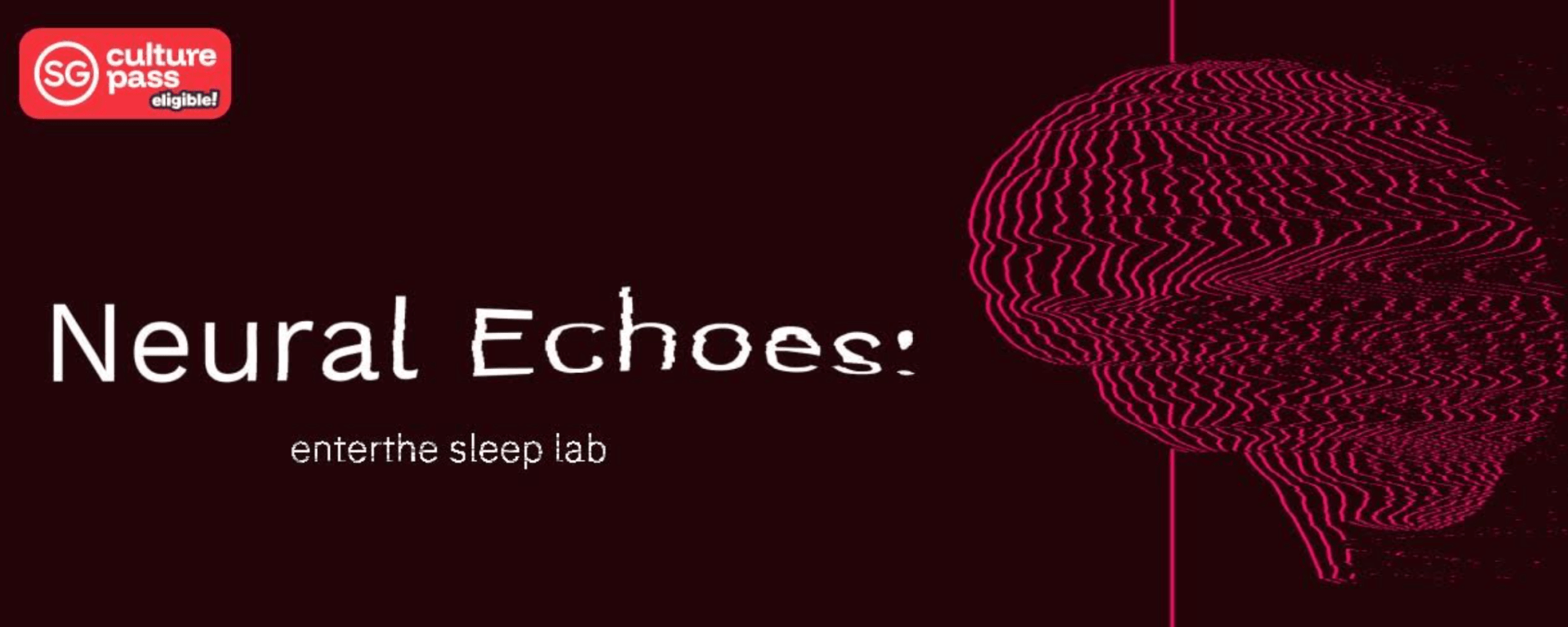
In a dimly lit room, a calm voice welcomes you to SomniTech’s Sleep Lab. You’ve been selected to participate in a cutting-edge clinical trial—one that promises to optimise your rest, enhance productivity, and unlock the hidden potential of sleep itself. But there’s a catch: previous participants never left.
This is the unsettling premise of Neural Echoes: Enter the Sleep Lab, a 50-minute immersive, narrative-driven experience that blurs the lines between literature, theatre, and escape-room gameplay. Designed for groups of four to six, it invites participants to go undercover as test subjects in a near-future research facility—one where sound guides your actions, technology watches your every move, and the truth is hidden somewhere between wakefulness and dreams.
SomniTech, the fictional corporation at the centre of the experience, represents an all-too-believable future: a world where sleep is no longer sacred and untouchable, but productive, optimised, and monetised. Using Brain–Computer Interfaces and experimental dream-tracking systems, the company claims it can map susceptibility, guide sleep states, and deliver precise auditory instructions straight into the subconscious.
The company’s visionary founder, Dr Adrian Tan, has since disappeared, along with multiple clinical trial participants. As a new recruit, you’re tasked with navigating controlled assessments, solving puzzles embedded in the environment, and uncovering what really happened behind the lab’s closed doors.
What sets Neural Echoes apart is its literary DNA. The experience is adapted from The Book of Red Shadows by Singaporean science fiction writer Victor Fernando R. Ocampo, originally conceived as a play-by-email narrative for the Singapore Writers Festival in 2020. “It was actually meant to be a novel,” Ocampo shared. “But when COVID hit, I was approached to see if it could become something more interactive. That idea eventually took on a life of its own.”
That life now exists in physical space. Led by digital storytelling studio Tusitala, the project brings narrative off the page and into an environment where participants will inhabit the world of the story.
There are no actors guiding you through the experience. Instead, sound becomes the main authority. From whispered instructions to layered soundscapes and original musical compositions, audio is what moves the story forward. Participants must listen closely to progress, making decisions based on tone, rhythm, and subtle cues.
This audio-first approach comes from Artwave Studio, co-founded by sound designers Ng Sze Min and Pan Zai’En, who were drawn to the challenge of creating liveness without live performers. “We pushed the dimensions of text,” they explain. “You’ll meet characters through sound, solve puzzles by listening, and experience a space that feels like it’s responding to you.”
It’s an unsettling reminder of how easily we surrender control to voices we trust—whether from smart devices, guided meditations, or algorithmic systems promising a better version of ourselves.
The idea for Neural Echoes emerged partly from frustration. Christine Chong, founder of Tusitala and the project’s creative producer, described feeling irritated by the rise of expensive but hollow immersive experiences post-COVID. “People were paying a lot for experiences that felt very ‘meh’,” she said. “Meanwhile, theatre makers were creating far richer work, but struggling to draw audiences.”
That irritation, combined with an empty office space and a desire to experiment, sparked a question: Could immersive theatre be built using everyday technology, without actors, and without massive budgets?
The answer involved smart devices, automation software, and a heavy reliance on sound. Lighting cues, IoT elements, and puzzle mechanics are all triggered automatically, creating a tightly controlled environment that feels eerily alive.
Scenographer Yeo Ker Siang approached the space less like a theatrical set and more like a psychological landscape. Rather than futuristic sci-fi spectacle, the design draws inspiration from films like Brazil and late-80s speculative cinema—worlds that feel just close enough to our own to be believable.
Office furniture, LED light tubes, medical props, and everyday objects are arranged to subtly guide behaviour. Participants instinctively know what to touch, where to stand, and how to move without ever being explicitly told. “When things feel possible, people behave differently,” Yeo explained. “That’s where the tension comes from.”
While Neural Echoes has puzzles and a clear objective, it resists tidy conclusions. There’s no single “correct” ending, and no definitive explanation handed to participants at the end.
Instead, the experience lingers. It asks uncomfortable questions about biohacking, self-optimisation, collective decision-making, and how easily ideology can be delivered through sound. It also invites reflection on the growing role of AI and automation in our most intimate spaces, including sleep. As Chong puts it, “We wanted participants to navigate individuality and consensus—to see how collective choices might shape our future with technology.”
If you’re drawn to literary experiments that stretch beyond the page, intrigued by immersive theatre or escape rooms, or fascinated by the promises and perils of sleep technology, AI, and speculative futures, Neural Echoes: Enter the Sleep Lab is likely to speak to you. It also works simply as a distinctive night out—one that stimulates the mind as much as it entertains. What it offers is a rare encounter: playful yet unsettling, immersive yet quietly reflective. Just don’t expect to fall asleep after.
Neural Echoes: Enter the Sleep Lab runs from 9th January to 7th February 2026 at The Arts House. Tickets available from BookMyShow
 Bakchormeeboy