
In Singapore, childhood discipline occupies a peculiar and uneasy place in collective memory. Rooted in the belief that hardship cultivates virtue, physical discipline was long distinguished from punishment. It was framed as care, as moral instruction, as a necessary measure for shaping obedience and respectability. Yet for those who experienced it, the body remembers pain before it remembers reason.
In their new exhibition, artists Yanyun Chen and Dave Lim return to this terrain not to accuse or absolve, but instead to sit with its contradictions. Their collaborative work traces how domestic discipline, particularly caning, lingers in the body long after its justifications have faded, and how humour often emerges as a coping mechanism in retrospect.

Fear is softened by laughter. Pain is retold as anecdote. Parents forget. Children remember, but learn to laugh along. How does one make sense of these contradictory feelings and memories? Together, Chen and Lim examine what over-compliance looks like when it is learned early, rehearsed daily, and later internalised as resilience.
While Yanyun recalls plenty of firsthand experience being hit by a ruler or by hand as a child (certainly less severe than her own mother’s experience with the cane), Lim’s upbringing was untouched by physical discipline. His position offered a vantage point from outside the experience. That distance becomes a counterpoint to a generation marked by it, allowing the work to hold both proximity and remove, intimacy and observation.

The collaboration proved essential in responding to the site itself: a literal tunnel connecting CityLink Mall to the Esplanade. Ordinarily, it is a transitional space, one that commuters pass through without thought, eyes forward, pace steady. It exists to connect rather than to hold attention. In this sense, it mirrors how childhood discipline often sits in memory: present, formative, yet rarely paused over.
“This is my first artwork in such a public space,” said Yanyun. “Dave has done more public art works, so he really understands the dynamics of these spaces and how immersion works within them.”

Rather than treating the tunnel as a neutral backdrop, the artists activate it as a structural analogue for discipline itself. Linear, unavoidable, and governed by conditions not of the subject’s choosing, the space enforces movement. Structural pillars interrupt sightlines, and strict limitations on sound, light, and safety narrow what is possible. These constraints shape the exhibition’s form and also echo the asymmetries of power embedded in childhood discipline, where compliance is learned through endurance rather than consent.
The walls of the tunnel are coated in blackboard-like paint, transforming the passageway into a surface for chalk drawings and inscriptions. These drawings, completed with the help of Yanyun and Dave’s family and friends, depict the rattan plant growing across the wall. The act of drawing together becomes quietly charged: a collective processing of family trauma enacted within a public thoroughfare. The familiar act of passing through is disrupted, replaced by an invitation to slow down, to linger, to look.

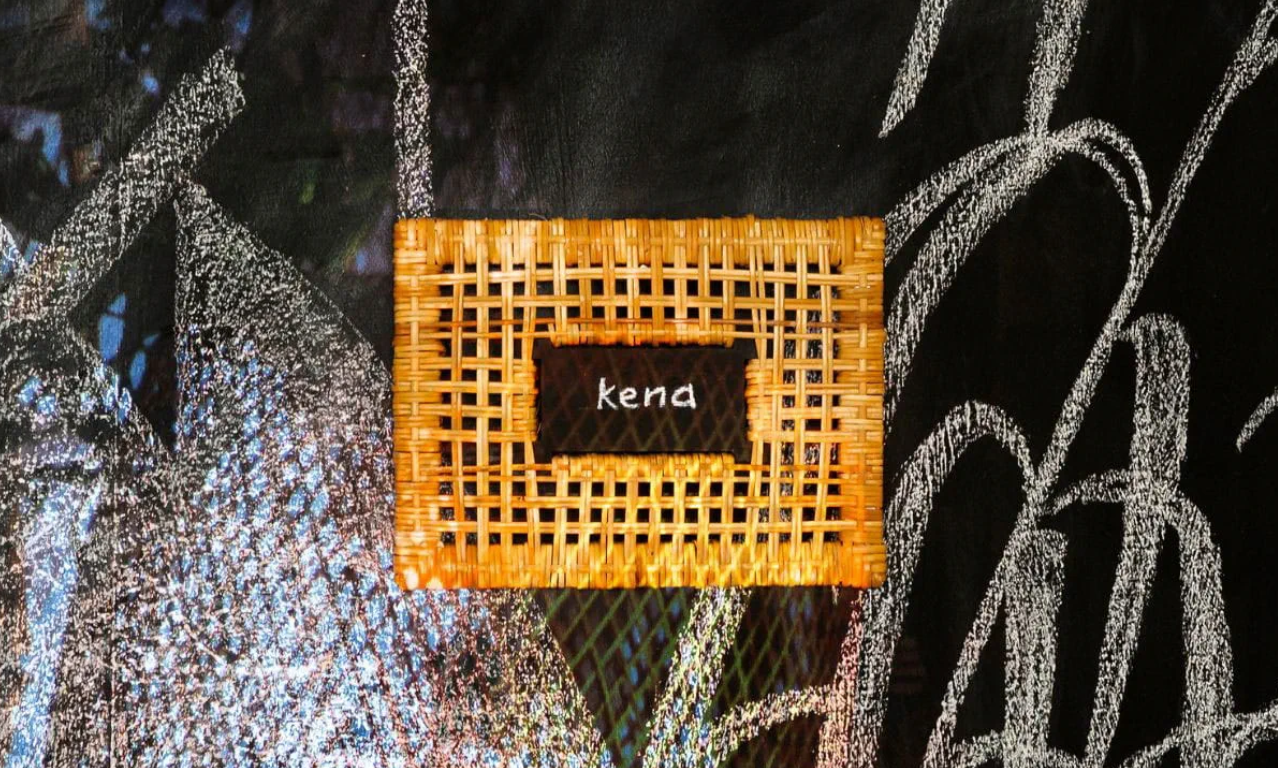
Alongside the drawings hang woven rattan frames, painstakingly crafted by Yanyun after two and a half years of training with a master rattan weaver. Small in scale yet dense with tension, each frame is held together by knots and technique. In places, the rattan appears to strain against its form, bending and buckling as if attempting to escape containment. Rattan, the same material used to make canes, becomes both medium and metaphor for resilience, pain, and how our selves were shaped through force.
Embedded within these woven frames are black rectangular chalkboard panels bearing words and phrases across multiple languages: English, Mandarin, Malay, Sinhala, Singlish. Familiar justifications surface alongside accusations and commands. “为你好” (for your own good). “不打不成器” (spare the rod and spoil the child). “Tahan” set against “whack.” “Si kin na” beside “mm zai si.” “Orh hor” alongside “orbigood.” Together, these fragments trace the mental negotiations that surround caning, revealing the linguistic scaffolding that normalises violence while reframing it as care.

Lim’s contribution extends this inquiry through film and documentation. He recorded acts of cleaning and caring for rattan, projecting these gestures onto the walls. A single framed image of a rattan stalk reaching skyward anchors the work. Growing up to thirty or forty metres over three years, armoured with spikes, the rattan plant embodies both vulnerability and threat.
As viewers move further along the tunnel, the work shifts from material to gesture, from object to memory. Two images of hand gestures appear on gauze-like cloth, flickering and semi-transparent, as if suspended between presence and disappearance. Nearby, a chalk-written dialogue unfolds across the wall: a conversation Yanyun had with her family at dinner, imagining how two children might speak about caning, and how two adults might later reflect on its significance. The text can be read vertically or horizontally, forming a twin cinema, non-linear poem. Detached in tone and strangely tender, it suggests how distance alters pain, allowing it to be absorbed into the rhythms of everyday life.

Further along, a quote drawn from a survey of adults who were caned as children speaks of fear, of not knowing when the punishment would end, of simply wanting it to stop. Beside it, two video screens play in parallel. One cycles rapidly through hand gestures associated with scolding, sharp and repetitive. The other lingers on footage of the rattan plant. The juxtaposition draws attention to repetition as both violence and training, the body learning through rhythm and restraint.
“We were quite lucky to be able to turn the wall into a giant blackboard,” said Yanyun, “to work with chalk drawings, and then light it in a way where you enter with light, move into darkness, and then exit with light. For me, I was thinking about it as a narrative and the experience of that narrative.”

Lighting and sound work together to alter perception. Low light slows movement and heightens bodily awareness. Water flows softly. Recorded voices recount experiences of physical discipline, while elsewhere those same voices dissolve into abstraction, becoming rhythm rather than speech. The tunnel no longer functions as a shortcut, but as a threshold into a different state of attention.
Importantly, the exhibition can be entered from either end. Depending on one’s point of entry, the work may feel like a confrontation with fear or a reflective return to it. This bidirectionality resists a fixed narrative, mirroring how memories of childhood violence are revisited and reframed over time. Trauma here is not linear as the tunnel suggests, but cyclical and two-way, a back and forth internal conversation that resurfaces differently across life stages. For adults who experienced caning, the work may reopen bodily memory. For children passing through, it gestures toward a future shaped by inherited practices.

The tunnel enforces passage. There is no escape, only movement forward. Viewers become captive audiences, compelled to confront the work whether they choose to or not. This condition echoes the dynamics of childhood discipline itself, where refusal is rarely an option and endurance becomes the only available response. “When you walk through a space, you’re not standing still,” said Yanyun. “So we had to think about what draws you in, what shocks you, what makes you walk faster or slower.”
Caning appears here not as spectacle, but as residue. The exhibition draws on three years of research and making, including Yanyun’s apprenticeship with a master rattan weaver. Processes of soaking, softening, and weaving echo cycles of harm and care, punishment and sayang. Throughout the space, gestures repeat without resolution. The story fractures. Memory persists. “I wanted to talk about something that’s tricky or even taboo,” said Yanyun. “You’re stuck with it in that moment of time.”

The exhibition is not looking for a proper resolution. Instead, it asks visitors to slow down, to remain present, and to confront an experience that is at once deeply personal and culturally pervasive. In transforming a space of passage into one of reflection, Dave and Yanyun Lim force a reckoning with a form of violence often dismissed as formative or necessary.
“The body remembers even when the story doesn’t,” said Yanyun. “As much as it’s part of my ‘Family Stories’ series, this isn’t just my family’s story. It’s a collective story drawn from friends, the community, and Singapore Children’s Society. It’s everyone’s story coming together in this space.”

In Singapore, caning is often recalled with laughter, jokes shared across generations, even by parents who once administered it. Violence is minimised through repetition and time, rendered bearable through wit. What remains is awareness: quiet, embodied, and unresolved. In a society shaped by over-compliance, this work offers a rare interruption, a moment to consider how discipline lives on in posture, memory, humour, and habit, and how its future might yet be reimagined.
Rotan Rattan: Meditations is on display at the Esplanade Tunnel till 8th March 2026. More information available here
 Bakchormeeboy