
Unexpectedly tender production offers an accessible, educational glimpse at hidden disabilities.
As much as Singapore has made visible efforts to dispel myths around disability and create space for greater awareness, the hard truth is that many persons with disabilities (PwDs) still feel out of place in a world designed primarily for the non-disabled. Being labelled ‘disabled’ often comes with the fear of being perceived as a burden or as abnormal. It is no wonder, then, that there exists a quiet pressure for PwDs to constantly ‘pull their weight’, to prove usefulness, to contribute, or to keep silent about their conditions altogether, lest they be seen as anything less than capable.

Tackling this unseen pressure are ART:DIS and The Necessary Stage, who join forces to stage Invisible as part of the Singapore Fringe Festival 2026. Both companies are no strangers to issues of disability and accessibility: ART:DIS is Singapore’s foremost advocate for PwDs in the arts, while The Necessary Stage has long centred marginalised voices and social issues in its work. Invisible brings together disabled and non-disabled artists and creatives to address invisible disabilities with care and sensitivity, resisting spectacle or pity in favour of grounded, human storytelling.

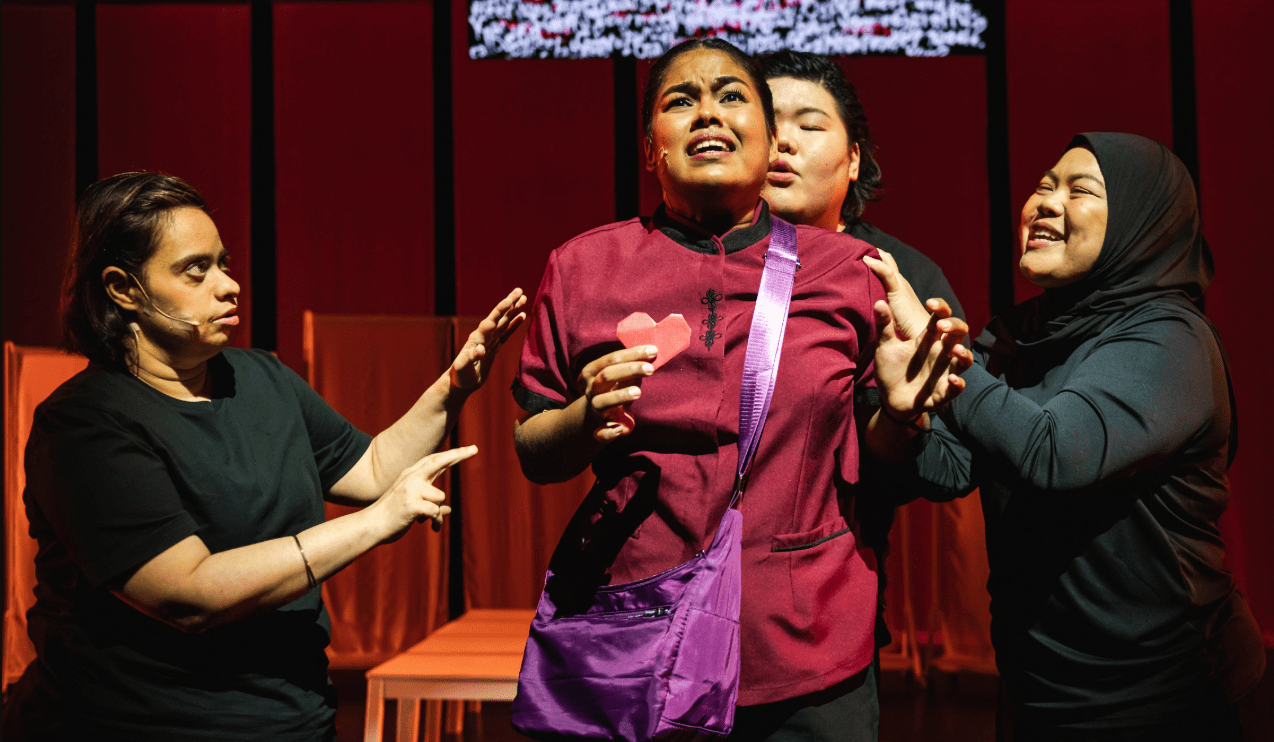
Invisible follows the lives of four women working in and around a hotel. Malini (newcomer Periyachi Roshini) is an optimistic young disabled woman starting her new job as a cleaner. Under the supervision of Safiah (Dalifah Shahril) and the watchful eye of hotel manager Jane (Deonn Yang), tensions arise when guest Anita (Jaspreet Kaur Sekhon) misplaces a prized possession. The incident itself is almost petty in scale, but it functions primarily as a narrative device, a pressure point that allows the women’s hidden insecurities, fears, and histories to surface over the course of the play.

Written by Haresh Sharma and co-directed by Sharma and Grace Kalaiselvi, Invisible is a surprisingly tender portrayal of disability. It never exploits difference for sympathy’s sake, instead offering four fully realised characters whose struggles feel specific and lived-in. Through a series of interwoven scenes and backstories, the play explores issues ranging from parents hiding diabetes from their children out of guilt, to the emotional toll of being a disabled parent raising a disabled child. While all the backstories are clearly laid out, some prove more compelling than others, yet even the less resonant threads contribute to the larger emotional tapestry of the work.

These moments are written with a directness that occasionally borders on the obvious, with a handful of lines spelling out their themes a little too neatly. Still, the writing largely avoids becoming didactic, favouring emotional clarity over moral instruction. At its best, Invisible trusts the audience to sit with discomfort and recognise familiar patterns of shame, fear, and self-blame without being told exactly what to think.

The production often finds its most evocative moments when it leans into theatrical abstraction. Anita’s backstory, for instance, blends realism with the myth of Ganesha’s birth to reflect her struggles with infertility. As Anita, Jaspreet Kaur Sekhon performs with quiet assurance, allowing her body to speak when words fall short. Under Ruby Jayaseelan’s movement direction, small gestures, outstretched arms, closed eyes, moments of stillness, become powerful expressions of longing and loss.

Staging-wise, Invisible remains accessible even to those new to theatre, while demonstrating a thoughtful use of form. The cast frequently describes their actions aloud, whether changing costumes or reconfiguring the modular set of white benches and curtained frames. These structures shift fluidly: at times forming crushing mental walls, at others opening up to widen the stage. The hotel setting itself, however, feels largely functional rather than deeply interrogated, a convenient frame to bring the characters together rather than a space whose labour hierarchies and invisibilities are fully explored.

Behind the scenes, Faith Liu Yong Huay’s lighting design creates striking illusions, at times resembling three-dimensional foliage behind translucent screens, lending an abstract yet arresting quality to the visuals. Bani Haykal’s sound design ranges from mythic, epic textures to softer compositions that land with devastating emotional precision, supporting the play’s shifts between realism and interiority.

Deonn Yang and Periyachi Roshini both deliver quietly assured performances that round out the emotional landscape of the play. As Jane, Deonn conveys the strain of suppressing and managing her own vulnerabilities, shaped by a background of parental ignorance and denial. Much of her conflict surfaces in restrained gestures and control. Roshini, as Malini, brings warmth and sincerity to a character whose central struggle lies in questions of lovability. Her open expressions and earnest delivery make Malini’s desire to be seen as capable and deserving feel deeply human rather than naïve.

But among the cast, Dalifah Shahril shoulders some of the heaviest emotional weight and emerges as the production’s strongest presence. As Safiah, a woman who hides her dyslexia and carries deep-seated shame, Dalifah charts a painful emotional arc when her daughter is born with disabilities. Watching her confront the very prejudices she endured as a child, fear etched across her face, her composure slowly crumbling, is quietly harrowing. Her performance captures the exhaustion of caregiving, the terror of lifelong responsibility, and the cruelty of inherited stigma.

True to its title, Invisible extends beyond unseen disabilities alone. It gestures towards the guilt and shame that compel some PwDs to make themselves smaller or invisible, as well as the expectation for certain forms of labour, such as hotel cleaning and motherhood, to go unnoticed. There are also softer undercurrents of care running through the play. Safiah and Anita’s stories, in particular, reflect anxieties about inheritance, responsibility, and the fear of passing on pain. While Invisible is not explicitly about womanhood, its focus on maternal endurance and protection adds another emotional layer to its exploration of disability.

Supported by accessibility collaborators such as Claire Teo and captioner Natalie Linn Titus, Invisible ultimately works best as an educational piece that knows its audience. It is the kind of theatre well-suited for wider community or school settings, presenting complex social issues in a clear, elegant, and emotionally grounded way. As a collaboration between ART:DIS and The Necessary Stage, it represents a meeting of values and strengths, resulting in a work that neither company could have achieved alone.

In its final moments, the cast breaks the fourth wall one last time, standing still and meeting the audience’s gaze. The gesture is familiar, but it delivers its message with sincerity, underscoring the play’s central plea for empathy and openness. Invisible may feel a little simple in its structure and techniques, but these are executed with enough imagination, conviction, and even a little humour that buoys its heavier moments. This is a play that does not offer easy resolutions, but it reminds us that shame thrives in silence, and that healing begins, however slowly, when we no longer have to hide.
Photo Credit: Tuckys Photography
Invisible played from 21st to 25th January 2026 at the Esplanade Theatre Studio. More information available here
Singapore Fringe Festival 2026 ran from 15th to 25th January 2026. Tickets and more information available here
Support the Fringe by donating to The Necessary Stage here
Production Credits
| Playwright/Co-director Haresh Sharma Co-director Grace Kalaiselvi Cast Dalifah Shahril, Deonn Yang, Jaspreet Kaur Sekhon, Periyachi Roshini Dramaturg Sindhura Kalidas Movement Director Ruby Jayaseelan Sound Artist Bani Haykal Lighting Designer Faith Liu Yong Huay Creative Access Collaborator Claire Teo Creative Narrator (Phase 2) Su Paing Tun Creative Captioner Natalie Linn Titus |
 Bakchormeeboy