
Good intentions, bad habits, and a whole lot of slapstick in this Singapore-Thai Chinese New Year release.
There is something ironic about a film called 3 Good Guys opening on three men who are, by most measures, failing spectacularly as romantic partners. In the familiar tradition of the Chinese New Year movie, goodness here is not a given but something to be learned by the end of the film; through chaos, humiliation, and an excess of slapstick, before the credits can roll.
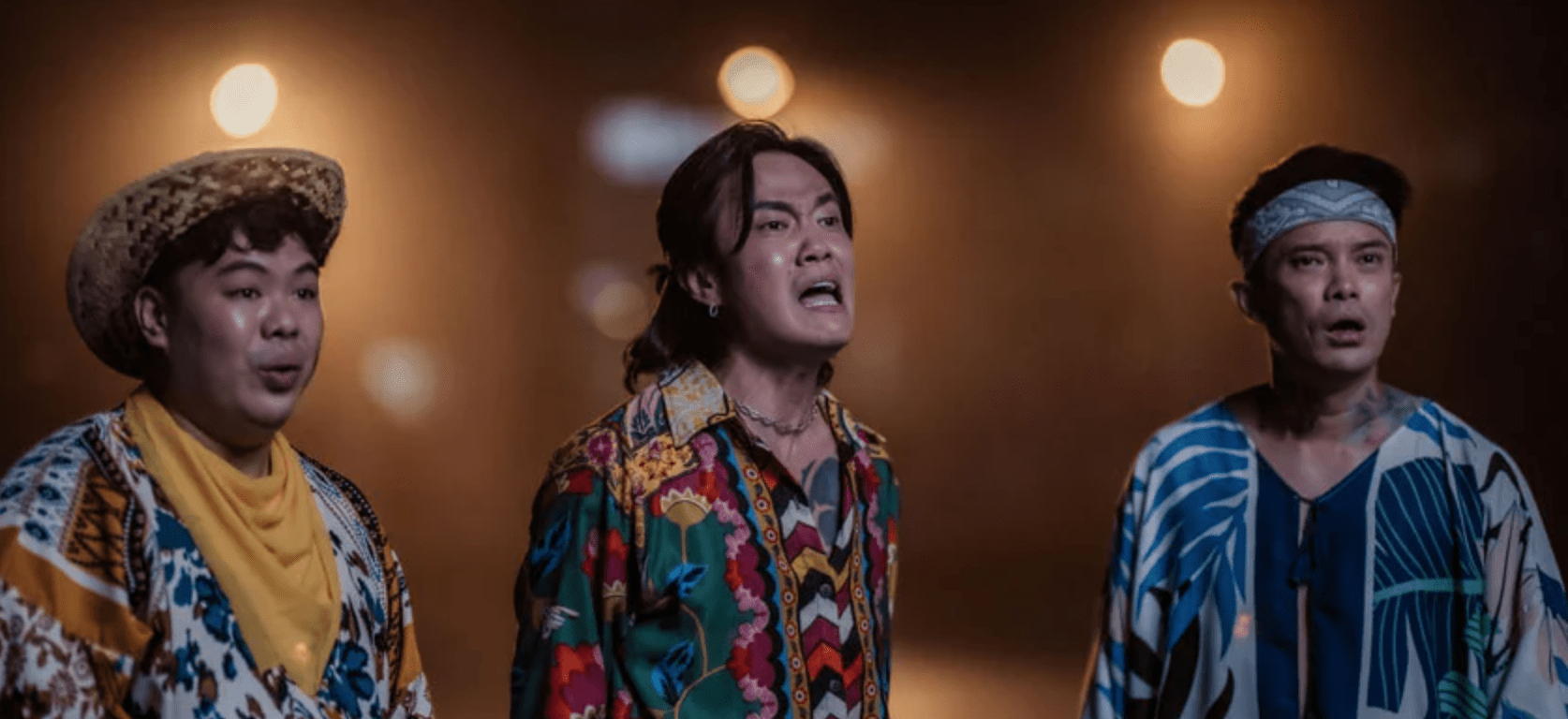
A Singapore–Thailand co-production, 3 Good Guys follows three men at various stages of romantic and marital disrepair. Jeremy (Simonboy), on the brink of marriage, is in love with a woman whose mother disapproves of him, echoing the tragic Thai folk tale of Kwan and Riam. His two closest friends reflect his anxieties in different ways: Mike (Tommy Wong) is locked in a marriage defined by constant tension, while Ah Bao (Mayiduo) desperately wants to start a family but remains wilfully blind to what his wife actually wants. Seeking luck and clarity, the trio pray at the Shrine of Kwan and Riam, only to end the night drinking instead. From there, the film plunges them into a surreal dreamscape where they are forced to confront their shortcomings as husbands, tasked to reignite the spark and get their wives’ consciousness to tell them ‘I love you’ before they’re trapped in the dream forever.

By now, the Chinese New Year movie has become a genre unto itself, complete with its own rhythms and expectations. 3 Good Guys understands these conventions well: escalating absurdity, broad comedy, and the promise that all emotional messes will be tidied up by the end. Here, the lesson revolves around marriage and emotional neglect, though the path to enlightenment is anything but subtle. Stylistically, the film feels like a throwback to early-2000s comedies, toeing a very fine line between misogyny and something that gestures towards feminism. The men are punished by being transported into their wives’ dreams, where exaggerated trials: menstruation, pregnancy, and the recurring indignity of losing one’s clothes, are meant to instil empathy. These scenarios rarely make sense beyond facilitating gross visual gags, and after an initially energetic chase, the dream world’s internal logic largely dissolves.
The comedy is broad, cringey, and relentlessly slapstick, but there is also an undeniable audacity to it. In this dream world, the wives emerge in skintight bodysuits like high-heeled secret agents, granted genuinely badass moments of agency, while their husbands attempt to fend them off with pepper. It’s silly, excessive, and often tasteless, but occasionally effective precisely because of how far it is willing to push its own joke.

The three male leads, themselves social media influencers, fully commit to this absurdity. Mayiduo’s Ah Bao brings bumbling physical humour, frequently serving as the butt of the joke due to his complete obliviousness. Tommy Wong plays Mike, the tough, emotionally guarded member of the trio, whose arc predictably nudges him toward sensitivity. Simonboy, controversial off-screen, is positioned squarely as the film’s emotional centre in Jeremy. For reasons that remain curious, 3 Good Guys also insists on framing him as a sex symbol: he is the one who repeatedly loses his clothes and is even given an extended sequence cross-dressing in skimpy go-go attire. Whatever the intent, all three leans into their roles, and all three men appear to be having genuine fun by embracing the film’s sheer ridiculousness.
If the men dominate the screen time, it is the women who carry the emotional weight. Fah Chatchaya, Grace Teo, and Germaine Chow play wives worn down by neglect and frustration. Though given fewer lines, they rely on tone and physicality to convey their dissatisfaction, and in doing so, the film is clear about where our sympathies should lie, and who truly needs to do the learning.

Much of the script remains undeniably strange. Otherworldly logic rules here, where Ananda Everingham appears as a guru-like presence spouting philosophical platitudes meant to contextualise the men’s journey. At times, 3 Good Guys begins to resemble a Greek sex comedy or even a warped echo of A Midsummer Night’s Dream, if the Mechanicals were Chinese men stumbling through a supernatural morality play. A jarringly unsubtle collagen product placement only adds to the sense that nothing here is meant to be taken too seriously.
Director Boi Kwong’s strengths lie less in narrative coherence than in his instinct for comedic pacing. The energy rarely lets up, and the film barrels forward like a madcap adventure, leaving little room for boredom. By the time 3 Good Guys reaches its conclusion, even if the journey has been frustrating and messy, the emotional payoff somehow lands. You find yourself hoping, perhaps optimistically, that these “good guys” have learned to be better husbands by the end of it.
Ultimately, 3 Good Guys feels designed for communal viewing during Chinese New Year: something that can play in the background while relatives drift in and out of the room, where you can miss scenes without losing the plot, laugh at the audacity, and enjoy the shared experience. It is not subtle, nor is it particularly progressive, but it is energetic and geared toward joy, as evidenced by the audience laughter.
And in a year that will see an unusually large number of local films released, that counts for something. Even if not every film fully works, the sheer volume signals an increasingly confident and flourishing local film industry. Supporting local cinema means allowing space for these messy, excessive, and imperfect stories to exist, and to keep bringing audiences together in laughter, however absurd that laughter may be.
3 Good Guys opens 12th February in Singapore, in cinemas such as Golden Village
 Bakchormeeboy