
Polite company quickly gives way to violent, yet cathartic truth in Nine Years Theatre’s God of Carnage.
It begins, as so many civilised disasters do, with good intentions. A carefully drafted statement, coffee and cake, and adults determined to behave. In Yasmina Reza’s God of Carnage, politeness is not resolution but provocation, and in Nine Years Theatre’s staging in Mandarin, that provocation unfolds with a slow, almost compulsive inevitability. What initially feels measured and contained gradually reveals itself as something far more volatile, an itch that cannot be ignored, only scratched until it draws blood.
Directed by Nelson Chia, with a script translated by Gong Baorong, the play unfolds within a single living room. In the aftermath of a fight between two eleven year olds, Bryan and Felix, their parents meet to resolve the matter civilly. Veronica and Michael (Mia Chee and Tay Kong Hui), and Alan and Annette (Cavin Soh and Oon Shu An), begin with shared intentions, but the encounter quickly stretches beyond mediation into an excavation of ego, class, ideology, and marriage. Staged in a thrust configuration at Wild Rice Theatre, the audience surrounds the action at close range. There is no safe distance. Every glance, every hesitation, every recalibration of allegiance is exposed, implicating the audience in the discomfort.
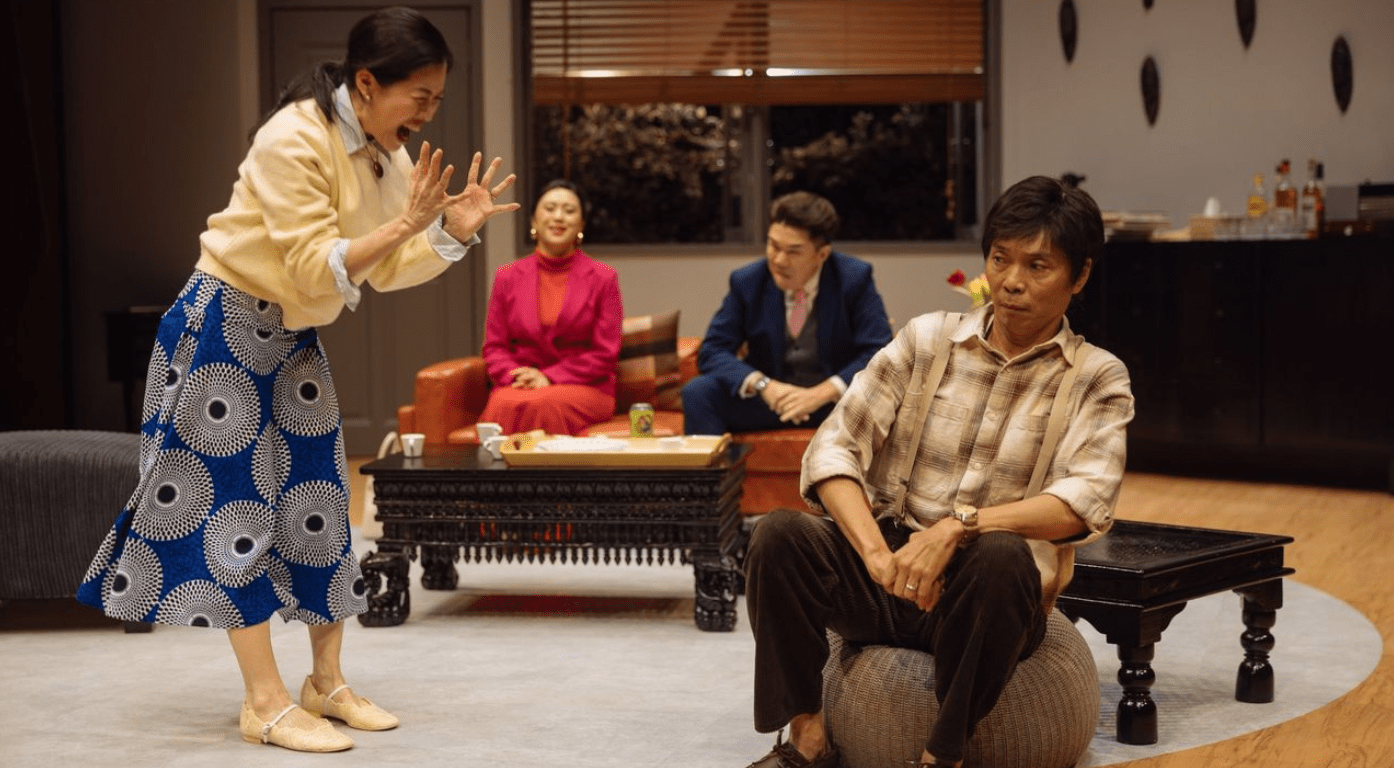
Wong Chee Wai’s set reinforces this tension between surface and fracture. The very aesthetic living room is meticulously composed, anchored by a stark white wall and adorned with African-inspired masks and artwork that gesture toward a curated identity of culture and taste. Yet when the lighting fully reveals the space, jagged edges above expose rows of blackened masks looming overhead. They feel less decorative than watchful. What begins as aesthetic detail grows increasingly unsettling, suggesting not only the personas the characters present, but something more primal beneath. As the evening progresses, the space itself seems to close in, as though these darker impulses have always been present, waiting for permission to emerge.

That sense of pressure is embedded in the script’s structure. Early exchanges feel slightly forced, as though the characters are performing politeness rather than inhabiting it. This strain becomes the engine of the play. Conversations circle the same fault lines, returning repeatedly to the boys’ fight, reframed from fact to interpretation to moral positioning. Responsibility is passed back and forth, while language itself becomes a battleground. Seemingly trivial details accumulate, from the fruit cake to offhand remarks about parenting, each one pushing the exchange further off balance. Attempts to finalise the written statement only reopen conflict, each revision undoing the last. What appears, on the surface, as repetition becomes something more insidious in performance. The characters are caught in a loop sustained by their own need to be right. Veronica’s exasperated insistence that the evening has become a “nightmare” lands not as exaggeration, but as recognition of the trap they have collectively constructed.
Nelson Chia’s direction meets this with quiet precision. Movement becomes a language of its own. Characters align, withdraw, circle, and close in on one another with careful modulation. Physical proximity signals fleeting alliances, or to physically divide two characters, while distance marks fracture and isolation. A particularly revealing moment occurs when Veronica and Michael clean together after Annette’s breakdown. In that brief intimacy, they bond through shared mockery, delighting in their exclusion of the other couple. The closeness feels conspiratorial, almost childish, and dissolves just as quickly when the dynamic shifts. These constant reconfigurations sustain tension within what is otherwise a densely verbal text, giving physical form to its emotional volatility.

Costume design by Audrey Tang sharpens these distinctions. Alan’s tailored suit and Annette’s striking pink ensemble suggest carefully constructed public identities, while Michael’s checked shirt and Veronica’s patterned skirt evoke a softer domestic image. Veronica’s costume subtly mirrors the aesthetic language of the set, aligning her with a self-fashioned identity rooted in cultural awareness and moral conviction. As the evening unfolds, these visual markers read less as identity and more as defence, surfaces that begin to strain under pressure.
The performances are finely calibrated, with each actor carving out a distinct trajectory. Mia Chee’s Veronica is anchored in unwavering conviction. She begins as articulate and principled, deeply invested in justice and moral clarity. Yet that conviction gradually calcifies into rigidity. Her insistence on doing what is “right” begins to alienate, then to provoke, and finally to expose a sharper, more hostile edge. Her unraveling is particularly compelling in moments where her composure fractures mid-argument, her voice tightening even as she insists on reason, revealing the aggression embedded within her certainty.

On the other hand, Tay Kong Hui’s Michael provides one of the evening’s most striking transformations. Initially genial and accommodating, he appears eager to keep the peace. Yet this affability carries an undercurrent of suppression. His growing impatience with Veronica’s moral posturing surfaces in small dismissals, before finding clearer expression when he breaks out the rum, a gesture that reads as both escape and invitation. From there, his restraint loosens. His casual admission of abandoning the family hamster lands with disarming ease, reframing his earlier warmth as performance. When he finally lets loose, there is a sense not of change, but of release, as though this more volatile self has been waiting beneath the surface all along.
Oon Shu An delivers the production’s most physically demanding performance as Annette, and commands it with remarkable control and weight. Her trajectory is marked by a series of escalating ruptures, beginning with the sudden vomiting across the carefully arranged books. The moment is shocking, but also oddly relieving, shattering the illusion of composure the evening has tried to maintain. What follows, from the insistence on drinking more, to the destruction of the tulips, pushes the play into a heightened absurdity. Yet within this escalation lies a sense of liberation. Her earlier restraint gives way to something freer, almost joyous, and the audience responds in kind, a collective exhale as she abandons the veneer she has been holding up.

Finally, Cavin Soh’s Alan operates on an entirely different frequency. Detached and persistently on his phone, he resists engagement even as he provokes it. His ongoing calls about a pharmaceutical case continue regardless of the escalating chaos around him, his tone unchanged. This dissonance becomes both comic and revealing. His detachment reads as its own form of aggression, one that withholds rather than confronts. When he does engage, it is with surgical precision, cutting through the others’ emotional arguments with a clarity that exposes their fragility. His nihilism is easy to detest, yet uncomfortably recognisable, reflecting a familiar impulse in Singaporeans to disengage rather than confront.
What sustains the production is its tonal balance. It is consistently, and often unexpectedly, funny. The humour emerges from accumulation, from the disproportion between cause and reaction. Minor irritations escalate into full confrontations, and the audience finds itself laughing even as the situation grows increasingly uncomfortable. As tensions rise, the characters begin to talk over one another, interrupt, and return to earlier grievances with renewed energy, as if the conflict itself has become sustaining. There is a strange pleasure in their antagonism. The unravelling is destructive, but also cathartic, a release from the constraints they have imposed upon themselves.

The use of Mandarin also sharpens this dynamic further. Compared to the elasticity of French or English, the language here feels direct and declarative. Even when delivered politely, the words land with precision. This creates a tension where civility exists in tone, while the content grows increasingly pointed. It reinforces the idea that politeness is not about what is said, but how it is framed, and how easily that framing can fracture.
The unseen children linger as a quiet but persistent presence. What begins as a playground incident gradually reveals itself as a mirror of adult behaviour. The parents debate ethics and responsibility, yet embody the very impulses they seek to correct. The boys’ violence begins to feel less like aberration and more like inheritance. Behaviour is modelled, absorbed, and repeated, collapsing the distinction between child and adult. By the final moments, the play returns to a quieter register. Veronica’s conversation with her daughter, in which she maintains the fiction that the hamster is fine, gestures toward continuity rather than resolution. Even after everything, the instinct to soften truth for comfort remains intact. Nothing has been resolved, only revealed.

In this way, God of Carnage feels endlessly analysable. It presents a world in which individuals cycle between restraint and release, searching for ways to cope within the suffocating expectations of civility. The living room becomes less a setting than a system, a kind of social hellscape where politeness and brutality coexist, each feeding the other. Nine Years Theatre’s production meets this with clarity and control. If the script risks circularity, the direction, design, and performances transform that repetition into tension. The result is a work that is as entertaining as it is disquieting, a sharp, unsettling reminder that beneath the structures we rely on to hold society together lies something far less stable, and far more recognisable.
Photo credit: Crispian, courtesy of Nine Years Theatre
God of Carnage plays from 20th to 29th March 2026 at The Ngee Ann Kongsi Theatre @ Wild Rice, Funan. Tickets available from SISTIC
Production Credits:
| Playwright Yasmina Reza Director Nelson Chia Script Translator Gong Baorong Producer Mia Chee Cast Mia Chee, Oon Shu An, Cavin Soh, Tay Kong Hui Set Design Wong Chee Wai Lighting Design Adrian Tan Sound Design Vick Low Costume Audrey Tang Hair Ashley Lim Production Manager Celestine Wong Stage Manager Keira Lee Assistant Stage Manager Lee Jia Min Props Master Daniel Sim (Prop-erly) Surtitle Operator Teo Pei Si |
 Bakchormeeboy
One thought on “★★★★★ Theatre Review: God of Carnage 《杀戮之神》by Nine Years Theatre”