
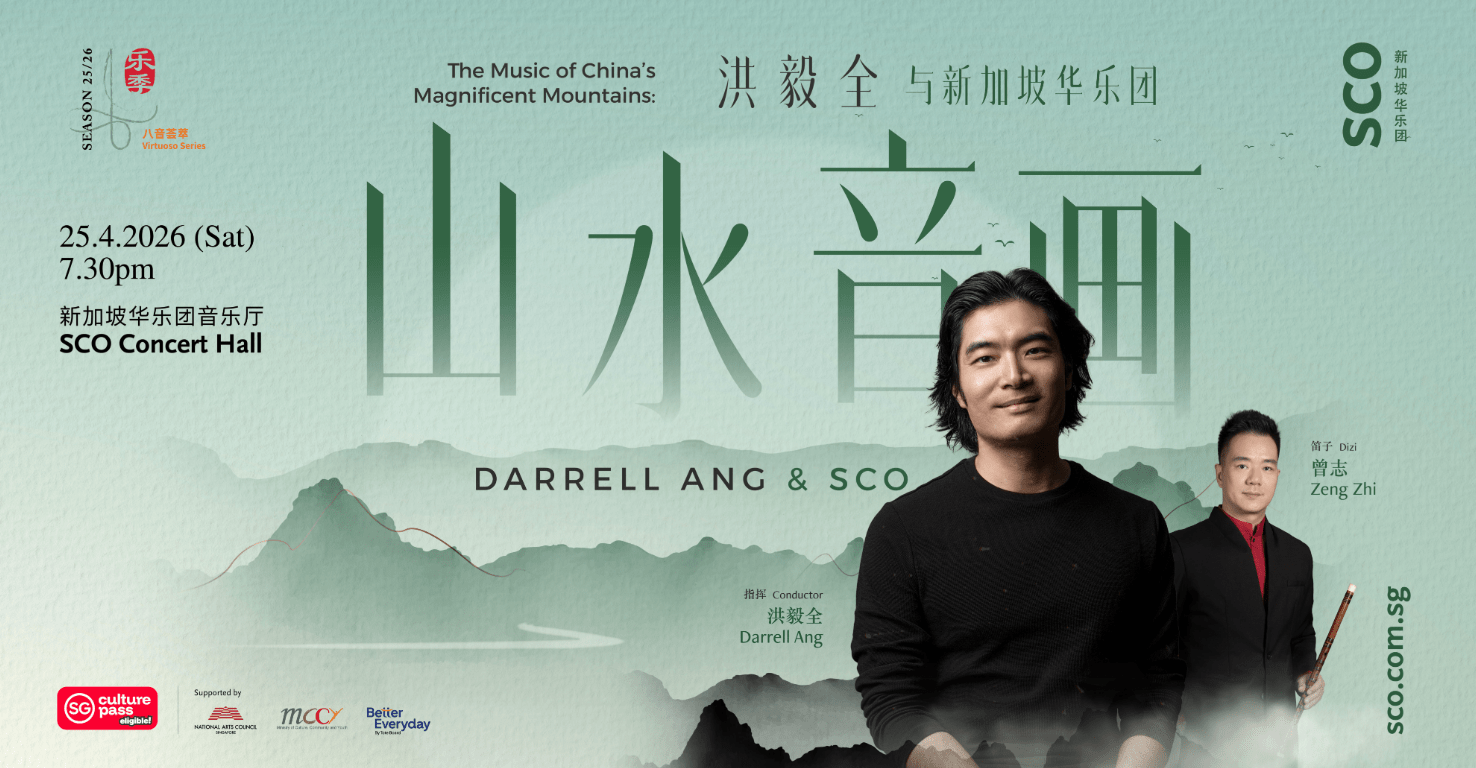
Darrell Ang leads the Singapore Chinese Orchestra through an immersive soundscape capturing a vivid journey across mountains.
Last weekend, under the baton of Darrell Ang, the Singapore Chinese Orchestra’s The Music of China’s Magnificent Mountains unfolded like a carefully charted expedition, one where every ascent, valley, and horizon was shaped with intention. From the very beginning, Ang established a distinct presence, where his entrance was marked by a small but telling gesture: a stylish nod to the orchestra before a single note was played. It was not theatrical, but assured; a sign of quiet authority and deep familiarity. All this signified a sense of control that would define the entire evening, as Ang guided the orchestra with precision and allowed space for resonance and colour to emerge naturally.

The Singapore premiere of Portraits of Mount Wuyi Landscape by Liu Bin opened the programme with a sense of anticipation, as though preparing for a long journey. The work’s modern sensibility was immediately apparent, blending Chinese idioms with a broader orchestral language. Yet what stood out was its sense of joy. The bright shimmer of cymbals and the buoyant rhythmic drive gave the music an almost festive quality, at times evoking the atmosphere of a New Year celebration. Ang allowed the textures to settle and expand into the hall, letting the sound reverberate fully rather than rushing it forward. This patience paid off, where in Jade Maiden Peak, the sparseness of the opening gave way to a haunting melodic line that seemed suspended in air, evoking folklore and distance. Sailing on the Nine-bend River unfolded with gentle fluidity, its flowing lines suggesting movement through landscape, while Tea Harvesting burst into life with witty exchanges and percussive interjections that vividly depicted human activity. By the final movement, the orchestra had built a layered, immersive soundscape, one that felt both expansive and grounded, culminating in a richly textured tribute to place and culture.
The shift to The Great Wall Capriccio by Liu Wenjin brought an immediate sense of scale. Grand from its opening, the piece captured not just the physical magnitude of the Great Wall, but also the imagination it inspires. Yet what was striking in this performance was its sense of delight. There was something almost childlike in the way the music invited listeners to marvel, to step back and take in the enormity of it all with fresh eyes. The orchestra clearly enjoyed themselves here, and that enjoyment was infectious. Ang balanced the grandeur with rhythmic vitality, ensuring that the music remained alive and forward-moving. The rousing conclusion felt less like a monumental statement and more like a collective celebration, an ode not only to the Wall itself, but to the act of imagining it.

With the first movement of Dianxi Folk Tunes by Guo Wenjing, the atmosphere shifted dramatically. A single, decisive gesture from Ang, where his hand struck the downbeat and set the tone, promising that this would be something epic, even elemental. The opening percussive sounds were raw and forceful, immediately conjuring a landscape of danger and uncertainty. Here, the orchestra navigated complexity with remarkable cohesion. Individual lines, when isolated, might have seemed disjointed or even chaotic, but under Ang’s direction they came together into a compelling whole. This was music that demanded trust in the conductor, and trust among the players, and that trust was evident in the performance.
The imagery was vivid: jagged erhu lines cut through the texture like sword clashes, evoking confrontation and tension. The mountain here was not serene, but daunting, a place to be conquered. Yet within this intensity, moments of lyricism emerged, offering contrast and depth. The result was a performance that was both dramatic and deeply engaging, drawing the listener into its rugged, almost mythic terrain.

The second half brought a different kind of focus with the Singapore premiere of The Capriccio of the Mountain Folk Song by Wang Dongxu, featuring dizi soloist Zeng Zhi. Entering with three dizi and dressed elegantly, Zeng immediately established a distinct presence. But it was in his playing that he truly commanded attention. What stood out was his control of his breath, tone, and narrative. Each phrase felt deliberate, each breath a new story. There was an intimacy to his playing, as though he were “caressing” the instrument, drawing out colours that ranged from bright and playful to deeply lyrical. Ang, in turn, demonstrated exceptional sensitivity, carefully balancing the orchestra so that it supported and elevated the soloist without ever overshadowing him.
This interplay created a compelling dialogue. Even in moments where the orchestra was fully engaged, the spotlight on the dizi remained clear, yet never isolated. Instead, soloist and orchestra existed in a shared musical space, each enhancing the other. The result was a performance that felt both virtuosic and deeply human, culminating in a richly expressive presentation of the folk melody.

The evening reached its apex with the Singapore premiere of Sketches in Mountains of Guizhou by Zhu Jian’er, a work that fully showcased the orchestra’s depth and Ang’s interpretive insight. Here, restraint became a powerful tool. Rather than overwhelming the listener, Ang shaped the music with care, allowing each layer to emerge with clarity. In The Old Xiao Player, the atmosphere turned introspective. The solo lines carried a profound sense of loneliness, as though the player were lost in memory. Yet there was also a sense of response, an impression that someone, somewhere, was listening. This subtle interplay between isolation and connection added emotional weight to the movement.
The transition into Serenade on a Moonlight Night was seamless, and here the orchestra achieved one of the evening’s most evocative moments. The textures were luminous, almost dreamlike. One could easily imagine standing on a bridge under a full moon, its reflection shimmering on the water below. The delicate timbres, including the gentle glow of the xylophone, created a soundscape that felt suspended in time, a fleeting, beautiful illusion. The final movement brought the listener back to communal life, depicting a vibrant festival. There was a sense of preparation, of layers carefully assembled, with winds, then strings, then the full orchestra, each contributing to a richly detailed tapestry. The music conveyed not just celebration, but memory and continuity, evoking the rhythms of village life.

The ending, interestingly, suggested the beginning of something new, an open-ended gesture that invited reflection. It was a thoughtful and intriguing close, one that lingered beyond the final note and sparked conversation. And as an encore, Ang led the orchestra in Hungarian Dance No. 5, delivered with charm and unmistakable confidence. Here, his rapport with the musicians was fully visible. The orchestra played with energy and enjoyment, a testament to the trust and cohesion built over the course of the evening.
What ultimately defined this concert was its thematic unity, a joie de vivre that can only emerge from a sense of lived experience. Through Ang’s direction and the orchestra’s responsiveness, the music became landscape, story, and imagination intertwined. It was a performance that went beyond the depiction of mountains in sound, inviting the audience to inhabit them, to traverse their heights and depths, and to emerge with a renewed sense of wonder.
Photo Credit: Singapore Chinese Orchestra
The Music of China’s Magnificent Mountains – Darrell Ang and SCO played on 25th April 2026 at the SCO Concert Hall. More information available here

