
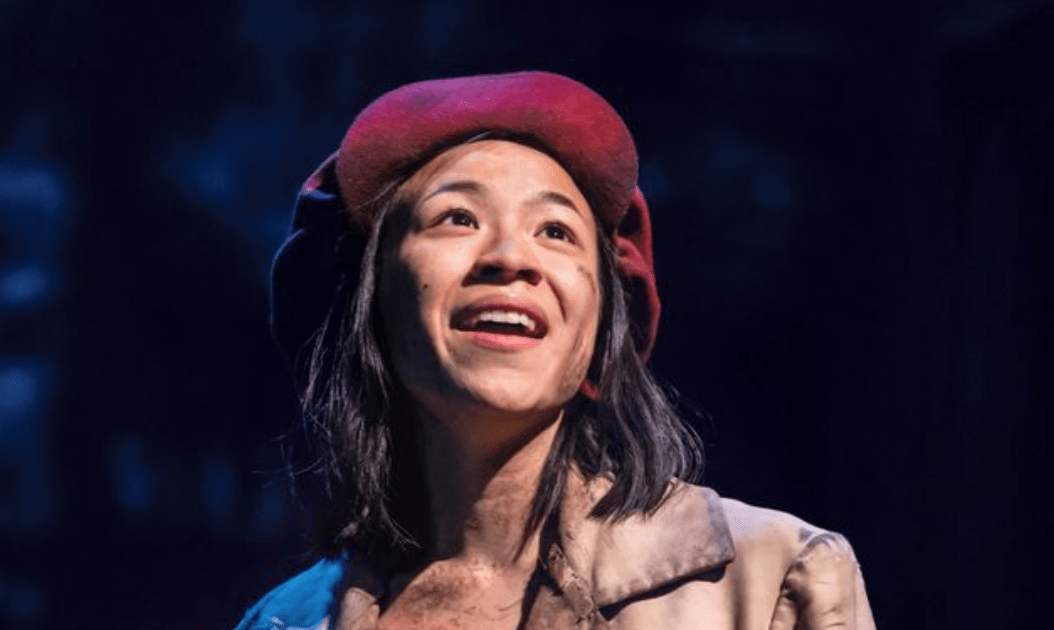
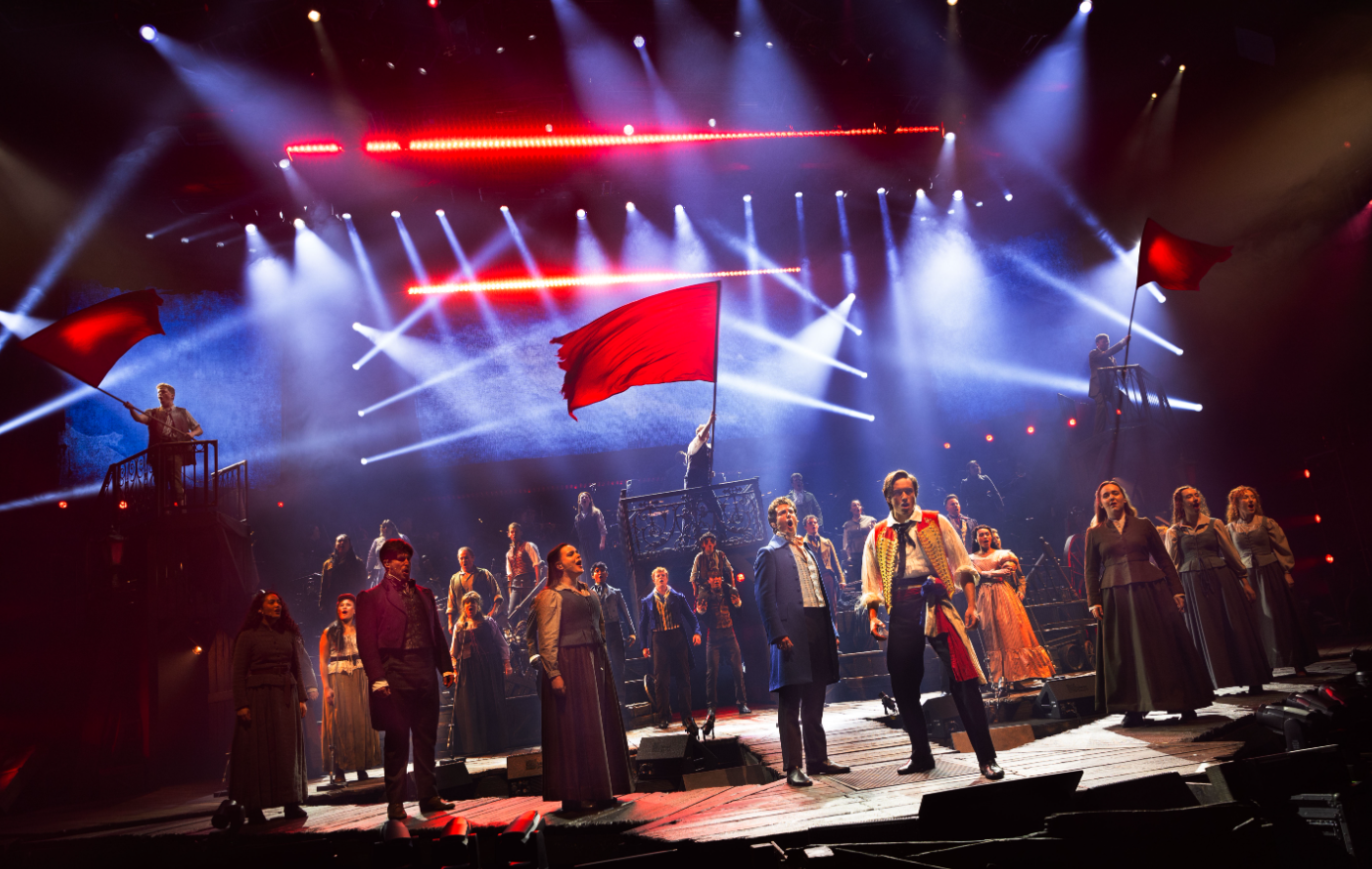
In Les Misérables – The Arena Spectacular, scale is everything: a full orchestra onstage, sweeping projections, and a staging language that expands the musical’s visual and sonic reach. Yet within that enormity, the production’s emotional force hinges on something far more intimate.
And doing exactly that is the character of Éponine. Portrayed by Singaporean performer Nathania Ong, the character emerges not as a peripheral tragic figure, but as one of the production’s most psychologically resonant presences. It is a role Ong has inhabited over several years and across iterations, long enough for familiarity to set in, but also for deeper transformation to take root.
What results is not simply a return to, but a re-examination of the character and its possibilities. For an actor revisiting a role over time, the challenge is all about imbuing it with vitality. Ong approaches Éponine with a clear awareness of structure. “I know the boundaries that I have to play in,” she explains. “The score is there, I know what notes to sing, what words to sing, I know my blocking.” Consistency, in that sense, is not the obstacle; it is the foundation.”
The difficulty lies elsewhere, and as Ong says plainly: “The challenge becomes keeping it fresh.”

Rather than forcing variation, Ong roots each performance in emotional immediacy. “I try to tackle each performance with as much truth and honesty as I possibly can,” she says. On some nights, that manifests as heightened emotional access; on others, it becomes a more deliberate act of storytelling, reconstructing the logic of Éponine’s love and loss moment by moment.
It is a balance between instinct and control, and one that has shifted over time. Where her earlier interpretation leaned more heavily on feeling, her current approach reveals a more analytical precision. “I’ve found more of the logic in a lot of different areas that maybe I hadn’t noticed when I was first starting out,” she reflects. “It’s really fleshed out in detail now.”
Éponine’s trajectory from longing to devastation unfolds strikingly, but Ong resists framing the character as purely tragic. “I always have to remember that Éponine is not a victim,” she says.
Instead, she locates the emotional core of the role in persistence rather than loss. “What makes Les Misérables really beautiful is the hope that each individual character carries,” she explains. “Even when things are completely hopeless, they still have to maintain that fight.”
For Ong, this reframing is essential to pacing the role. By foregrounding Éponine’s love,her defence of Marius, her presence in his moments of happiness, the eventual heartbreak is not merely observed, but earned. “If I didn’t have that love for him,” she notes, “then it wouldn’t hurt as much as it does.”

The Arena Spectacular introduces a significant formal shift: live cameras projecting close-ups of the performers onto large screens. For Ong, this alters not just the audience’s experience, but the actor’s process itself. “In a normal stage production, you have to act with your full body,” she says. “But with the cameras, you can actually see our eyes.”
The effect is both liberating and exacting. It is, as she describes, a “double-edged sword”, one that demands honesty, but rewards it with a heightened sense of connection. Subtlety becomes legible; internal shifts, previously invisible at scale, are now amplified. “We actually don’t have to do quite as much,” she explains. “We can really trust that we are telling the truth, and that the audience can read it through our eyes.”
Éponine is, according to Ong, a role that feels “quite instinctive.” It was one of the earliest major characters she inhabited, and that proximity initially shaped her approach. Yet instinct alone has not defined her performance. Through research, textual analysis, and lived experience, Ong has gradually expanded her understanding of the character. “She is not me,” she says. “She has lived in her own very specific set of circumstances.” Bridging that gap required both intellectual and emotional work, finding parallels where possible, and constructing meaning where none existed.

Just as significantly, the role has reshaped Ong’s broader artistic philosophy, where it has shifted it from external expression to internal complexity, signalling a performer increasingly attuned to nuance. “Earlier on, it was always bigger is better, more is more,” she reflects. “Now I think she has dimension. She can be soft, she can be rough, she can be kind, she can be mean.”
While Ong is able to “shed the character” at the end of each performance, traces of Éponine linger in unexpected ways. “I just find myself buying clothes that are aligned with my character,” she admits, laughing. During her time as Éponine, her wardrobe subtly shifted towards a more androgynous, utilitarian aesthetic; as Eliza in Hamilton, it softened into flowing silhouettes and gentler textures.
More profoundly, each role leaves an imprint on her sense of self. “I feel like putty being pulled in all sorts of directions,” she says. “With each role that I take on, I really discover and learn a lot more about myself.”
Éponine, in particular, arrived at a formative moment, one that demanded not just technical ability, but presence. “I was trying to gain the confidence to stand in a space and say, ‘You can look at me. I deserve to be here.’”

Ong’s career trajectory, spanning international productions and the West End, has required significant personal trade-offs. “You relinquish the comfort that you would normally have at home,” she says. Moving overseas meant leaving behind family, friendships, and everyday familiarity. “I didn’t really have a lot of people that I could turn to.”
There are quieter losses, too: missed milestones, absent celebrations, the gradual distance from moments that cannot be reclaimed. Yet these experiences have also reshaped her understanding of success. “Initially, it was: I want to book a job. Then I want to book a lead,” she recalls. Now, that metric has shifted inward. “My idea of success is less about forwarding my career. I want to hear the sound of my voice: what do I want to say?”
This desire is beginning to take concrete form in an upcoming solo concert, where Ong plans to reinterpret musical theatre repertoire through an R&B lens while introducing original material. It is, in many ways, an extension of the same impulse that drives her current work: to locate authenticity within structure.
And for her, performing alongside Lea Salonga, a figure synonymous with musical theatre excellence, inevitably brings its own psychological weight. “I was honestly so nervous for the first week,” Ong admits.
What has eased that pressure is not distance, but proximity. “She is someone who is so personable, and so funny. She’s given me no reason to feel intimidated.” Still, admiration persists.
“She’s still the Lea Salonga to me,” she says. Navigating that dynamic required a reframing of perspective. “There is only one Lea Salonga,” Ong says. “But there is also only one Nathania Ong.” It is a statement not of comparison, but of coexistence, a recognition that individuality, rather than hierarchy, defines artistic space.
Reflecting on Singapore’s theatre ecosystem, Ong describes a landscape of both opportunity and uncertainty. Government initiatives such as the SG Culture Pass have helped bring visibility to local productions, yet structural challenges remain. “It’s still a little bit of an uphill battle,” she notes, particularly in cultivating consistent audiences for homegrown work.

At the same time, international productions serve as both competition and catalyst: drawing audiences into the theatrical experience, and potentially encouraging deeper engagement. For many performers, however, the path remains self-directed. “A lot of them still have to carve out their own opportunities,” she says.
Despite a career defined thus far by iconic roles, from Les Misérables to Hamilton, Ong’s long-term aspirations lean towards creation rather than reinterpretation. “I would actually really love to originate new work,” she says.
For now, her focus remains immediate: completing her current productions, and shaping the upcoming concert that signals a new phase of artistic exploration. Beyond that lies a more open horizon, one defined less by specific benchmarks than by internal clarity and confidence in her path.
Between returning to Éponine and stepping into new creative territory, Ong stands at a point of transition, no longer simply inhabiting roles, but beginning to define the voice that will carry her forward. And increasingly, that voice is becoming unmistakably her own.
Featured Image Credit: Johan Persson
Les Misérables The Arena Spectacular World Tour runs from 24th March to 10th May 2026 at the Sands Theatre, Marina Bay Sands. Tickets available here

