

Demystifying the backstage and paying tribute to the unseen parts of production
In line with Emergency Stairs’ ethos, Backstage Protocol, part of the NAFA Industry Project 2026 by Nanyang Academy of Fine Arts and Emergency Stairs, leans fully into uncertainty, trading narrative clarity for process, and polish for possibility. As a showcase, it feels less concerned with delivering a cohesive theatrical product and more invested in exposing the mechanics, hierarchies, and quiet labour that make theatre possible in the first place.
From the outset, the production establishes its preoccupation with systems. Upon the house opening, a live phone video feed projects the theatre foyer onto a screen in the theatre studio, immediately collapsing the divide between audience space and performance space. Surtitles dominate the early portion of the show, listing protocols, rehearsal etiquettes, and theatre terminology, turning reading into an active part of spectatorship. It’s a curious inversion: rather than easing audiences into the performance, the work asks them to learn its language first. Even the audience is implicated, invited to contribute to “audience protocol,” reinforcing the idea that theatre is not just what happens on stage, but a network of behaviours and agreements we unconsciously participate in.

A brief moment of familiarity arrives with a rendition of Adele’s “Let You Feel My Love” from outside the theatre, but it doesn’t linger. The song is cut short, and director Selena Lu steps forward. Her presence is not framed as an interruption but as part of the fabric of the piece from early on. She addresses the audience directly, navigating between Mandarin and English when prompted, responding in real time rather than maintaining any illusion of theatrical distance. We’re told a cast member has food poisoning, though whether this is real or constructed remains deliberately unclear. What matters is how the ensemble absorbs the disruption, reconfiguring the performance so that the absent performer is still felt within it. From this point on, the work begins to subtly warp reality, dissolving the boundaries between rehearsal, accident, and performance.
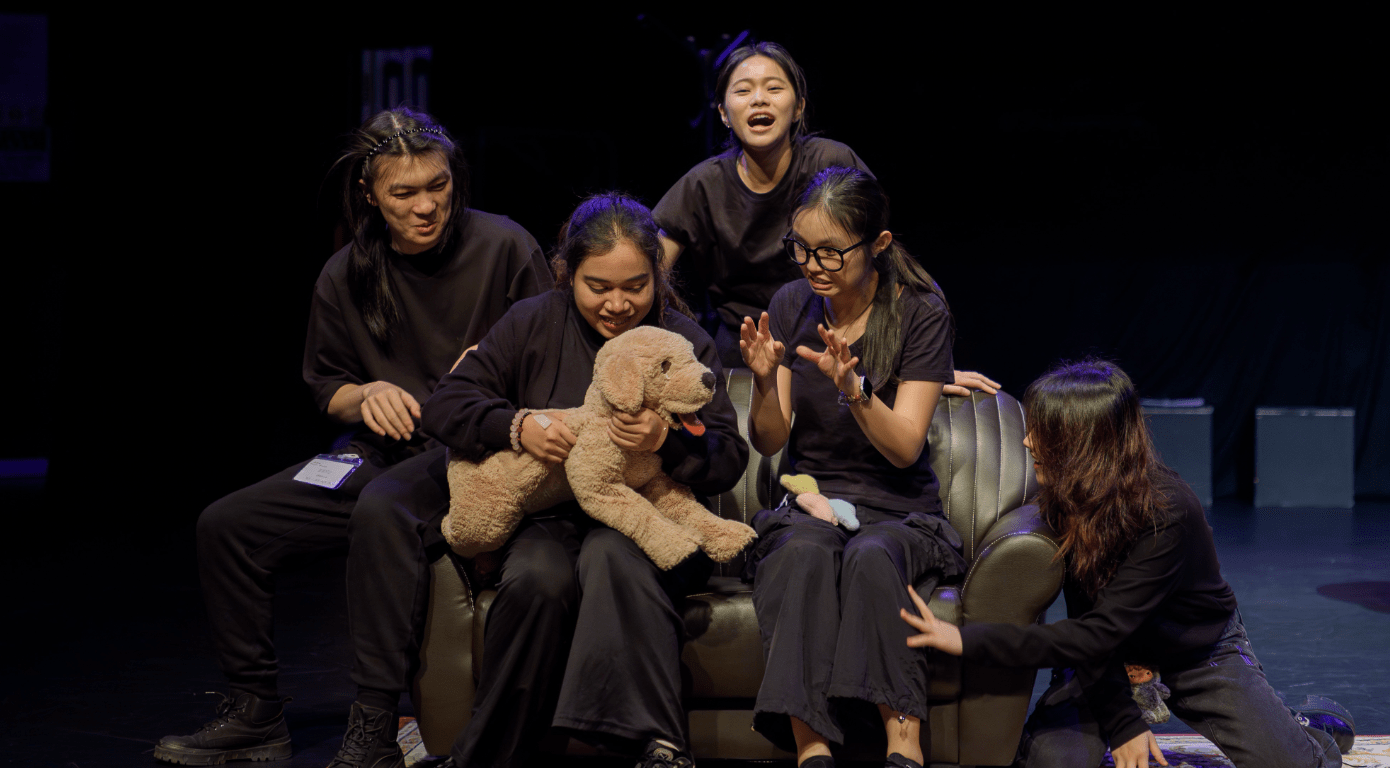
What gradually emerges feels more like a constellation of fragments orbiting a central idea: the unseen labour of theatre that goes on behind the scenes. The production becomes, in some sense, a tribute and spotlight on those who operate out of sight: the stage manager, the technicians, the backstage crew, without ever sentimentalising them. We hear about dedication not as romantic sacrifice, but as routine, repetition, and choice. The backstage is never explicitly shown, yet its presence becomes increasingly tangible. When performers appear dressed in black, the distinction between actor and crew blurs further, raising the question of whether such roles are ever truly separate.

The structure resists linearity. Scenes unfold in no particular order, often slipping into the absurd. At one point, the cast revisits a production of Who’s Afraid of Virginia Woolf?, not by staging the play itself, but by recounting the backstage tensions and concentration surrounding it. Elsewhere, we learn about how they have late night conversations smoking and eating. These moments feel like micro-dramas, where the personal, self-contained explorations are collected and refracted through an avant-garde lens. It can be difficult to grasp the work as a whole, and there are stretches where its conceptual density risks distancing the audience. But within that difficulty lies a kind of invitation: to engage not through narrative clarity, but through accumulation and association.
As a student production, what Backstage Protocol ultimately foregrounds is not so much acting virtuosity as creative process. Traditional markers of performance, such as character arcs, emotional continuity, narrative payoff, are largely set aside. In their place is a focus on theatre making: on how theatre is constructed, negotiated, and constantly rewritten. This aligns closely with the philosophy of Emergency Stairs, where experimentation and risk-taking are prioritised over polish. The students move fluidly between roles, inhabiting performers, technicians, and facilitators of the space, at times even inhabiting stage versions of themselves, suggesting a broader understanding of what it means to be a theatre-maker today.

Even the ending refuses to resolve cleanly. The performers decide how to take their bows, and the conclusion feels deliberately ambiguous. There’s a moment of hesitation in the audience, uncertainty over whether the piece has actually ended, or if this too is part of its unfolding logic, and there is something more to come. It’s an unusual sensation, but one that feels consistent with the work’s broader refusal to conform.
Backstage Protocol is not an easy piece to pin down. It is dense, occasionally disorienting, and more invested in questions than answers, its attempt to demystify at times even more wrapped up in mysticism thanks to its form. Yet as a platform for emerging artists, it reveals something valuable: a willingness to interrogate systems, to embrace ambiguity, and to rethink the structures they are about to inherit. In its attempt to demystify the backstage, it ends up reframing theatre itself as a collective, evolving process, one that extends far beyond what is visible under the stage lights alone.
Photo Credit: Emergency Stairs
Backstage Protocol plays from 23rd to 25th April 2026 at the NAFA Studio Theatre. More information available here
Pulau Rindu, also part of the Emergency Stairs x NAFA Industry Project 2026, plays from 30th April to 3rd May 2026 at the NAFA Studio Theatre. More information available here
Production Credits
| Director Selena Lu Artistic Director/Producer Liu Xiaoyi Co-Producer/Graphic Designer Huang Suhuai Dramaturg Deng Xiaofei Production Manager Victoria Anna Wong Stage Managers Linfelide Pte. Ltd. Lighting Designer Emanorwatty Saleh Sound Designer Meng Jiaoyang (Intern) Video Designer Zhu Xuanru (Intern) Project Coordinator Chen Yu Chi (Intern) Production Assistant Nurul Hanna Daud Performers Chua Wen Sin, Crebee Gan Yuen Yean, Dai Xinyi, He Zeyu, Liang Xiaomu, Shen Yao, Zhang Aijia |
 Bakchormeeboy