

Spiritual sequel to Haresh Sharma’s godeatgod explores faith, identity and belonging through a modern, foreign lens.
Presented by the Intercultural Theatre Institute’s graduating class of 2026, Haresh Sharma’s godategod acts as a spiritual successor to his earlier godeatgod, originally written as a theatrical response to the devastating events of 9/11 and how to carry on in the face of the existential and spiritual crises it provokes. In the case of godategod, the work becomes less of a journey than a collage of stories, assembled from Sharma’s past works and new stories from the three performers, and attempting to answer the ever illusory question: the meaning of life.
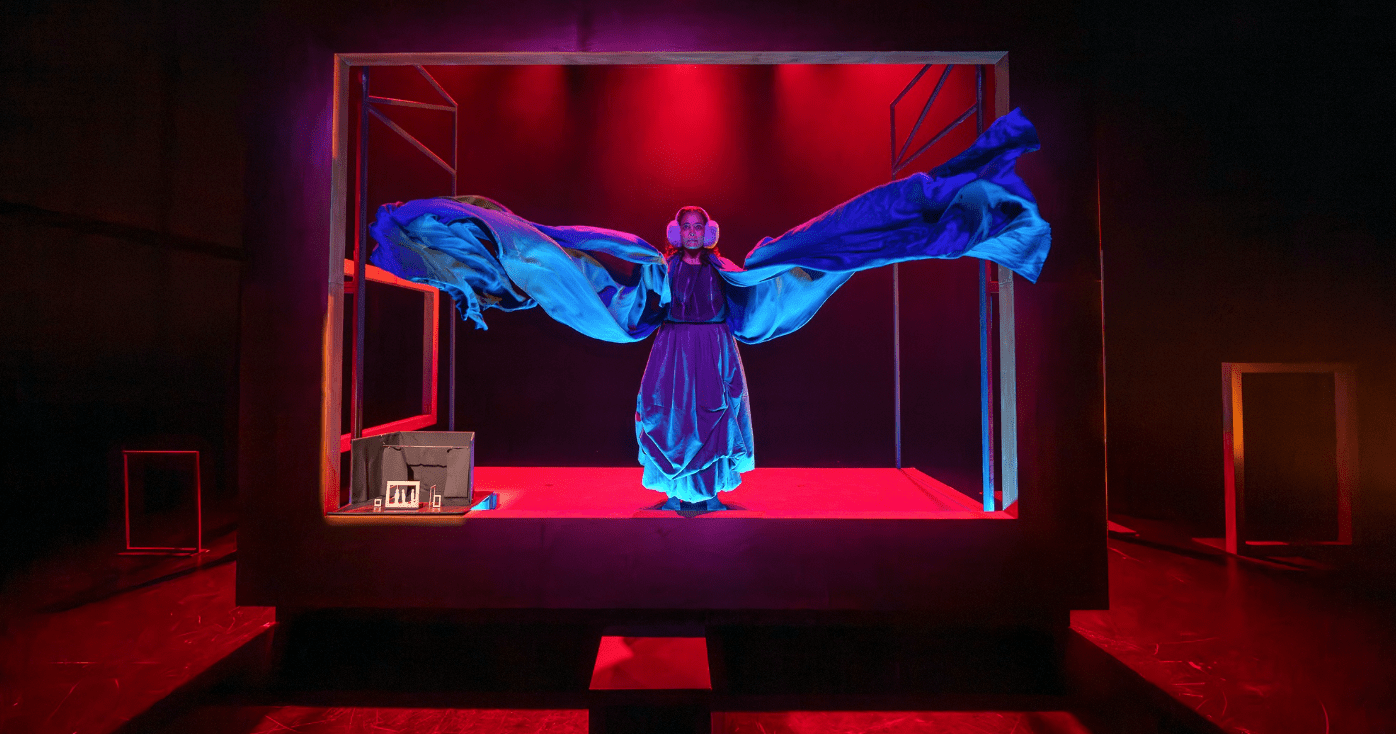
Set within an abstract stage design of empty frames of varying sizes at the Drama Centre Black Box, the visual language suggests multiplicity: fragments of stories, shifting perspectives, and the porous boundaries between performer and character. It’s a fitting metaphor for a work that moves restlessly across time, space, and emotional states.

The structure mirrors this intent. godategod operates in what feels like a stream-of-consciousness mode, drifting between the absurd and the intimate. Scenes emerge and dissolve without clear resolution, at times melodramatic sketches of familial conflict which sit alongside more stylised, almost camp portrayals of divinity, including a weary, disillusioned god figure in contrast with a flamboyant adversary. These moments feel deliberately untethered, circling philosophical questions rather than arriving at answers, provocative in their premises but never conclusive.

Such openness is both the production’s strength and its challenge. The thematic throughline is essentially an exploration of identity and one’s place in an often chaotic, indifferent world, something that remains conceptually clear, but the execution can feel diffuse. Without a strong anchor, the audience is essentially surrendering to “go with the flow,” which may be rewarding for some, but disorienting for others. At times, the work risks feeling less like a journey and more like a series of ideas still in the process of finding their shape.

Where godategod resonates most deeply is in its moments of sincerity. When the three student performers, Henry Joseph Fundo, Jyoti Rana, and Pratiksha Sindhu, step out from behind the layers of stylisation and speak from their lived experiences as foreign students in Singapore, the production sharpens into focus. These segments carry an emotional clarity that cuts through the abstraction, grounding the larger philosophical inquiries in something immediate and human. As performers, the trio demonstrate versatility and control, shifting between heightened theatricality and quieter, more introspective states. There’s a clear willingness to take risks, tonally, physically, emotionally, even if not every experiment lands with equal impact.

The production’s collaborative elements, such as movement, sound, and lighting, contribute to its fluid, almost dreamlike atmosphere, reinforcing the sense of a world in constant flux. Still, a more defined sense of direction could help unify these components, offering audiences a firmer point of connection amid the expansiveness.

Ultimately, godategod feels like a work in search of itself, which, perhaps, is precisely the point. It reflects a generation navigating uncertainty, displacement, and the persistent question of where and how one belongs. While the piece may not fully cohere, its ambition is certain. And in its most honest moments, it offers glimpses of something affecting and real, suggesting that with time, refinement, and continued exploration, these emerging artists have compelling voices worth following.

Photo Credit: Wesley Loh, courtesy of Intercultural Theatre Institute
godategod played from 23rd to 25th April 2026 at Drama Centre Black Box.
Production Credits
| written and directed by Haresh Sharma cast Henry Joseph Fundo, Jyoti Ranam Pratiksha Sindhu movement director Ruby Jayaseelan set designer Yvan Karlsson light designer Faith Liu Yong Huay sound designer Bani Haykal production manager Clarisse Ng stage manager Marilyn Chew assistant stage manager Cheryl Lee production intern / surtitle operator Cheah Yan Ni publicity visual photographer / videographer Gwyn Lau publicity video movement director / costume designer Lim Chin Huat front of house manager Khalid Bin Supandi |

