
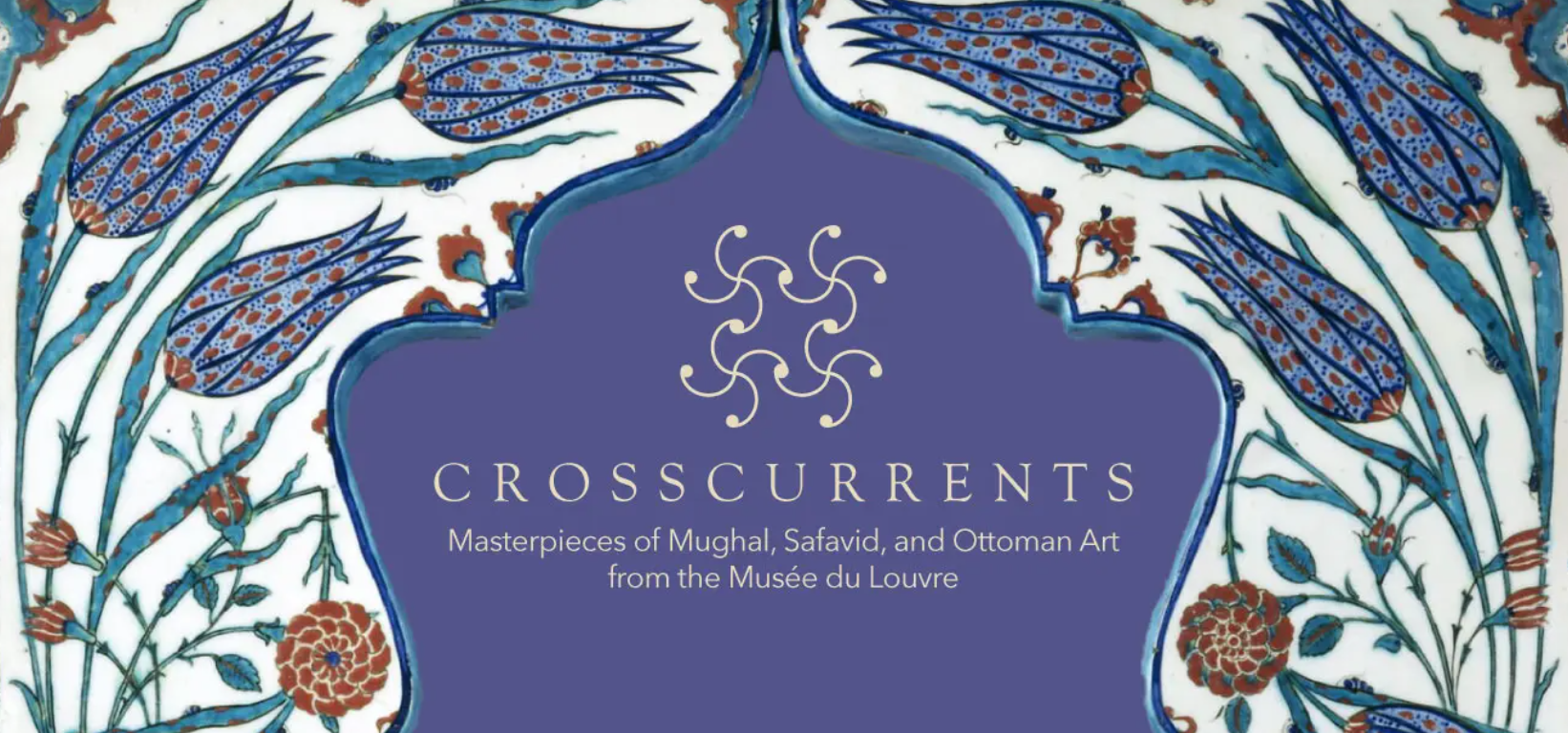
In Singapore’s Civic District, the Asian Civilisations Museum (ACM) is set to open Crosscurrents: Masterpieces of Mughal, Safavid, and Ottoman Art from the Musée du Louvre, an exhibition that does more than bring together rare objects from one of the world’s greatest museums. It reconstructs a historical world in motion, where empires were less boundaries than bridges, and where art moved as fluidly as the people who made, traded, and reimagined it.
At its core, Crosscurrents is built around a remarkable loan: around one hundred masterpieces from the Musée du Louvre’s Islamic art collection, many leaving Paris for the first time, joined by thirty works from ACM’s own holdings. But the exhibition’s deeper ambition lies not in the rarity of individual objects, but in the relationships between them.
That idea of “conversation” is not a metaphor reserved for curatorial language—it is physically embedded in how the exhibition is staged. Rather than isolating masterpieces in a traditional loan showcase, ACM and the Louvre have co-curated the installation so that objects constantly speak across time and geography.

Christophe Leribault, President-Director of the Musée du Louvre, frames it as an active circulation of meaning as much as materials: “Crosscurrents interweaves a hundred masterpieces from the Louvre museum with the ACM’s collections, creating a compelling conversation between objects and artworks, and highlighting the artistic circulations across Asia, between the 16th and the 18th centuries. Taking the Safavid, Ottoman and Mughal worlds as its focus, it examines the cosmopolitan world that connected Istanbul, Isfahan, Delhi and the Southeast Asian region through all kinds of currents – whether commercial, diplomatic, migratory, or artistic.”
The exhibition is anchored in the 16th to 18th centuries, a period when the Mughal, Safavid, and Ottoman empires were at their cultural height. Yet rather than presenting them as separate civilisations, Crosscurrents reveals them as interlinked systems shaped by trade, diplomacy, and artistic exchange. Chinese porcelain shaped Persian ceramic design; Indian craftsmanship travelled westward; Ottoman aesthetics responded to European court tastes; and Southeast Asia absorbed and transformed influences from across the Indian Ocean world.
This sense of movement is immediately visible in one of the exhibition’s most compelling objects: an Ottoman jade cup once belonging to the royal collection of Louis XIV. Displayed at Versailles before entering the Louvre in 1796, the cup carries within it a geography far larger than its size suggests. Carved from jade, inlaid with gold, and set with rubies originating from Myanmar, it embodies the global circuits of luxury that linked imperial courts across Asia and Europe. The object is not only a masterpiece of craftsmanship but also a record of mobility—of materials, techniques, and prestige passing between worlds.

From there, the exhibition expands into a wider landscape of material cultures. In Mughal India, a mother-of-pearl ewer and basin reveals the sophistication of Indian Ocean luxury production between the late 16th and early 17th centuries. Its surface appears almost fluid, yet radiographic analysis shows an intricate internal structure that stabilises the delicate shell. Such objects were not static possessions but highly mobile goods, often exported through ports such as Goa and adapted for different audiences, from local elites to Ottoman and European courts.
The Safavid section shifts the tone from material opulence to literary refinement. A glazed tile panel from Isfahan depicts a poetic contest unfolding in a garden, where one figure recites verses while another records them in a safina, a portable manuscript format designed for collecting poetry. The scene reflects a broader Safavid culture in which poetry, painting, and courtly performance were deeply intertwined. As the exhibition text notes, “Beyond the royal court, poetry and literary exchange were central to Persian society and deeply influenced artistic traditions across the wider Islamic world.” Those traditions did not remain in Iran; they travelled eastward, shaping Malay literary genres such as the shair and hikayat, and embedding Persian vocabulary and narrative structures into Southeast Asian court cultures.

One of the most striking aspects of Crosscurrents is how it makes these connections visible not as abstract ideas but as lived, material transformations. Ottoman ceramics in Iznik, for example, begin in the 16th century by closely imitating Chinese porcelain before developing their own visual language of tulips, carnations, and bold turquoise glazes. Over time, they incorporate European influences as well, reflecting the Ottoman court’s evolving relationship with imported luxury goods. A later gilded copper set belonging to Mihrimah Sultan, daughter of Sultan Mahmud II, demonstrates this hybridity even more explicitly, combining Ottoman metalworking techniques with European-inspired diamond lattice patterns, all while employing the costly trompe-l’oeil effect of gilded mercury.
If the Ottoman and Safavid sections explore transformation within imperial centres, the Southeast Asian works in the exhibition show how those influences were received, adapted, and reimagined far from their origins. A mosque model from West Sumatra, made by the Minangkabau community, embodies this process vividly. Its multi-tiered roof reflects local architectural traditions, while its small dome—introduced in the late 19th or early 20th century—signals Mughal or Ottoman influence, producing a hybrid form that expresses a distinctly cosmopolitan Islamic identity. Elsewhere, textiles from Aceh incorporate the “tree of life” motif, drawing on both Islamic symbolism and older Indic cosmologies, while metalwork from southern Thailand and the Sulu archipelago reveals how techniques such as high-contrast inlay travelled and transformed across maritime Southeast Asia.

What emerges across these galleries is a consistent curatorial argument: Southeast Asia is not peripheral to Islamic art history, but central to its circulation. The exhibition explicitly challenges the tendency of global Islamic art narratives to focus on the Middle East, reframing the region as an active participant in centuries of exchange. In doing so, it aligns with ACM’s long-standing curatorial mission to foreground Asia as a network of connections rather than isolated civilisations.
This sense of connectivity is reinforced by the exhibition’s design, which transforms the museum space itself into a visual metaphor for movement. The galleries are organised across two levels, beginning in the Islamic Art Gallery on Level 2 and continuing on Level 3. Visitors move through a sequence of architectural references drawn from Mughal, Safavid, and Ottoman traditions, alongside Southeast Asian reinterpretations. These arches are not decorative gestures but navigational tools, subtly signalling shifts in geography and cultural influence. Even the stairwell becomes part of the exhibition language, extending the visual rhythm between floors.
The curatorial team has also expanded the experience of viewing by rethinking scale. Miniature paintings, traditionally intended for close reading within manuscripts, are enlarged into immersive projections that allow visitors to encounter their detail at a monumental scale. This transformation changes not only how the works are seen, but how they are felt, inviting viewers into the intimate worlds of courtly gardens, literary gatherings, and imagined histories.

As the exhibition progresses into its Ottoman-focused sections, the narrative returns once again to Istanbul, a city positioned at the crossroads of Europe and Asia. Here, Iznik ceramics and court objects demonstrate both the refinement of Ottoman craftsmanship and its responsiveness to global trade. Chinese porcelain remains a key influence, but is gradually absorbed into a distinctly Ottoman visual system, enriched by new pigments and motifs. Floral patterns become increasingly elaborate, while fantastical elements, parrots, boats, hybrid creatures, reflect a court culture comfortable with visual experimentation.
In its final arc, Crosscurrents also gestures toward the present. The exhibition coincides with the signing of the Singapore–France Roadmap on Cultural Cooperation, a framework aimed at deepening institutional collaboration between the two countries. In this sense, the exhibition is not only a historical reflection but also a contemporary diplomatic moment, reinforcing the role of museums as spaces of cultural exchange and soft power.
Ultimately, what makes Crosscurrents distinctive is not simply the prestige of its loans or the beauty of its objects, but the way it reconstructs a world where art was never static. Objects moved, techniques evolved, languages shifted, and identities were continuously reshaped through contact. A jade cup carries Myanmar rubies to Ottoman courts; a Persian poem finds new life in a Malay manuscript; a mosque in Sumatra echoes architectural ideas from Istanbul while remaining rooted in local tradition.

As ACM Director Clement Onn explains, the show is the culmination of a long institutional relationship that stretches back more than a decade, shaped by earlier collaborations and steadily deepening trust between the two museums. He notes, “This partnership with the Louvre brings some of the world’s finest works of Islamic art to Singapore, many of them on view in Southeast Asia for the first time. By placing these works in conversation with objects from ACM’s own collection, the exhibition highlights the artistic and cultural connections that have linked Southeast Asia with the wider Islamic world over many centuries.”
Seen together, these works form a collection of masterpieces, and forge a map of relationships. They remind us that the histories of Mughal, Safavid, and Ottoman art are not separate stories, and that Southeast Asia is not an afterthought in Islamic art history, but one of its most dynamic meeting points. In tracing these flows, Crosscurrents does more than revisit the past. It restores a sense of how the world has long been connected by water, by trade, by language, and by the enduring human impulse to create objects that travel further than their makers ever could.
Images courtesy of Asian Civilisations Museum
Crosscurrents: Masterpieces of Mughal, Safavid, and Ottoman Art from the Musée du Louvre runs from 19th June 2026 to 24th January 2027 at the Asian Civilisations Museum. More information available here

