
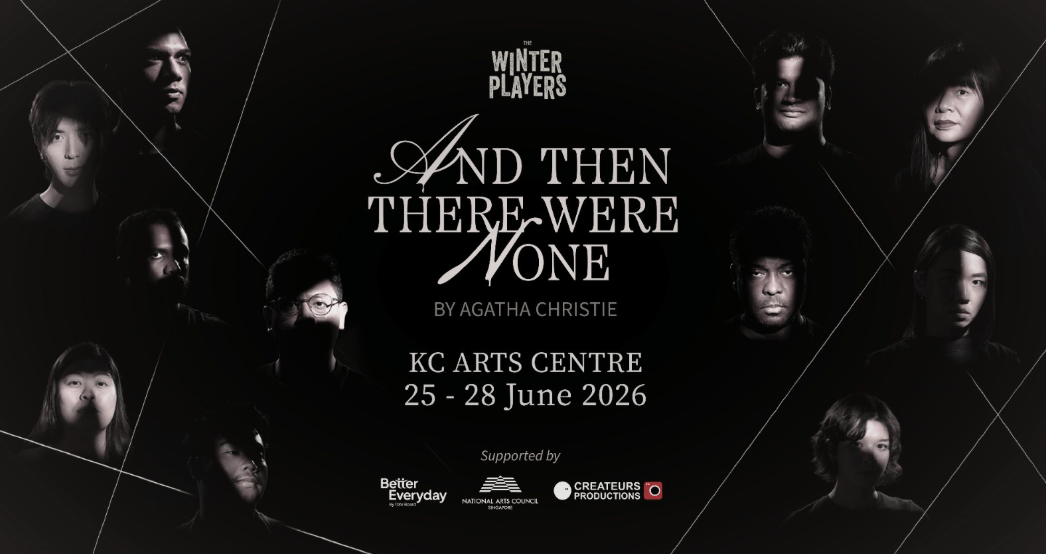
For audiences who enjoy tightly wound mysteries, atmospheric stagecraft, and the thrill of trying to outguess a murderer, the end of June brings a particularly unsettling invitation to the KC Arts Centre. The Winter Players return following a run of well-received and sold-out productions with Agatha Christie’s enduring classic And Then There Were None, a work that continues to define the modern whodunit. Running from 25 to 28 June, the production also serves as the concluding chapter of the company’s two-year residency with Singapore Repertory Theatre, marking a significant milestone in the collective’s development under its Company-in-Residence programme.
First published in 1939 and later adapted for the stage by Christie herself, the story remains one of her most tightly constructed and psychologically unnerving works. Ten strangers are drawn to a secluded island estate, only to find themselves accused, observed, and eliminated one by one in accordance with a chilling nursery rhyme. Under the direction of Feroz J. Malik, the production leans into the claustrophobia and moral unease that underpin the narrative, turning suspicion itself into a constant presence onstage. In our conversation, Feroz discusses why this particular Christie work stood out among her canon, the complexities of staging suspense in real time, and how The Winter Players are approaching their final season with SRT. Read the interview in full below:
Bakchormeeboy: You’ve mentioned that a classic whodunit has long been on your wishlist. Why did Agatha Christie’s darkest mystery feel like the right choice for this moment?
Feroz J. Malik: Of Agatha Christie’s best plays, And Then There Were None was the most classically ensembled one. By that I mean there’s the colourful gallery of suspects. The Mousetrap was too iconic with its legendary tenure at St Martin’s Theatre on the West End, Witness for the Prosecution was intimate and not quite a classic murder mystery, and of course Murder on the Orient Express had Hercule Poirot, and that was simply far too big an undertaking. Of course it wasn’t simply a process of elimination, I have a taste for these dark tales. And Then There Were None has no eccentric detective to save the day, but it has the thickest atmosphere of terror and isolation, and has a haunted cast of characters, in a kind of haunted house, on a possibly haunted island.
Bakchormeeboy: Agatha Christie is best known as a novelist. What are the unique challenges of bringing her work to the stage? Is there a certain trick to sustaining suspense and surprise when audiences are watching events unfold in real time rather than reading them on the page?
Feroz: Fortunately Christie wrote the stage adaptation to the novel herself! Which is incredibly rare as far as Novel to Stage adaptations go. She certainly takes a lighter, more fun and entertaining approach when she writes her plays. Without the prose to weave a mystery, drop clues, and paint scenes of terror, one is left mostly with quite snappy dialogue descended from the emotive traditions of melodrama. It is a strong separate style on its own, the exclamations, the thunder and lightning, the blackout murders.
The hardest thing practically is juggling movements of several suspects in logical order accounting for alibis and opportunities to be possible malefactors. Making sure the murderer is masked with other suspects, and that people aren’t teleporting around when committing their misdeeds. And Then There Were None is a profoundly psychological work, exploring the minds and guilts of the guests on soldier island. Naturally, that leads to the play being rife with revelatory monologues. The suspense comes by default, a murderer in the room. An impostor among us. The promise and knowledge that more will die. In the theatre you see the real people who must die and suffer, and share the room with them and their killer. It is not a distant tale in the pages of a book in your hands, soldier island stands before you.
Bakchormeeboy: This is one of The Winter Players’ largest and most diverse casts to date. How has that shaped the rehearsal process, especially when it comes to working with performers from different generations and at different stages of their careers?
Feroz: We rehearse evenings due to the juggling of everyone’s busy schedules. The process has been incredibly collaborative. Most times it simply feels like a room full of colleagues who are eager to work with the great desire to put on a show. I find myself often taking a step back and realising how colourful the cast truly is. I think it is important that there is more cross-generational and cross-experience in rehearsal rooms, because you really only learn and improve palpably by doing real work with the people who know and have been doing it well.
As opposed to what I think often happens is that generations and cohorts of actors break off alone, and develop their own isolated vocabularies and sensibilities, causing the rift between the generations and actors at different stages to be wider. As a 22 year old juvenile myself, the room is full of people older and more experienced than I am, and it has been profoundly stimulating and illuminating watching them work.
Bakchormeeboy: Before directing this production, audiences saw you onstage as Judge Brack in Hedda Gabler. How does your experience as an actor influence your work as a director? Has stepping between both roles changed the way you approach rehearsals or character development?
Feroz: Though I cannot claim to have an illustrious acting career under my belt, I find myself far more understanding of the actor’s process. Although for stage I think there is really no escape from having to be an Actor’s director, as Theatre I think really is the Actor’s art. You cannot put up a show without trusting your actors; there is no post production cutting room to doctor the work. There is only the uninterrupted passing of time between the dimming of the lights and the bowing at the curtain. As an actor I find myself having to resist the urge to constantly give readings and my personal takes of lines when giving direction, which is generally bad practice as it often infringes on the actor’s agency to make the choice. However I have admittedly been bouncing off the walls and launching myself out of the chair any chance I get to physically demonstrate movements and blocking within a scene.
Bakchormeeboy: Many people know And Then There Were None as a classic murder mystery, but beneath the suspense are themes of guilt, justice and accountability. What do you think makes the story so timeless and still resonate with audiences today?
Feroz: It’s a damn good mystery. Probably one of her absolute hardest to solve. It invented a genre beyond the mere locked-room murder mystery, and contributed greatly to the tropes of horror and crime fiction to this day. Just as Shakespeare reverberates throughout every romantic comedy ever made, so does And Then There Were None for every slasher film out there.
In addition, the idea of punishing crimes that could not regularly be punished, murders that have been muddied by too many degrees of distance, is a concept that has constantly weighed upon the soul of humanity. We all pray, often quite literally that evil-doers will be judged and punished. It is a compulsive comfort to man that the villain must never get away with it. This story gives us the reckoning for almost every kind of murder that society could not punish, which I imagine satisfies those who may not wish to wait for the earth to swallow these criminals, or depend on the eternal flames that we believe they must be consigned to.
Bakchormeeboy: The Winter Players has quickly built a reputation for reimagining classic works for contemporary audiences. What is the collective’s approach to making these stories and the experience feel relevant and accessible, especially for younger theatregoers?
Feroz: We are young theatregoers. For the most part we are not stuffy academics with hyper reverence and the duty to uncover absolute truth. We make shows that we want to watch. We are people who have enjoyed reading drama, been enraptured by the poetry of writers dead and alive, and are acutely aware of the life that all printed words once had and must again have.
Language I think is a far shorter hurdle than people make it out to be. Classic theatre was not written to be Classic. If I had to sum it up in a word, it really is just Life. Characters are real and alive, people who inspired the playwright 400 years ago were real and alive, just as we are real and alive. They all had life. Life just as we have it. Their words may be different, but they saw the same Sun and Moon in the sky that we pay no mind to. That this same play was put up for those same people, and many different people every century after that, and if they could enjoy it truly without pretence then, surely we can enjoy it now.
Moreover as Asian artists, the asian lens is important to us. For better or for worse, and out of little personal choice, it is in the English language that we mastered and found ourselves most expressive in, and it is these largely English works that we have loved. So we feel we must bring as much of ourselves into it as we can, and I think it makes something unique that you don’t really find anywhere else.
Bakchormeeboy: As someone working closely with emerging artists, how do you see opportunities for young theatre-makers in Singapore today? Are there changes or developments in the local scene that excite you about the future?
Feroz: I think it’s difficult for me personally to say. Putting the “we” of TWP aside briefly, I am a young theatre-maker hoping to get opportunities. I was fortunate to have met and coupled myself with Marwyn in LASALLE and gone on to be able to create our own work and our own opportunities, which I think is far from usual for the average aspirant coming out of drama school. I don’t think there’s a drought of opportunity by any means, I’ve been given many and been very grateful for them, but I think there can always be more. I’m incredibly proud of my peers and friends who surround me who have been given opportunities, and have flourished. From where I’m standing, and though I would never dare to speak for everyone, the people of my generation who have committed themselves to the theatre, are not stagnating, and that’s a good thing. I hope the evolution of this not-stagnation comes in even greater waves in the years to come.
Bakchormeeboy: This production marks the end of The Winter Players’ two-year residency with SRT. Looking ahead, what do you hope audiences will remember about this chapter, and what’s next for the company after And Then There Were None?
Feroz: I would personally find it a profound honour to have our shows be simply marked in memory. Theatre seasons come and go, and the companies will continue their eternal dance to fill their halls. In all of that it would be quite heartening to know that we did something that people will remember to be unique, that was not simply part of that cycle. We will not stop making theatre. Marwyn and I always have a dozen shows in our to-do list and discuss endlessly about our upcoming seasons. We have no shortage of dream plays to put up, and we only hope that we will be able to keep this up for as long as possible. We have another cross-gartering Shakespeare comedy already lined up for this year’s Christmas season. We’re not really going anywhere for now, and do follow us on Instagram @thewinterplayers to stay tuned for any upcoming excitement. In the meantime, I very much hope that you will enjoy our production of Agatha Christie’s And Then There Were None.
And Then There Were None plays from 25th to 28th June 2026 at the KC Arts Centre. Tickets available from BookMyShow

