
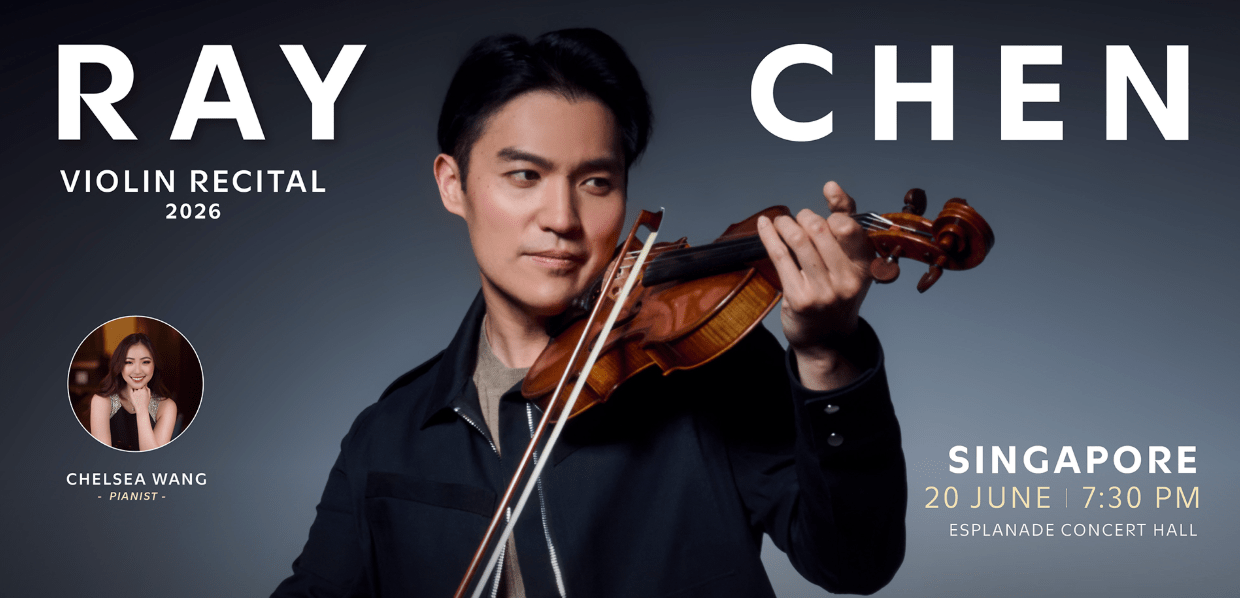
Virtuosity, storytelling, and enough encore pieces for a second recital, Ray Chen makes classical music feel welcoming, alive, and deeply human.
Ray Chen’s return to Singapore felt less like a standard recital and more like a showcase of how flexible a classical concert can be in 2026. Part virtuoso display, part storytelling, part direct conversation with the audience, Chen was joined by pianist Chelsea Wang, as he presented a wide-ranging program that moved from Mozart and Grieg to Bach, Sarasate, and a series of crowd-pleasing encores, all anchored by his unmistakable stage presence and sense of spontaneity.
Opening a recital is always a balancing act: it needs enough energy to capture attention immediately, but enough restraint to leave space for what follows. Chen and Wang found that balance in Mozart’s Violin Sonata in B-flat major, K.454. Chen entered with his trademark ease, shaping the Largo introduction with a steady, grounded pulse that allowed the harmony to settle naturally before the Allegro took off with crisp coordination between both players.
The highlight came in the central Andante, where their playing opened up into something more conversational and searching. Phrases were shaped with a natural give-and-take, and the silences felt just as intentional as the notes. By the final Allegretto, the sonata had done exactly what an opening work should: draw the audience in and quietly raise the energy in the room.
Before moving on, Chen shared a short anecdote about Mozart premiering the work with a blank keyboard part and performing it from memory. It was a light moment, but it also set up the next shift in character as the program moved into Grieg’s Violin Sonata No. 3 in C minor, Op. 45. A brief introduction about Grieg’s harmonic language helped frame the contrast between Mozart’s clarity and the more shadowed, dramatic world ahead.
The Grieg was delivered with clear narrative intent. Chen leaned into strong contrasts in mood and colour, keeping the music constantly in motion. The first two movements had a driving, almost restless energy, while the finale stood out for how he handled its returning themes. Rather than repeating them in the same way, he subtly reshaped their character each time, which kept the momentum alive and made the structure feel more like a journey than a formal outline. Wang matched this approach closely, keeping the piano part responsive and tightly aligned throughout.
The second half shifted into dance-inspired repertoire, beginning with Bach’s “Gavotte en Rondeau” from Partita No. 3 in E major, BWV 1006. Playing unaccompanied, Chen avoided a rigid or overly “academic” approach and instead treated it as a living dance. Each return of the rondeau theme came with small but noticeable changes in articulation and colour, giving the piece a sense of play rather than repetition. The clarity of his voicing also stood out, with multiple lines shaped so distinctly that the violin often sounded like more than one instrument at once.
Wang then rejoined him for two works by Sarasate. In Playera, Chen took a more lyrical, vocal approach, drawing out a warm, singing tone that suited the piece’s nostalgic character. Without pause, he moved straight into the Carmen Fantasy, creating a seamless transition from introspection to theatrical brilliance.
What stood out most in the Carmen Fantasy was how flexible his rhythm felt without ever losing its underlying pulse. The phrasing had a natural elasticity that gave the music a sense of freedom, especially in the more dance-like sections. In the final “Chanson Bohème,” he handled the technical demands: rapid passages, double stops, flying staccato, and left-hand pizzicato, with remarkable ease, but what carried through most strongly was the sense of drive and character rather than sheer difficulty.
After closing the main program at full intensity, Chen returned for four encores that extended the recital’s range even further. He began with Joe Hisaishi’s theme from Howl’s Moving Castle, shaping its simple melody into something broader and more orchestral in effect. This was followed by Monti’s Czardas, complete with a striking opening cadenza and his familiar playful touches, including the “dolphin sound” harmonic effect.
Next came a surprise shift into Mandopop with Jay Chou’s Greatest Works of Art (最偉大的作品), a nod to Chen’s own crossover work with the artist. The final encore brought everything down in scale and intensity: Debussy’s Clair de Lune, played with a lightness and restraint that contrasted beautifully with everything that came before it.
What made the evening stand out wasn’t just the technical level of performance, but the atmosphere Chen created around it. The concert felt unusually open and unforced, shaped as much by his communication with the audience as by the repertoire itself. There was a noticeable sense that the usual distance between stage and hall had been reduced.
The audience itself reflected that shift. It was younger and more diverse than what classical recitals often draw, and the energy in the room felt closer to a shared experience than a formal event. By combining serious musicianship with a relaxed, engaging presentation style, Chen showed why he connects so easily with audiences beyond the traditional concert-going base. It was more than an impressive recital; it was also one that felt accessible without losing its artistic weight.
Ray Chen – Violin Recital played at the Esplanade Concert Hall on 20th June 2026. More information available here


Was it Greatest Works of Art (最偉大的作品)? I thought it was 青花瓷 Blue and White Porcelain perhaps…..
LikeLike