
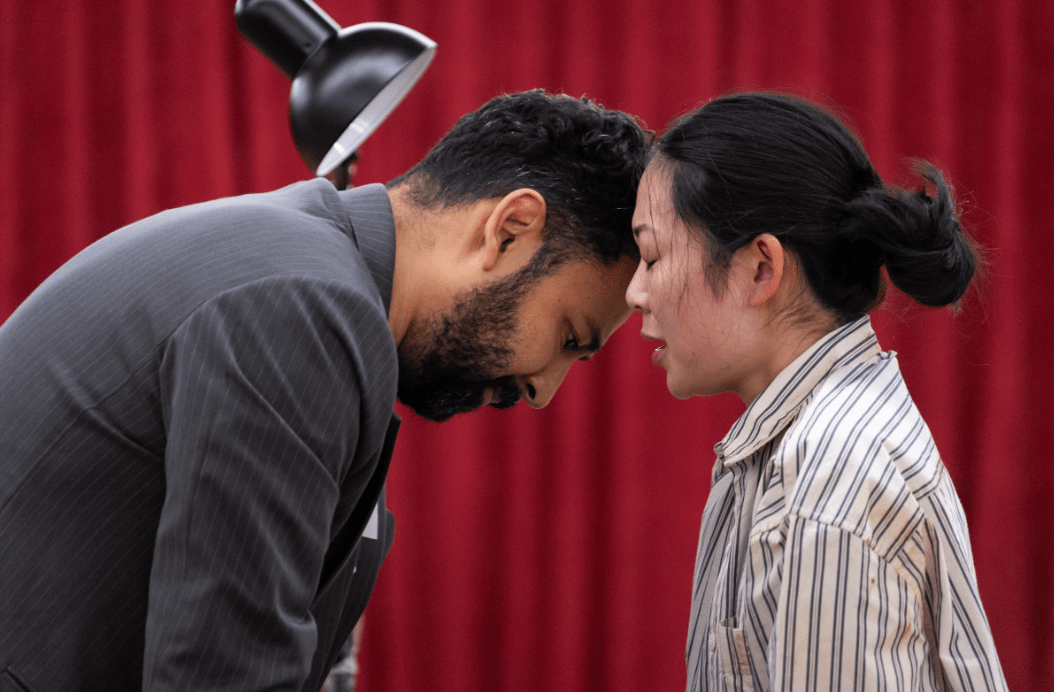
“It wasn’t intentional that A Mirror was chosen for our final season,” says director and Pangdemonium founder and co-artistic director Tracie Pang. “We had already programmed the season before the decision was made that it would be Pangdemonium’s last. We had maybe five shows planned and moving forward, and then it became a question of which of those we would keep and which we would let go.”
But to stage this one in particular, was never in question. “This was a piece I fell in love with the minute I encountered it. I just knew it was a Pangdemonium show. It was the one I wasn’t willing to let go of.”
Written by British playwright Sam Holcroft, A Mirror is set to be staged this June at the Singtel Waterfront Theatre at the Esplanade, and marks one of its first restagings outside of of the UK. In the play, truth is never offered cleanly. It is rehearsed, redirected, repeated and reflected until certainty itself begins to feel unstable. A wedding becomes a performance. A performance becomes surveillance. A state becomes a script. And somewhere within that shifting machinery, the audience realises it is no longer merely observing events unfold, but participating in the construction of reality itself.

When the play premiered at London’s Almeida Theatre in 2023, critics described it as a hall of mirrors, a Russian doll of plays within plays, a theatrical puzzle box built around censorship, performance and power. Inspired in part by Holcroft’s experiences visiting North Korea, and later working alongside playwrights from countries where scripts are routinely scrutinised by censors, A Mirror emerged from a question that haunted her: what does it mean to tell the truth when truth itself carries consequences?
As the acclaimed work arrives in Singapore, Tracie reflects on her attraction to the play, both in terms of its themes and elegance in design. “I’m actually very happy that this is the last piece I’ll direct for the company because it sits very much within the style that Pangdemonium has become known for: the way the story unfolds, the twists and turns it takes. It feels like a return to the kind of work people know us for.”
That reputation has always rested on stories that challenge audiences without alienating them; productions that ask viewers to lean forward rather than sit back. A Mirror may be the purest expression of that instinct yet. It is a play about censorship, certainly, but it is also about performance itself: who controls the narrative, who is allowed to tell it, and what happens when audiences become implicated in its telling.
“Because of the layers in this play, the audience becomes part of the conceit almost immediately,” Tracie explains. “In the opening prelude, we tell them that they’re not simply here to witness a wedding. They’re part of the conceit itself. Straight away, they’re invited into the mechanism of the play.”

From that point on, spectatorship changes shape. Watching is no longer a passive experience, and interpretation is no longer optional. Every scene becomes an invitation to question what is being seen, and why.
The experience feels especially resonant when viewed through the lens of Holcroft’s wider body of work. The playwright has long been fascinated by systems, rules and hidden structures. Following an autism diagnosis later in life, she spoke publicly about her lifelong tendency to observe human behaviour almost scientifically, studying the rules by which people interact and constructing frameworks to understand them. Looking back, she recognised how often her plays revolved around scripts within scripts, performances within performances, and the invisible mechanisms that govern human behaviour.
That fascination runs through A Mirror. The play refuses to conform to a conventional narrative, instead fixating on a core mechanism designed to reveal itself slowly. Scenes repeat with subtle variation. Meanings shift depending on perspective, and every apparent certainty is later reframed. For Tracie, staging that complexity has required an almost forensic level of precision. “What’s fascinating is that the tiniest shifts create the biggest waves,” she says. “We can make a very small adjustment in rehearsal and suddenly the entire scene feels different.”
To translate that elegance from page to stage requires far more rigour in practice. “One of the discoveries in the rehearsal room has been that the play is not as easy as it looks on the page. You read it and think, ‘This is so clever. It’s so well written. We know exactly what to do.’ We do know what to do, but it’s also much harder than I expected.”

The challenge comes from the interconnectedness of every element. “The smallest shifts create knock-on effects for every actor. They have to dive deeply into their own characters while simultaneously keeping track of what everyone else is doing. They’re constantly observing and mentally recording what another character is doing so they can recall it later when needed,” she says. “But at the same time, that makes the process incredibly interesting. It sometimes feel like I’m conducting a CSI investigation, dissecting everything and figuring out how all the pieces fit together.”
Yet beneath all that complexity sits a surprisingly simple objective: cutting through it all so the audience understands exactly what is going on at any one point in time. “My job is to create clarity,” Tracie says. “I want the audience to feel that clarity as they go through. With each shift, I want them to think, ‘Oh, it’s changed,’ not to feel confused that something has changed. In a way, it’s like removing a layer each time so it becomes clearer and clearer as the play progresses.”

For cast member Ghafir Akbar, understanding the play begins with understanding the system beneath it. “For me, I’m still in the middle of trying to solve the play,” Ghafir says. “I approach it the way I approach any play: by understanding what it’s trying to do and what it’s trying to say. Only when I fully grasp the playwright’s intent and understand how she has constructed the characters, the story, and its reversals do I feel comfortable enough to let go.”
Yet paradoxically, the deeper he understands the structure, the more uncertainty becomes necessary. “The letting go comes from accepting that anything can happen. You need to live on the precipice of feeling that something bad could happen at any moment. That’s where the freedom exists in the performance itself, even though I’ve spent time building the foundations of that performance.”
That tension between control and unpredictability sits precisely at the core of the work. “With this play in particular, it’s about paying close attention to why certain things are said in a particular way. My character repeats a lot, and not only does he repeat himself, other characters repeat what he says as well. Understanding how that affects the audience’s listening experience is crucial.”

The result is a form of theatre that resists individual ownership. “If anything, the process requires being analytical and laser-focused on the smallest details,” Ghafir adds. “At the same time, while theatre is always collaborative, this play takes that collaboration even further. You’re not building a character on your own. The entire ensemble contributes to the construction of every character.”
“It’s not simply about sharing scenes. It’s about understanding what another character is doing to your character in a particular reality. It’s exciting because the work genuinely feels created by everyone: you’re not responsible only for your own piece of the puzzle; you’re responsible for everybody else’s little game of theatrical Tetris as well.”

For Coco Wang Ling, that collective responsibility defines the rehearsal room. “This script, in particular, really requires everyone to be on the same page,” she says. “As actors, it’s easy to think, ‘This is my character, and I want to make this choice.’ But every choice you make affects everyone else and how they’re playing their scenes.”
Meaning is never fixed. “Everyone needs to agree on the lens through which a scene is being viewed. Sometimes we think we’ve settled on one interpretation, and then we discover another perspective that completely changes our understanding. What’s been really exciting is having all of those possibilities available and then deciding which choice best serves the story we want to tell.”
That process demands rigour rather than instinct. “In rehearsal, I don’t think you can rely on vibes, I find this script particularly difficult to simply let loose with. It feels much more delicate than that,” she says. “Even when I want to try something new, I tell my fellow actors and my director first. I want everyone to know what I’m exploring rather than suddenly doing it in the moment. That way, everyone can listen differently and become more attuned to where the scene might go.”

Yet within that precision, Coco, who is working with Pangdemonium for the first time, has also found something unexpectedly generous. “Working with any new group of people can be daunting. You don’t know whether you’ll fit into the rehearsal culture or connect with the directing style.”
“Very quickly, though, I discovered that this was a safe and empowering space to explore, communicate, and try different things. I’m incredibly grateful for that. Nothing has felt confronting. It’s been a joy to come in each day knowing that everyone is there to support one another and figure the play out together in a healthy, collaborative way.”
For Tracie, that spirit of collaboration begins with casting itself. “It’s a small cast, and I’ve always been very careful about casting. I work hard to find the right people for the roles rather than simply choosing people I already know well.” It’s lovely to work with friends, but it’s really important to cast the right person because once you’ve done that, half your job is done.”
“Having read this character, Ghafir was the first person I went to. I knew he would make a wonderful meal out of the role,” she says. “And regarding Coco, I’ve always believed in finding the right person for the right role, we’ve had our eye on her ever since she was in school, and she even auditioned for Falling sometime back. It just so happens that for my last show, the time was finally right for Coco.”

The cast’s admiration is mutual. “I think Coco is an incredibly curious person,” Ghafir says. “Whenever we’re working together, she always has a book with her, she’s always reading plays, and she’s constantly exploring new projects and opportunities. That’s one way artists keep themselves sharp. You’re always doing different things, always learning, always finding ways to keep your skills in top form.”
If the rehearsal room has become a place of discovery, the play itself remains deeply concerned with larger questions of freedom, censorship and artistic responsibility. “What I love,” Tracie says, “and what I enjoy about many of the plays I’ve chosen to work on, is that there are often two completely opposing points of view, and you can understand and agree with both of them. You understand where someone is coming from and recognise that they’re trying to do the right thing, yet you may still disagree with them. That’s where the richness lies.”
That complexity feels especially relevant to a work inspired by artists who have created under systems of control. Holcroft’s encounters with writers in Lebanon and Syria, some of whom feared secret police might attend their performances, helped shape the questions that eventually became A Mirror. Rather than offering easy answers, the play asks what art is for, why artists continue pushing boundaries, and whether truth remains worth pursuing when the costs become personal.

“What I love about the play is that it could be set anywhere,” Tracie says. “Because of the research behind it, it speaks to so many places that have experienced censorship, and artists who have struggled under it. It asks why artists feel the need to push boundaries, and why these stories matter.”
While the play is not set in Singapore, she believes its themes resonate locally. “Singapore audiences often read censorship and surveillance through both historical and contemporary lenses,” she says. “I have personal experience of taking scripts down to the police station to be ‘marked’ with a black marker in the past. We’re not in that place now, but the questions still exist in the room, in that there may not be as overt censorship, but there are still pressures including funding, subtle constraints, and questions about what is being said and how. So while this isn’t set in Singapore, it is a global issue. And the questions it raises are still relevant here.”
The urgency of those questions is reflected in the production’s rhythm, where there is no intermission at all, and you’re locked in with the cast for 150 minutes. “If you put an interval in, it breaks the conceit of the piece,” says Ghafir. “It’s supposed to feel like a pressure cooker and needs to stay closed long enough to cook. If you open it too early, it just doesn’t work, while balancing an urgency in telling this story as quickly as possible.”
That also ultimately extends beyond the stage. “I don’t think audience responsibility ends,” Tracie says. “Theatre is a live, breathing thing, and that’s what makes it different from film or TV. No two shows are ever identical. That’s the nature of human beings telling stories.”

Because the audience becomes part of the play’s machinery, she believes their role continues after the final scene. “Because the audience is complicit in this piece, their responsibility continues after they leave; to talk about it, and decide whether these questions matter and should continue to be asked.”
Ghafir sees it similarly. “There’s an agreement with the audience. They come, and for those two hours they give themselves over to the performance. When they leave, hopefully it’s not the same experience they came in with. Everyone will remember it differently. The audience brings their own experiences, and that colours what they take away.”
For Coco, the responsibility is even more direct. “I wonder whether audiences will feel empowered enough to choose to stay, not because they’ve paid for a ticket, but because they want to hear the story. That their choice to stay is because they want to hear the truth, and that they deserve to hear the truth.”

And perhaps that is what makes A Mirror feel so unsettlingly contemporary. It is a play about censorship, but also about complicity. About storytelling, but also about spectatorship. About how narratives are constructed, repeated, amplified and believed.
“What I hope that lingers,” Tracie says, “is not passivity, but the ability to question things in life. To stay engaged as a community.”
“I hope they leave reminded of how exciting theatre can be,” Ghafir adds. “Not just as entertainment, but as something that can change you, even in small ways.”
Coco’s hope is simpler but no less significant. “In theatre, you are complicit. It’s not passive like film. It’s an exchange every night between actors and audience.”
That exchange may be the play’s greatest trick. Long after the final scene, after the illusions have been exposed and the reflections have fractured into countless interpretations, A Mirror leaves behind a lingering uncertainty about how we decide what is true in the first place. And in an age increasingly shaped by competing narratives, contested realities and endlessly reframed truths, that question feels less like theatre than life itself.
Photo Credit: Ruey Loon
A Mirror plays from 26th June to 12th July 2026 at the Singtel Waterfront Theatre. Tickets available here


One thought on “Turning Audiences Into Accomplices: An Interview with director Tracie Pang, and cast members Coco Wang Ling and Ghafir Akbar on Pangdemonium’s ‘A Mirror’”