
Koreeda’s retreads familiar ground with themes of found family and the process of grief in this futuristic fairy tale with mixed results.
Sheep in the Box sees award-winning filmmaker Hirokazu Kore-eda return to his specialty of family, grief, and the fragile systems we build to survive both, but refracts them through a near-future setting that is conceptually rich, emotionally uneven, and structurally overextended. It is a film that often feels like it is circling something profound, even when it struggles to fully arrive there. At its core, the film is less interested in whether artificial grief “works” and more in how grief itself behaves like a system, one that can be redirected into technology, family roles, and even ecology, but never fully contained.
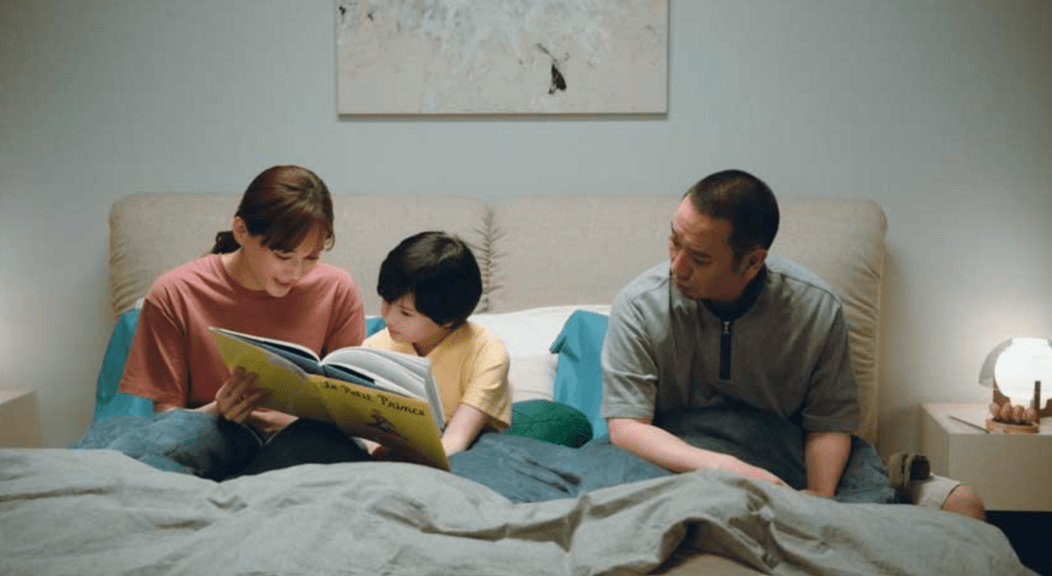
The story follows Otone Komoto (Haruka Ayase) and Kensuke Komoto (Daigo Yamamoto), a couple still unmoored two years after the death of their young son, Kakeru. Their lives are disrupted by REbirth, a corporation offering an AI humanoid reconstruction of the deceased child. What arrives is Kakeru 2.0 (Rimu Kuwaki): physically identical, behaviourally reconstructed, and emotionally unreadable in precisely the ways that make him both comforting and unsettling.

Kore-eda’s approach remains observational, almost documentary in texture. He does not rush the emotional consequences of this substitution, nor does he moralise it. Instead, he watches the couple diverge in their grief strategies. Otone leans into the replacement, structuring her days around caregiving routines that blur the line between coping and dependency. Kensuke resists, referring to the humanoid as a “Roomba” or “Tamagotchi,” before gradually shifting into something more ambiguous: not acceptance, but reclassification, where he eventually stops treating the child as a son and begins treating him as a companion, a tool, and eventually a confessor for guilt he cannot otherwise articulate.
What the film captures well is how grief refuses stability. Otone’s attachment is not linear; it curdles at moments when the humanoid behaves with too much autonomy, as if the simulation is trespassing on memory rather than preserving it. Kensuke’s arc moves in the opposite direction, culminating in a quietly devastating attempt to reconstruct his son’s death and futile search for closure by dressing the humanoid in Kakeru’s clothes and forcing a replay of the past, an act that collapses into apology rather than revelation.

At its best, Sheep in the Box treats the humanoid not as a technological object but as a psychological interface: a space where guilt can be spoken without consequence. Kensuke’s comparison of the humanoid to a Tamagotchi becomes unexpectedly precise. What the parents engage with is not resurrection, but a form of rehearsal, a system that allows them to perform parenting, regret, and forgiveness without the permanence of real relational harm.
This logic extends into the film’s central metaphor, drawn from The Little Prince. The “sheep in the box” is initially presented as a simple idea of imaginative belief, but gradually becomes something more structural: a theory of containment. The humanoid child is literally a boxed solution to grief, but so too are the emotional strategies surrounding him. The box is not just the AI system but the entire architecture of coping. Grief is placed inside it, but never fully contained by it.

Read this way, the film’s recurring imagery of trees, wood, and architectural design becomes more than decorative symbolism. Kakeru’s fascination with tree grain and Otone’s profession as an architect suggest a shared logic between organic and artificial systems: both are forms of networked intelligence. Trees communicate through unseen underground systems; AI responds through data loops; grief itself spreads through families like a living network of signals, misreadings, and inherited emotional patterns. The film is less interested in AI as machine than as ecology.
This is reinforced by Otone’s family dynamics. Her mother, played by Kimiko Yo, introduces a colder, generational logic of emotional efficiency: the idea that loss can be solved by substitution, and that another child could simply replace the broken system. What makes this unsettling is not its cruelty but its continuity. Otone’s architectural mindset, her belief in design as a solution to instability, feels like an extension of this inheritance. Across mother and daughter, the same impulse recurs: control grief by rebuilding the structure around it.

The film occasionally pushes this metaphor into broader territory, hinting that AI and humans are co-evolving systems, or that artificial children mirror ecosystems rather than machines. These ideas are compellingly suggested rather than fully stabilised, but the ambition is clear: grief is not resolved in Sheep in the Box, but redistributed across overlapping systems of care, memory, and simulation.
The weakest elements of the film lie in its more explicitly speculative B-plot involving missing children, runaway humanoids, and a shadow network of escaped AI beings. These sequences broaden the film’s ethical scope, introducing questions of abuse, autonomy, and refusal, but remain narratively underdeveloped. The logic of the world often gives way to allegory, and the tonal shift from intimate domestic drama to techno-parable never fully coheres. Yet these sections also feel like an extension of the film’s central concern. If grief is a system of containment, then anything that escapes that system: children, humanoids, memory itself, necessarily appears as disruption. The result is messy, occasionally frustrating, but thematically revealing.
By the final act, when the humanoids and abused children move toward a forest refuge, the film settles fully into metaphor. The escape is not resolution in a narrative sense, but an exit from ownership, from fixed definitions of family, and from grief as a closed circuit. The forest becomes the opposite of the box: not containment, but continuation.
Sheep in the Box feels like a film about ‘boxes’ at every level: grief contained within artificial bodies, memory stored inside technological systems, family enclosed within unstable definitions, and identity shaped by inherited emotional structures. As narrative cinema, it sits a step below Kore-eda’s strongest work, burdened by an overabundance of ideas and a tendency toward thematic sprawl. But as a meditation on grief, simulation, and the systems we build to survive loss, it remains compelling enough to justify engagement and praise for its emotional persistence. It is uneven, sometimes diffuse, but recognisably Kore-eda in its patience, empathy, and refusal to reduce human attachment to a problem to be solved.
In that sense, the film’s title becomes its final argument rather than its premise. The “sheep in the box” is never something that can be verified or disproven. It exists only insofar as it is collectively sustained: an object of belief produced through shared attention rather than material certainty. As The Little Prince reminds us, what is essential is invisible to the eye, not because it is absent, but because it only exists in the act of perceiving. Kore-eda ultimately returns to that fragile space where perception replaces proof: where Kakeru is no longer the child he was, yet cannot be reduced to absence, because he continues to exist within the emotional structure his family has built around him. The question Sheep in the Box leaves behind is not what is real, but what can still be held together through perception and reframing the box.
Sheep in the Box opens in Singapore cinemas from 25th June 2026.


2 thoughts on “★★★★☆ Film Review: Sheep in the Box 箱の中の羊 dir. Hirokazu Koreeda”