
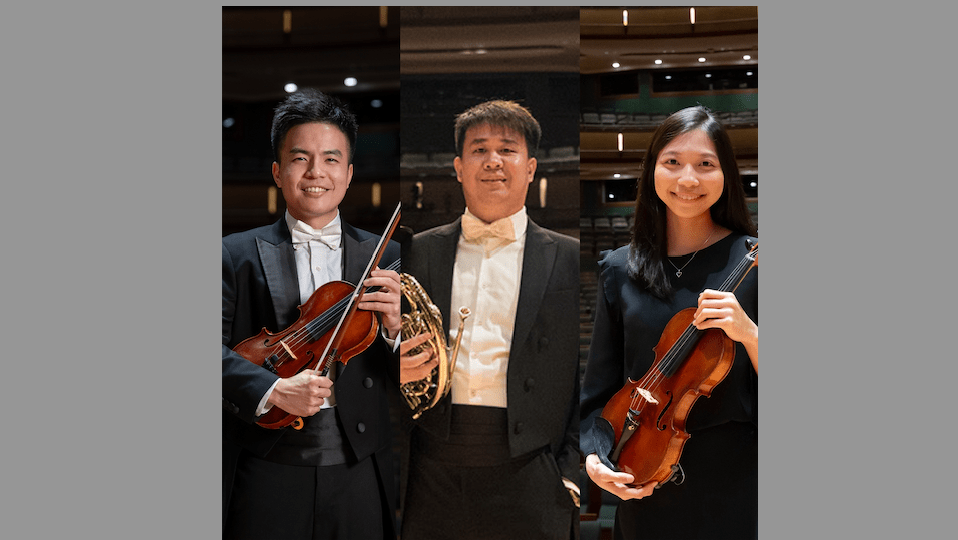
In the hearts of many young Singaporean musicians, performing with the Singapore Symphony Orchestra (SSO) is an aspiration that begins long before they step onto the concert stage. For Bryan Chong, Martin Peh and Reina Teo, that aspiration has now become reality.
Horn player Bryan joined in September 2025 after years of performing alongside the SSO as a freelance musician. Violinist Martin joined full time in April 2026 following performances with the SSO since March 2025, returning home from almost a decade of study overseas. while fellow violinist Reina is the latest to join the orchestra after building her musical career across Singapore, Europe and China. Although each arrived by a different route, all three share a sense of gratitude, curiosity and excitement as they embark on the next stage of their musical journeys.
For all three musicians, joining the SSO carries a deeply personal significance. For Reina, it is a dream she has carried since childhood. “Growing up in Singapore, the SSO was always the orchestra I looked up to. I remember attending concerts as a student and performing alongside the SSO as a member of the Singapore National Youth Orchestra, so joining the orchestra as a section violinist feels like a full-circle moment.
“I wasn’t expecting the outcome, so it took a while before the news really sank in. I felt grateful and excited for what lies ahead.”
Bryan describes his appointment as the fulfilment of a journey that began years earlier. “Being part of the SSO is a dream come true and a source of great pride. It represents the fulfilment of my musical journey throughout my time in the Singapore National Youth Orchestra (SNYO). and Yong Siew Toh Conservatory of Music. When I received the news after the audition, I felt a mixture of relief, joy and gratitude – it was a proud and humbling moment that filled me with a lot of excitement to continue contributing to this orchestra every day.”
For Martin, the moment was equally meaningful. “Joining the SNYO while I was in primary school and now playing as a first violinist in Singapore’s national orchestra, the SSO, feels like a full-circle moment as a Singaporean musician. Being part of this orchestra means having the joy of contributing to my home country while collaborating with exceptional colleagues. When the news came, I felt deep gratitude and excitement. I also felt all of the hours of practice and studies finally aligning with this opportunity.”
Each musician credits different experiences for shaping the artist they are today. Bryan says it is difficult to pinpoint a single defining moment. “I’ve been really blessed to have met and be inspired by many amazing teachers from around the world through masterclasses and festivals. But if I had to pick teachers who had the biggest impact on me, I would have to mention my two teachers Gao Jian and Jamie Hersch who’ve paved the way for me to become the musician and horn player I am today.”
Martin immediately thinks of his first Suzuki violin teacher, the late Mr Kang Choon Sim. “My first Suzuki violin teacher, the late Mr Kang Choon Sim, always reminded me not to give up the violin (there was a time when I seriously considered changing to be a viola major). I only wish I could have invited him to my first SSO performance…he would have been so happy to know he made an impact in my life.”

For Reina, her greatest lessons came from experiencing different musical cultures. “I’ve been fortunate to learn from many wonderful teachers, some of whom are members of the SSO. Looking back, I think the biggest influence has been studying and performing in different musical environments, and learning from teachers with different backgrounds and perspectives.
“Each place challenged me in different ways and introduced me to new approaches to music-making. There was always something new to learn, and along the way there were concerts that reminded me why I chose this path. Those moments of connecting with the music and the audience have stayed with me and continue to motivate me.”
Those experiences continue to influence the musicians they are becoming. Having already spent several months with the orchestra, Bryan says settling into life as a full-time member has been made easy by the support of those around him. “Making the transition to full-time musician has been really easy for me because my colleagues in and out of the horn section have all been very welcoming, appreciative and supportive of what I do, and that gives me a good platform to continue growing as a person and a musician.”
He has also been struck by what goes on beyond the concert platform. “I’ve been most surprised by both the musical intensity and the organisational excellence of the orchestra. The level of focus and collaboration needed on stage, combined with the efficient support behind the scenes, has been impressive and rewarding.”
As she prepares to begin rehearsing with the orchestra, Reina is looking forward to what lies ahead. “Musically, I’m looking forward to performing a wide range of repertoire with the orchestra. There’s also an incredible lineup of soloists this season, so I’m really excited to share the stage with them. Most of all, I’m looking forward to learning from my colleagues and continuing to grow through making music together.
“Personally, it’ll be great to be back home and sharing music with audiences here.”
Her years overseas have broadened her artistic outlook. “Each place has shaped me in a different way. Singapore gave me my musical foundation, Europe encouraged me to be bolder in my interpretations and playing, and studying in China taught me the importance of attention to detail and collaboration. Along the way, I also had the opportunity to meet and perform with musicians from many different backgrounds who continue to inspire me.
“Experiencing these different musical environments has taught me to be adaptable and open-minded. It’s shown me that there isn’t just one right way to make music, and I think that’s made me a better listener, collaborator and musician.”
She has also embraced collaborations beyond the traditional classical stage. “What I enjoyed most was how different every experience was. Each collaboration came with a different audience, a different way of working and a different goal, and that made me realise there isn’t just one way to share classical music.
“I’ve never really seen classical music as something that should only exist in the concert hall. Whether it’s a traditional concert, an educational performance, or a collaboration with artists from different genres, if it helps someone connect with the music, I think it’s worthwhile.”

Reina is also performing on a 1922 Carlo Carletti violin on loan from the Rin Collection, an instrument she describes as a constant source of discovery. “It’s a privilege to perform on an instrument with so much history. Every violin has its own personality, and building that relationship takes time. The more I play it, the more I discover what it responds to best.
“The Carletti has a warm and rich sound, but what I appreciate most is how sensitive and responsive it is. It encourages me to listen more carefully and be more intentional with every phrase. I’m grateful to the Rin Collection for the opportunity to perform on such an instrument.”
Martin’s own journey has also been shaped by experiences beyond performance. Alongside earning a doctorate and performing extensively, he taught music theory and apprenticed as a luthier. “Music theory sharpened my analytical ear, working towards a doctorate built discipline, and luthier work deepened my appreciation for sound production and setup. It all makes my playing more intentional and connected to the instrument’s craft.”
Returning to Singapore after eight and a half years abroad was an easy decision. “After studying for eight and a half years, being together with my family and a desire to be home motivated my return. Singapore’s growing scene, with vibrant ensembles and audiences, is exciting. Classical music is the best remedy, and I’m eager to use it to help nurture talent and give back to my country.”
Having performed in both chamber ensembles and orchestras, he relishes the contrast. “The musical resonances that are produced when playing in a small group versus a big group are quite varied. Chamber music offers intimacy, individual voice, and close collaboration. Orchestral playing also has these same qualities, except that it brings the additional thrill, power and unity under a conductor. Switching between these two settings keeps me versatile and musically fulfilled.”
Like Bryan, Martin has also been impressed by the work that happens behind the scenes. “At the SSO, behind every successful concert season lies extensive planning and dedicated preparation by the management team. Behind every memorable performance are countless hours of intensive rehearsals. This is a place where I can continually grow as a musician, constantly inspired and motivated by my highly skilled colleagues.”
Bryan, meanwhile, remains fascinated by the versatility of his instrument. “It is challenging but also highly exciting and rewarding. I’m drawn to the depth of sound and colours that this instrument can produce, and the repertoire that we have is just simply amazing – one moment we can be playing a heroic or fanfare melody along with the other brasses, and the next moment we have a lush quiet moment with the woodwinds. These colours and textures change depending on the composer and context, and I feel really blessed to be experiencing this on such a high level every single day.”
Away from rehearsals, each musician has their own way of staying inspired. Bryan enjoys exploring other artistic disciplines. “I like spending time exploring other art forms such as visual arts and dance among others. I am constantly inspired by other artists when I observe them working and building towards something, and I believe that inspires and expands my creative vocabulary as well.”
Running and video games also help him maintain balance. “They both help in different ways. I like running especially after a day of intense rehearsals because it allows me to just be with my thoughts and process the day, and it also helps me stay mentally clear during a busy period. Besides loving music, I love playing video games as well (especially those of the open world and soulslike genres), as they give me an opportunity to immerse myself in a different world where I can explore, solve problems and sharpen my thinking in a relaxed setting. Both running and video games provide the perfect balance for me personally.”

Martin draws inspiration from Singapore’s vibrant performing scene. “Performing with local ensembles like Resound Collective and T’ang Quartet, plus teaching and playing gigs, keeps me inspired. Having a variety of performing opportunities in Singapore enriches me with diverse perspectives.
“To recharge, I always spend time with family, friends, and occasionally travel.”
For Reina, travel offers an opportunity to reconnect with music from the audience’s perspective. “I love travelling whenever I get the chance. Exploring new places and experiencing different cultures helps me step away from music for a while and come back feeling refreshed.
“Whenever I’m overseas, I also try to attend concerts. As performers, we’re usually the ones on stage, so it’s refreshing to experience music from the audience’s perspective. Watching other orchestras and soloists perform often reminds me what it’s like to be on the receiving end of a meaningful performance, and I try to bring that perspective back into my own playing.
“Having that balance reminds me that there’s a life outside of music, and I think that ultimately helps me become a better musician too.”
Asked what advice they would offer aspiring musicians, all three emphasise embracing the journey as much as the destination. Reina encourages young musicians to seize every opportunity. “I’d say, put yourself out there. Play with different people; join festivals, auditions and chamber groups. Say yes to as many opportunities as you can.
“Personally, I never really chased after one specific thing. I just took every opportunity as it came and tried to give my best in everything I did. I’ve always approached each performance or project as if it might be the last time I’d get to do it, and that mindset has made me appreciate every experience.
“It’s good to have big dreams, but don’t get so caught up chasing them that you forget to enjoy the journey. Spend time with the people around you, live a little, and don’t forget that we’re all human at the end of the day.”
Bryan agrees. “Playing professionally requires a really high level of consistency and attention to detail. I would say for a start, to enjoy the journey as much as possible, cultivate patience, resilience and a lifelong love for learning, and always stay curious.”
For Martin, the key is to keep exploring. “I would recommend trying all kinds of projects and finding something that resonates with you (for me it was playing in an orchestra and working as a team). Persistence and adaptability are key, and I believe that hard work will pay off in the end.”
Their paths to the SSO may have been different, but together Bryan, Martin and Reina represent a new generation of Singaporean musicians who continue to learn, grow and contribute to the country’s musical landscape, one performance at a time.
Find out more about the SSO and upcoming events here

