
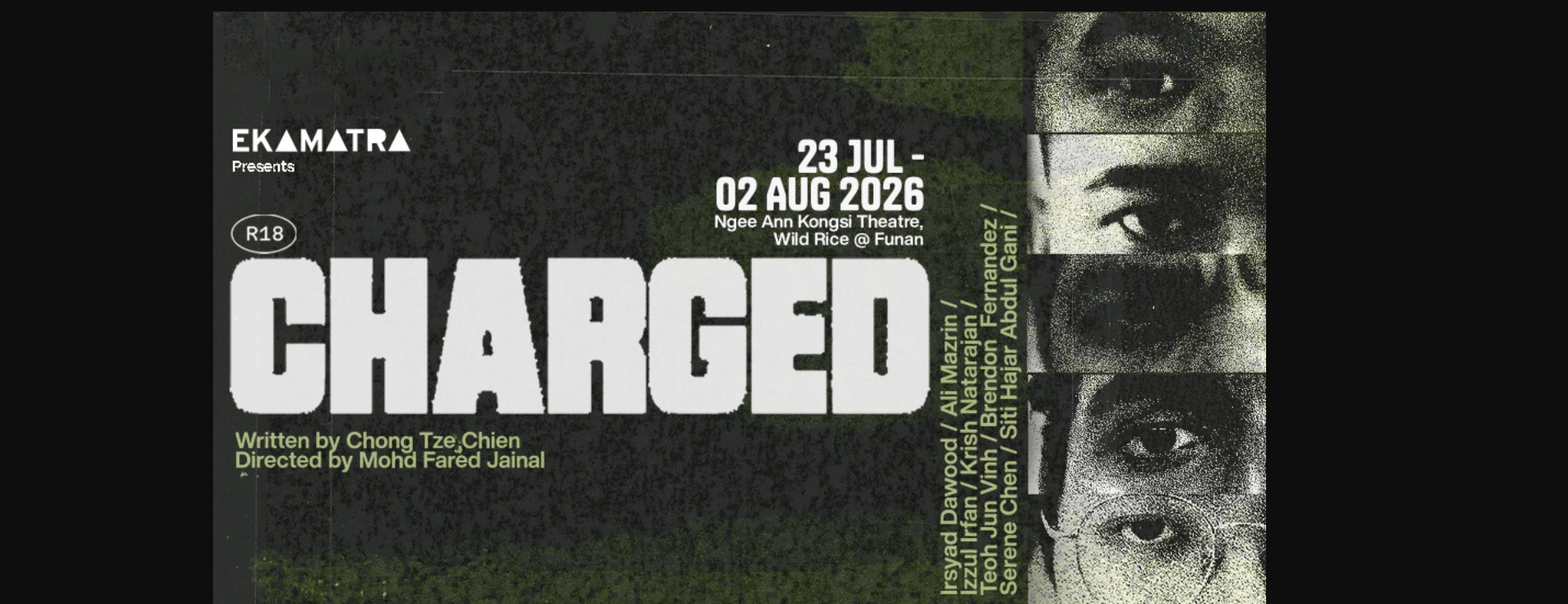
When Charged premiered in 2010, it did something few Singapore plays had dared to do back then. Set over a single night in an army camp during Chinese New Year, Chong Tze Chien’s drama placed one of Singapore’s most enduring fault lines of race within one of its most sacred institutions. The Singapore Armed Forces has long been imagined as a crucible of nation-building, a place where young men from different backgrounds are brought together under a common purpose. Charged questioned what happens when that ideal fractures.
Beginning as an investigation into a fatal shooting, Charged slowly unfolds through conflicting testimonies, exposing simmering resentments, unequal opportunities, casual prejudice and institutional blind spots. As the testimonies grow, rather than assigning blame to a single villain, the play asks a far more uncomfortable question: how do ordinary people become participants in systems that perpetuate harm, often without fully realising it?

And now, sixteen years later, Teater Ekamatra is bringing Charged back. In many ways, Singapore has changed since the play’s original run. Conversations about race are more visible than they were in 2010. Terms like privilege, systemic discrimination and unconscious bias have entered public discourse. Social media has amplified conversations that once took place quietly behind closed doors. Yet for Artistic Director Shaza Ishak, one aspect of revisiting Charged has been particularly sobering.
“What was scary for us was how little we needed to change in the script,” she says. “The vocabulary around race has expanded. We talk about these issues with a lot more nuance. But the emotional experience of navigating race hasn’t changed.”
That observation perhaps explains why Charged feels like a fresh, still relevant conversation rather than a revival dragged out from the archives. Rather than functioning as a period piece, the play returns to ask questions that continue to resist comfortable answers. Shaza believes the play’s endurance also reflects the strength of Chong’s writing. “Great plays need to be revisited,” she says. “If we’re serious about building a Singapore theatre canon, then we have to keep reintroducing those works to new audiences.”

That philosophy has increasingly shaped Teater Ekamatra’s programming. While the company has consistently championed new voices and contemporary stories, Shaza argues that a healthy theatre ecosystem also requires audiences to return to landmark works, seeing them as living texts that continue to evolve alongside society. “Every story feels urgent,” she reflects. “There are many great stories waiting to be told, but we’re limited not only by money, but by building enough audiences for those stories.”
Finding that balance, she says, means deciding when to nurture something entirely new and when to invite audiences back to works that still have more to say. “Sometimes theatre is so focused on chasing novelty that we forget to build memory.”
For cast member Serene Chen, returning to CHARGED has been just as much about rediscovery as remembrance. Chen reprises the role of the deceased’s grieving mother she first performed 16 years ago, a rare opportunity for any actor. Yet she insists revisiting the character was never about recreating what came before. “I think letting go is the best,” she says. “Trying to recreate something from 16 years ago is a recipe for disaster.”
Instead, she found herself bringing an entirely different life experience into the rehearsal room. “When I first did the role 16 years ago, I was 36. Now my own son is 14, and he’s not that far away from enlistment.”

That shift has fundamentally changed how she experiences the play. “Being a parent changes the way you think about these themes, because one day your child will also share those intimate, difficult spaces with other people.”
It is one example of how Charged reveals different layers each time it is revisited because of how much its audiences and performers change. While the play is often remembered primarily for its treatment of race, both Chen and Shaza believe that description only scratches the surface. “If I had to choose one theme,” Chen says, “it would be belonging.”
“When you talk about belonging, you’re naturally talking about inclusion and exclusion, about how you’re accepted or not accepted, what parts of yourself are embraced, what parts are privileged. It becomes a question of whether I feel like I’m part of this fabric, and whether I’m an important part of it.”
For Shaza, race cannot be separated from the other systems operating within the play. “Race doesn’t exist independently of class, masculinity, power or belonging,” she says. “The brilliance of Chong Tze Chien’s writing is how all those conversations are interwoven.”

Interestingly, she notes that during rehearsals, younger members of the cast found themselves particularly drawn to another aspect of the play that perhaps received less attention in 2010. “The boys were really interested in talking about the misogyny in the work.”
That, she believes, reflects a generational shift towards understanding how different systems of power intersect with one another. The play’s military setting becomes particularly significant in this regard; National Service remains one of Singapore’s most defining shared experiences, yet it is also an institution built upon hierarchy, conformity and collective identity.
Charged does not present the military as either hero or villain. Instead, it examines what happens when deeply personal anxieties about race, class and masculinity are compressed within an institution that asks individuals to become part of something larger than themselves.
Chen sees that refusal to simplify as one of the play’s greatest strengths. “I feel like the play asks us to recognise how ordinary people can become part of larger systems without fully understanding the impact of their actions. Sometimes you think, ‘This person is racist, full stop.’ But it’s rarely the case. It is almost always systemic racism.”

Rather than leaving audiences with someone to condemn, she hopes the production encourages introspection. “Theatre is very good at cultivating empathy. I would love audience members to think about where they themselves might sit within those dynamics.”
The structure of CHARGED reinforces that invitation. The story unfolds through contradictory recollections, each testimony reshaping the audience’s understanding of what happened the night before.
For Shaza, that narrative device captures something profoundly human. “Memory is an unreliable narrator,” she says. “People aren’t remembering facts—they’re remembering their experience.”
Two people, she observes, can witness exactly the same event and carry away entirely different truths. Chen believes that openness is precisely what distinguishes theatre from more didactic forms of storytelling. “Theatre is about experiencing something and filling in the missing pieces yourself,” she says. “If everything was simply explained to you, then you might as well attend a lecture.”
She remembers audience members from previous productions telling her they wanted to watch Charged a second time.”To me that’s lovely because it’s a posture of curiosity. It’s wanting to understand more, rather than being told there’s only one way to understand.”
That sense of curiosity extends beyond the play itself to the rehearsal room. Having spent years teaching younger performers, Chen has noticed how much Singapore’s theatre industry has evolved since Charged was first staged. “The cast, particularly the boys in the army, have been a real joy to work with,” she says. “Wearing my educator’s hat, I think we now have a lot more young people who have gone through theatre training and arts schools. The way they’ve approached the work is fairly different.”

Perhaps the biggest change, however, has been in how artists care for one another. “We’re very particular now about how we take care of each other,” says Chen. “It was all great in the past—we did whatever we could—but let’s face it, the industry was a lot younger then.”
Creating emotionally demanding work, she says, now goes hand in hand with creating emotionally safe rehearsal spaces. “The company has been very supportive and has tried to make the environment a safe one so that we’re able to do our best work.”
She laughs before adding, “Well done, Shaza and team.”
That emphasis on care feels especially significant given the weight of Charged‘s subject matter. The play remains uncompromising in its examination of prejudice and violence, yet neither Chen nor Shaza believes audiences should approach it expecting to leave with definitive conclusions. “One of our best friends has always been word of mouth,” Chen says. “People advocate for watching this play because you just have to.”
She acknowledges that audiences may expect Charged to be difficult. She describes theatre as a communal act of working through uncertainty together. “People will always find a difficult play difficult to watch,” she quips. “But you’ll be surprised. It’s okay to ask questions. You don’t have to arrive at an answer.”

For Shaza, that openness has become even more important in an increasingly polarised world. “Maybe once upon a time it was easier to come under the umbrella of an institution,” she reflects. “Can we really do that today?”
Rather than searching for certainty, she believes audiences should begin with themselves. Quoting Dolly Parton, she smiles. “‘Find yourself and do it on purpose.’ It sounds tongue-in-cheek, but I actually like it. If the big questions are too big to grapple with, then maybe start with the smaller ones.”
Ultimately, she sees theatre less as a vehicle for persuasion than for reflection. “Going to the theatre is actually a gentle way of saying, ‘I want to know what other people are talking about. I want to know what people are thinking.,” she says. “Theatre holds up a mirror to—if not all of society—then at least some of society. It begins a conversation with others, but more importantly, it begins a conversation within yourself.”
Perhaps that is why Charged continues to resonate, and remains so important today. Not because Singapore has failed to move forward over the past sixteen years. Not because the play offers prescient solutions to enduring social tensions. Rather, Charged endures because it refuses the comfort of certainty. It challenges audiences to sit with contradiction, to recognise themselves within imperfect systems, and to resist the temptation to reduce complex questions into simple binaries.
In an era where public conversations increasingly reward certainty, outrage and instant judgement, Charged remains quietly radical for asking something much harder: not who is right, but what it means to keep asking the question.
Photo Credit: Teater Ekamatra
CHARGED plays from 23rd July to 2nd August 2026 at The Ngee Ann Kongsi Theatre, Wild Rice @ Funan. Tickets available from BookMyShow

