

A tender, bewildering piece of participatory theatre where audiences learn to get things right (and wrong) together, revealing us at our most human selves.
Performance attended 7 Aug 8pm
60 minutes, no intermission
In theatre, one would naturally assume that actors are required. There might be a director somewhere in the wings, technicians behind the scenes, a script determining what happens next, and an audience whose primary responsibility is simply to watch. Belgian theatre company Ontroerend Goed has, over the years, steadily subverted these conventions through participatory works that question just how much control an audience can, or should, have over a theatrical experience.
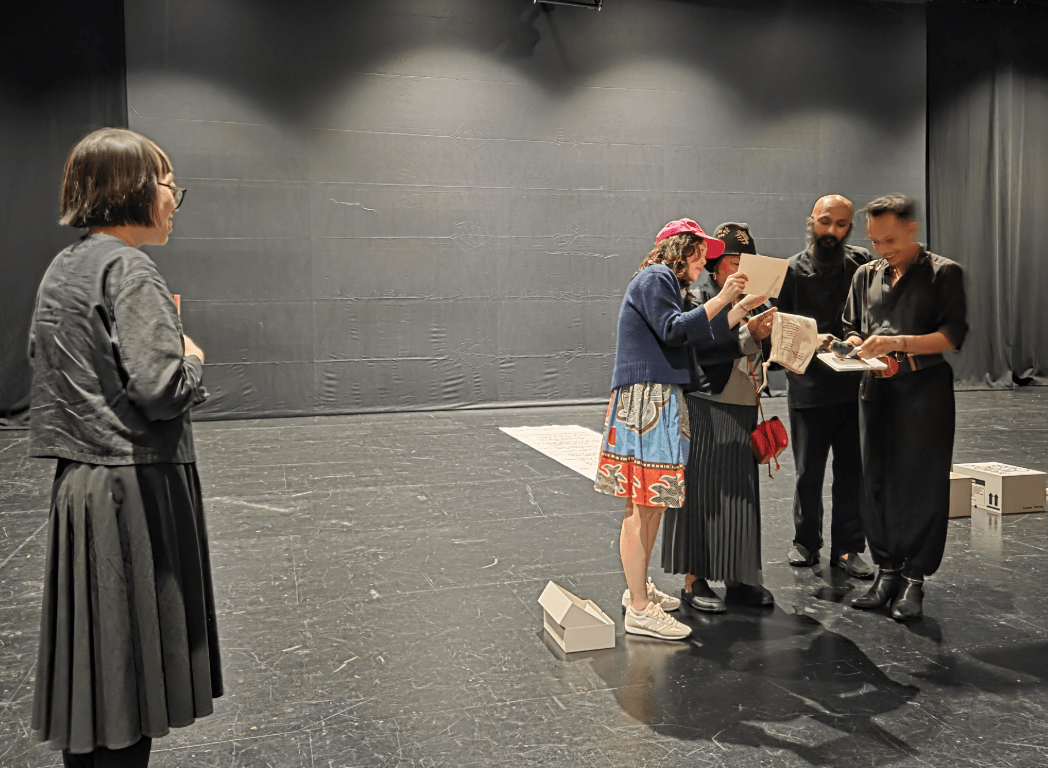
With Handle with Care, however, they take that question to its most radical extreme. Can there be a theatre performance with no performers? No actors, no technicians, no visible director, and no conventional script? The answer is a rather wonderful yes. Instead, there is a box at the centre of the stage, and a room full of people who have no idea what they are about to become. The audience is not merely invited to participate in Handle with Care; we become the performers, directors and, to some extent, authors of the experience itself.
Walking into the Esplanade Theatre Studio, there is initially little to suggest that a performance is about to begin. The house lights remain on. There is no announcement, no actor emerging from backstage, no theatrical flourish to tell us to suspend disbelief. There are simply cards on our seats containing instructions, and a single box onstage. There are fewer than 30 of us in the room, and for a moment, we do what audiences are so often trained to do: sit and wait. Except that this time, there is no performer to tell us when to stop waiting.

We look at one another, whisper, wonder if we are supposed to do something, and glance towards the box. Eventually, one man gets up. He walks towards it, opens it, and in that deceptively simple gesture, the performance begins. From there, the experience unfolds through a series of instructions, objects, questions and tasks, each leading into the next without revealing too much about where we are headed. The less said about the specifics, the better, because the discovery is part of the pleasure. What matters is how quickly the responsibility for making theatre shifts away from the stage and into the room.
This initial hesitation felt particularly revealing in Singapore. We are, after all, a society that often prizes order, efficiency and doing the “right” thing according to pre-established rules. Faced with an unfamiliar participatory experience, there is an almost immediate instinct to work out the objective and understand the boundaries before making a move. Even when we are told that we cannot really do anything wrong, there is still that lingering anxiety: what if I misunderstand the instruction? What if I embarrass myself? What if I do something that permanently ruins the experience for everyone else? There are whispers around the room and an unmistakable reluctance to be the first person to take a risk.
Yet Handle with Care is patient. It doesn’t demand that we throw ourselves into participation, nor does it force anyone to perform. There is always the possibility of handing something over to someone else if you do not wish to engage. Instead, the show creates a gentle pressure through the simplest mechanism possible: somebody else goes first. One person gets up, and suddenly it seems a little less frightening for someone else to do the same. Someone examines what has been revealed. Someone responds to an instruction. Someone approaches another audience member. Almost imperceptibly, the room begins to change.
This is where the work becomes more interesting than a simple exercise in interactive theatre. There is a strange combination of individual agency and collective behaviour at play. Nobody is exactly forced to participate, but neither are we entirely left alone. We observe one another, take cues from one another and encourage one another. There is a gentle kind of groupthink, but it is surprisingly generous rather than oppressive. Someone takes a risk and the room applauds; someone hesitates and another person helps; someone interprets an instruction unexpectedly and, rather than being told they have misunderstood, everyone simply adapts and continues.

Before long, people who entered the theatre as separate individuals are working towards something together. We are no longer simply asking, “What am I supposed to do?” but, “What are we supposed to do?” That shift transforms the show from individual participation into a collective act of trust. Even those who might ordinarily be uncomfortable with interactive theatre find themselves becoming a little less self-conscious, a little more willing to step outside their comfort zone, because there is reassurance in knowing that everyone else is figuring it out too.
And perhaps this is where the title begins to reveal its deeper meaning. Handle with Care initially sounds like an instruction meant for a fragile package, fitting given the centrality of the box, but the phrase gradually feels like an instruction for how we might treat one another. The work asks us to be attentive not just to the objects in front of us, but to the people around us: their hesitation, discomfort, willingness to participate and unexpected choices. There is remarkably little judgement in the room. Nobody is an “actor” trying to deliver the correct performance, and nobody is an audience member assessing whether someone else is doing it well. We are all equally exposed, equally uncertain, equally responsible for keeping the experience going. Put a group of strangers in a room, give them loose instructions and ask them to make something together, and what emerges is not necessarily chaos. More often, people start helping one another.
Language, too, becomes surprisingly secondary. There are moments when words are important, but much of the connection happens through gestures, glances, body language and simply paying attention. In a city as linguistically and culturally diverse as Singapore, language can easily become a barrier, but Handle with Care seems to understand that human connection doesn’t always begin with conversation. We learn to recognise when someone is unsure, when someone needs encouragement, when someone is amused, when someone is willing to take the next step. There is something almost comforting about watching people negotiate meaning together without necessarily having all the vocabulary to do so. The performance becomes less about communicating a predetermined message and more about discovering how much communication is already happening before we even speak.
There is also something wonderfully paradoxical about the show’s relationship with rules. On one level, Handle with Care is built around instructions: do this, look here, pass this on, involve someone else, continue. It has the basic architecture of a game, and part of the pleasure comes from figuring out how its rules work. Yet the creators have deliberately designed a work in which control is ultimately surrendered, accepting that people will inevitably interpret things differently.

That unpredictability is not a flaw to be corrected; it is the substance of the theatre. Somewhere in the experience, you may find yourself tempted to do something unexpected, to knock the production slightly off its intended flight path just to see what happens. Yet even when things don’t go perfectly, there is a sense that perfection was never really the point. There is something liberating about realising that you can make a mistake without destroying the experience.
That idea of unpredictability kept bringing my thoughts back to the strange concept of parallel universes. Every performance of a conventional theatre show is technically unique, but Handle with Care makes that uniqueness fundamental to the work. Change one person in the room and the entire constellation changes. Give the same instructions to another group and they will respond differently, hesitate differently, laugh differently and solve problems differently.
Somewhere else in the world, another group of strangers is going through the same broad experience, but their performance is entirely their own. The creators in Ghent can send the box across borders, languages and continents, but they cannot send the actual performance with it. That can only be created by the people who happen to be there. The box contains the potential for theatre, but the audience supplies the variables that bring it to life. Every performance becomes its own small universe, existing once and then disappearing.
This sense of impermanence becomes increasingly poignant as the experience unfolds. There are moments when the show touches upon mortality, death and the eventual fate of everything we know, ideas that could easily make a theatrical work feel heavy-handed. Yet here, they exist alongside the immediate business of simply being in a room with other people. There is something almost cosmic about that contrast: we can contemplate the eventual heat death of the universe and, at the same time, worry about whether the person next to us has understood an instruction. We know that the hour will end. We know that whatever we are creating cannot last forever. And perhaps precisely because of that, there is something meaningful about being present for it. The experience is temporary by design, but that does not make it meaningless. If anything, its impermanence is what gives it value.
By the end, there is a peculiar sense of camaraderie among the people in the room. It is difficult to identify a single achievement that has brought us together. We haven’t necessarily won anything or solved a great mystery, and we may not even leave with a fully formed interpretation of what the performance was “about”. But we have gone through something together. There was risk, however small; there was work and tension as we watched others attempt to complete tasks; there was an invisible time limit; and there were moments when we had to trust somebody we had never met. Perhaps that is enough. We do not always need a profound shared revelation to feel connected to another person. Sometimes the simple knowledge that we were present for the same strange hour is enough.

What happens after the performance is almost as revealing as what happens during it. The room does not immediately empty. People linger, talk, take photographs together and look at one another with the slightly bewildered familiarity of people who have just shared something they could not possibly explain to someone who wasn’t there. Some remain curious about the objects left behind, still trying to uncover whatever mysteries might remain. There is an almost childlike reluctance to accept that the experience is really over. The people who entered the room as strangers have, in the space of an hour, become the only people who can fully understand what just happened. We leave with our own interpretations and memories, but also with the strange knowledge that we are now part of a much larger chain of experiences, one group among countless others who have opened a box somewhere, at some point, and created their own version of this performance.
And perhaps that is the most affecting thing about Handle with Care. It doesn’t insist upon a single message, nor does it tell us what we are supposed to take away from the experience. Instead, it creates the conditions for something to happen between people and trusts us to make meaning from it ourselves. For a theatre company that has spent years interrogating the relationship between performer and audience, this feels like a natural culmination: not simply breaking the fourth wall, but removing the wall altogether. The theatre is no longer something happening in front of us. It is something we are temporarily responsible for.
By its end, there is no single, definitive message to take away from Handle with Care. What lingers instead is the strange sense of having accomplished something with people we had never met; the small acts of trust that emerged almost instinctively; the amusement at our collective anxiety about doing things “right”; and the wonder at how quickly that anxiety gave way to curiosity, laughter and connection.
We leave with no tangible achievement, only the memory of having been there together. The performance cannot be preserved or repeated; this particular constellation of people, choices and emotions will never exist in quite the same way again. But perhaps that is precisely why it stays with us. For one hour, in one room, we made something that belonged only to us. And somehow, that was enough.
Photos courtesy of Esplanade – Theatres on the Bay.
Handle With Care plays from 7th August to 6th September 2026 at the Esplanade Theatre Studio or Esplanade Recital Studio. Tickets available here
The Studios 2026 – Precarious Bodies runs from July to September 2026 at the Esplanade. Full programme and tickets available here
Production Credits
| Concept & creation Alexander Devriendt, Karolien De Bleser, Samir Veen, Leonore Spee & Charlotte De Bruyne Design Nick Mattan & Edouard Devriendt |

