
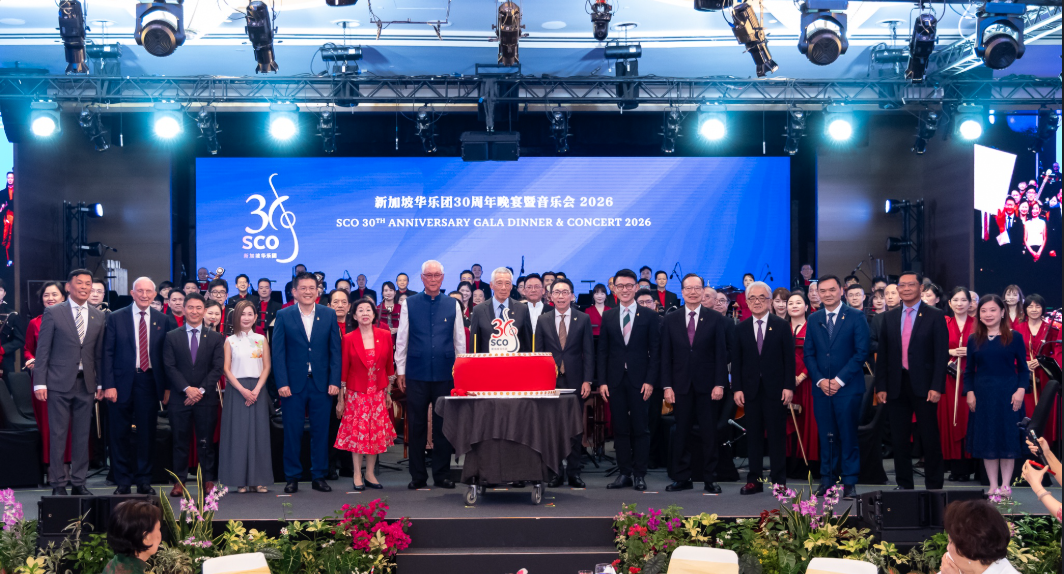
There was something fitting about the Singapore Chinese Orchestra (SCO) celebrating its 30th anniversary with an evening that felt as much like a family gathering as it did a gala. Held at the Ritz-Carlton, Millenia Singapore’s Grand Ballroom on 6 September, the SCO 30th Anniversary Gala Dinner & Concert brought together more than 300 donors, Friends of SCO, partners and supporters, the very people whose contributions have helped sustain the orchestra across three decades.
The evening was deliberately framed less as a conventional fundraising dinner than as an expression of gratitude. Its theme, “Looking Back, Giving Back”, is also the theme of SCO’s six-month anniversary season, and the idea ran through almost every aspect of the night: the speeches, the commemorative gifts, the concert programme and even the audience’s participation in the performance.

SCO Patron and Guest of Honour Senior Minister Lee Hsien Loong, who attended alongside Emeritus Senior Minister Goh Chok Tong and Mrs Goh, and Minister of State for the Ministry of Culture, Community and Youth and Ministry of Transport Baey Yam Keng, described the orchestra as having “played an important role in enriching Singapore’s cultural landscape” over the past three decades.
He pointed specifically to SCO’s artistic excellence, innovation and community engagement, while recognising the “vision, dedication and generosity” of the individuals and organisations who had enabled its success.

Board Chairman Ng Siew Quan offered a similar reflection in his welcome address, saying that the anniversary was an opportunity to honour the generations of Board members, management, music directors, conductors, musicians, staff, donors, sponsors, partners and supporters whose belief in music had allowed SCO to “grow, innovate and inspire countless lives”.
There is a reason both men placed so much emphasis on the people behind the orchestra. After all, the remarkable thing about SCO’s 30 years is not simply that Singapore has a Chinese orchestra. It is that we have a national, professional Chinese orchestra with an ambitious artistic programme, an international presence and a genuine place in the country’s musical life. And judging by the atmosphere of the evening, it is a place that people care deeply about.

The evening began before the music, with a cocktail reception featuring two bespoke creations by Slab Coffee inspired by SCO30’s “Looking Back, Giving Back” theme. The non-alcoholic Golden Bloom combined jasmine tea, white peach, snow pear and osmanthus, while City Echo paired baijiu, cold brew coffee, tangerine and brown sugar. The drinks were a small but apt prelude to the evening’s larger idea: tradition meeting contemporary Singapore, with the past providing material for something new.
Inside the ballroom, the 86 musicians of SCO appeared in their signature red and black, beginning to tune as the room settled. The concert, specially curated by Principal Conductor Quek Ling Kiong, opened with Gu Guanren’s A Glimpse of Singapore, specifically its fourth movement, The Festival. It was a suitably exuberant beginning: bright, jaunty and full of movement, capturing Singapore not as a static postcard but as a place alive with people, sounds and celebrations.
The music seemed to travel through the island. Chinese musical colours gave way to sounds inspired by Malay and Indian traditions, becoming more controlled and ritualistic without losing the underlying sense of joy and grandeur. Then these strands came together again, producing a cohesive musical portrait, one that felt distinctly Singaporean precisely because it was made up of so many different influences.
It was also a reminder of something SCO does particularly well: taking Chinese orchestral music and allowing it to converse with the many other musical traditions that coexist here. That ability is central to SCO’s identity; when the orchestra was inaugurated in 1996, it took on the twin role of preserving traditional arts and culture while establishing new frontiers, including through the incorporation of Nanyang musical elements into its repertoire.

Thirty years on, that experiment no longer feels experimental, and now feels like an established part of Singapore’s cultural vocabulary. Wang Chenwei’s Lion City Rhapsody brought that idea even closer to home. The work celebrates the dialect communities of Cantonese, Hokkien, Teochew, Hakka and Hainanese, turning their voices and musical associations into a spirited portrait of Singapore.
It began with percussion and drums on an emphatic, confident note, immediately establishing a sense of pride and momentum. Midway through the item, the celebratory atmosphere became more personal. Messages of thanks from the musicians and crew were projected for the audience, turning the anniversary from an abstract institutional milestone into a recognition of the many individuals behind the orchestra. That was part of the “giving back” of the evening: not merely giving music to an audience, but acknowledging the people who had given their time, trust, talent and support to SCO over the years.
Watching the musicians perform, there was also the feeling that this was an orchestra genuinely enjoying what it does. There was pride in the playing, but also playfulness and joy. After all, a national orchestra can be an institution on paper, but it only becomes part of a country’s cultural life when audiences feel that its music belongs to them. This spirit continued after the dinner’s initial appetisers, ushering in a gentler change of pace with Bengawan Solo, the beloved Indonesian song composed by Gesang Martohartono and arranged by Peng Xiuwen. Its slower, more lyrical character offered a moment of calm after the exuberance of the opening works.
Multiculturalism returned in Our Songs of Love, rearranged by Sulwyn Lok. Drawing together songs such as Rasa Sayang, Jinkli Nona and Liang Wern Fook’s Xi Shui Chang Liu, as the piece brought together Malay, Eurasian and Xinyao musical traditions. The projections accompanying the performance helped reinforce the atmosphere. This was, after all, a ballroom rather than a purpose-built concert hall, but the music and visuals gradually transformed the space into something more immersive.
There was a particularly satisfying build towards the end, as the audience itself became part of the performance. With the Treble Boost keycaps distributed as keepsakes, guests were also invited to participate rhythmically as we clicked along. It was a simple gesture, but an effective one. The distance between orchestra and audience seemed to dissolve. And for an anniversary built around gratitude, that sense of participation felt especially appropriate.

Over the evening, the focus repeatedly returned to SCO’s history. A new MediaCorp documentary on the orchestra’s 30-year journey featured figures including Principal Conductor Quek Ling Kiong, Conductor Emeritus Tsung Yeh and Executive Director Terence Ho, tracing the institution’s development and the people behind it. Former music directors have also returned during the anniversary season to conduct the orchestra once again, bringing different chapters of SCO’s history back into the present.
That looking back is important because SCO’s existence was not a given. Established in 1996 as Singapore’s only professional Chinese orchestra, it represented a significant ambition: that Chinese orchestral music could have a permanent, professional and nationally significant home in Singapore.
Three decades later, it is difficult to regard that ambition as anything other than a success. SCO has grown into an orchestra of more than 80 musicians, performing a wide repertoire that spans traditional Chinese music, original compositions, popular music, jazz and ethnic folk influences. It has performed at major events locally and internationally, toured Asia and Europe, and continued to commission new works.
Its most recent year alone saw 118 programmes, more than 54,000 people reached through live performances, more than eight million digital views and 41 new works commissioned. Those figures are impressive, but they tell only part of the story. What is perhaps more meaningful is the breadth of SCO’s role. As a “People’s Orchestra”, it has developed education and outreach programmes, workshops, competitions and school performances, while initiatives such as the Caring Series bring music to hospitals, hospices and elderly homes.
Its success is therefore not simply a matter of artistic prestige. It is also about accessibility and relevance, about ensuring that an orchestra founded to preserve a musical tradition continues to find new ways of making that tradition meaningful to contemporary audiences. Senior Minister Lee expressed a similar hope for its future, saying he looked forward to SCO continuing to “inspire audiences, nurture talent, and strengthen community bonds through the power of music”, marking a substantial role for any national orchestra to play.

SCO’s ambitions are no longer confined to Singapore. Over the coming years, the orchestra plans to bring Singaporean Chinese orchestral music to audiences across Southeast Asia, China, Korea, Japan and Europe, building new friendships and sharing something of Singapore wherever it performs.
One particularly memorable example came just two weeks before the gala, on 14 August, when SCO presented a concert for Singapore’s diplomatic community. Ambassadors, high commissioners and diplomatic representatives from more than 30 countries and missions were in attendance. There was something powerful about that image: Singapore’s Chinese orchestra playing for representatives of the world, with the music becoming a point of encounter between cultures, and reinforces why calling SCO a “national” orchestra matters.
Its role is not simply to represent Chinese music in Singapore, nor to represent Singapore overseas. It sits somewhere in between: taking a Chinese orchestral tradition, filtering it through Singapore’s multicultural experience, and offering the resulting sound back to both local and international audiences. That distinctive voice is something we must continue protecting and continuing to develop.

Near the end of the gala came one of its most ceremonial moments. Senior Minister Lee and members of the SCO Board of Directors officiated the cutting of an enormous 82kg anniversary cake, specially designed in the shape of a biangu, a traditional Chinese flat drum, and of course, singing a birthday song.
Later, as a token of appreciation, SCO presented donors with commemorative gongs (tangluo), inspired by one of the Chinese orchestra’s most iconic instruments. Senior Minister Lee received one himself and struck the small gong in celebration.
The gong was an especially appropriate object for the occasion. Traditionally associated with ceremony, celebration and resonance, it also offered a metaphor for the orchestra itself: something whose sound does not simply arrive and disappear, but carries outward.
The commemorative gong, sponsored by Shanghai No. 1 National Musical Instruments Factory, was one of several keepsakes marking the milestone. Guests also received Little Treble Makers plushies and Treble Boost keycaps, considerably smaller souvenirs, but ones that helped keep the celebratory spirit light and playful.
The concert then moved into Liang Wern Fook’s Take It Step by Step, arranged by Wang Chenwei. A montage of photographs charting SCO’s journey from its beginnings to the present accompanied the performance, offering a visual reminder of how much can change over 30 years, and how much can endure.
Finally came Full Moon Blossoms, composed by Huang Yijun and arranged by Peng Xiuwen. Fast-paced, bright and almost floral in its energy, it was an apt finale with the Mid-Autumn Festival just around the corner. By the end, guests were clapping along, bringing the evening to a genuinely joyous close.

For all its grandeur, the most memorable thing about SCO’s 30th anniversary gala was perhaps its warmth. The evening could easily have become a conventional milestone celebration; a roll call of achievements and a look back at institutional history. Instead, the music continually brought the focus back to people: the people who founded the orchestra, the musicians who perform in it, the composers and conductors who have shaped its sound, the audiences who listen, and the donors and partners who have sustained it.
Thirty years is a significant milestone. But the more interesting question is what those 30 years have produced. They have produced an orchestra that can sustain a packed season of performances and new commissions, move comfortably between traditional Chinese repertoire and music inspired by Singapore’s many cultures, perform for thousands at home and abroad, engage communities beyond the concert hall, and still make an anniversary gala feel like a celebration shared by the people on stage and the people in the room.
That is something Singapore should be proud of. The SCO is now one of the world’s leading Chinese orchestras, and more importantly, it is ours: a national orchestra shaped by Singapore’s particular mixture of histories, languages, cultures and ambitions. Ng Siew Quan said that, looking ahead, SCO remains committed to nurturing talent, advancing Chinese orchestral music, strengthening community engagement and creating meaningful musical experiences for future generations. Likewise, Senior Minister Lee expressed his hope that the orchestra would continue to inspire, nurture and bring people together.
After 30 years, those ambitions feel less like aspirations than an ongoing responsibility. The task now is not merely to preserve, but to keep our music alive, relevant and resonant, to continue taking Chinese orchestral music somewhere new while remaining rooted in the Singapore that has given it its distinctive voice. Looking back, there is much to celebrate. Giving back, there is much more still to do, with the support of an entire nation behind them.
Photo Credit: Singapore Chinese Orchestra
More information about the Singapore Chinese Orchestra available here

