
There are few Southeast Asian artists whose work has travelled as fluidly between painting, poetry and sculpture as Latiff Mohidin. Across more than seven decades, the Malaysian modernist has developed a visual language rooted in movement, landscape and memory, one that has continued to evolve without losing sight of its beginnings. Now, one of his earliest sculptural ideas is taking on a new life.
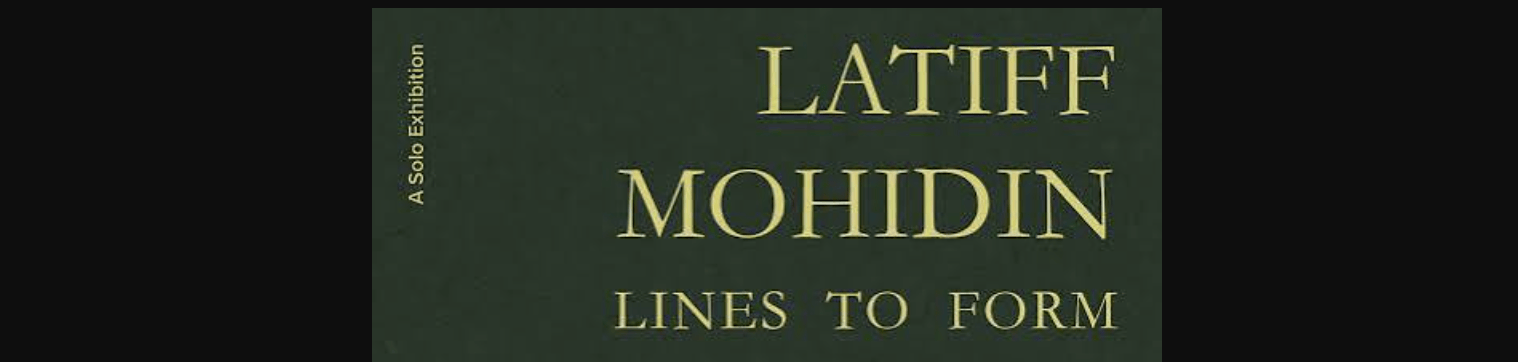
Latiff Mohidin: Lines to Form, presented by Gajah Gallery Singapore in collaboration with LM Studio, brings together a selection of works on paper from several important periods of the artist’s career, alongside Burung 1 (Bird 1), his first-ever cast bronze sculpture.

Latiff Mohidin, Bird 1
2026, Cast Bronze, 180 x 65 x 58 cm Edition of 3 and 1 Artist Proof
The exhibition runs from 28 August to 20 September 2026 at Gajah Gallery Singapore, offering an opportunity to see how an artistic vocabulary first developed in the 1960s continues to resonate in a new material more than half a century later.
Centring the exhibition is Burung 1 (Bird 1), a 2026 cast bronze work measuring 180 by 65 by 58cm. The sculpture is scaled from Latiff’s original ciment fondu sculpture of the same name, created in 1967, and was cast in silicon bronze under the artist’s direction. It is a significant moment in Latiff’s practice: his first foray into bronze.
The work was realised in collaboration with Yogya Art Lab (YAL), Gajah Gallery’s foundry arm in Yogyakarta. Rather than simply reproducing an earlier sculpture in another material, the process extends an idea that has remained central to Latiff’s work, the movement of lines between two and three dimensions, and the possibility of transforming a drawn or painted gesture into physical form. That relationship between line and form gives the exhibition its title.

The story begins with Pago Pago, the landmark series that helped establish Latiff as one of the defining figures of Southeast Asian modernism. First conceived in the early 1960s, Pago Pago grew out of the artist’s travels across Southeast Asia. His encounters with different landscapes, architecture and cultural traditions informed a visual language that was modern without being detached from the region around him.
Rather than looking solely towards Western models of modernism, Latiff developed a distinctive approach that drew from his own geographical and cultural experiences. The resulting works are recognisable for their strong lines, organic forms and suggestion of places and structures without necessarily depicting them literally.
The significance of Pago Pago has endured well beyond its beginnings. The series was presented at the Centre Pompidou in Paris in 2018 and at the National Gallery Singapore in 2020, underscoring its place within the wider story of Southeast Asian modern art.

Lines to Form returns to that formative period while showing how Latiff’s visual vocabulary has continued to shift. Alongside Bird 1, the exhibition features works on paper from Pago Pago, Gelombang, Rimba and Voyage. Spanning more than six decades, they offer a condensed view of an artistic journey that moves between imagined landscapes, natural forms, travel and cultural encounter.
A work such as Pago-Pago Bangkok from 1964 sits alongside later works including Rimba 96 – 10 from 1996 and Wetlands from 2002, allowing viewers to trace the evolution of Latiff’s approach across different periods. There is a continuity in that progression. The imagery changes, but the underlying fascination with line, structure, landscape and movement remains.

Burung 1 (Bird 1) offers perhaps the clearest physical expression of that continuity. The original sculpture dates back to 1967, when Latiff was still developing the ideas that would come to define his early practice. Nearly 60 years later, the work has been reimagined in silicon bronze, creating a dialogue between the artist he was then and the artist he remains today.
The collaboration with YAL is particularly fitting. Based in Yogyakarta, the foundry was established as a space for artists to experiment with new mediums and materials. Under Foundry Director James Page, it has developed into a production house supporting artists in translating ambitious ideas into physical forms.
For Latiff, the bronze version of Bird 1 represents a new dimension of a work that has already existed in another form for decades. It also reinforces one of the central ideas behind Lines to Form: that an artist’s language does not necessarily belong to a single medium.
A line that begins on paper can become a shape. A shape can become a sculpture. An idea formed in the 1960s can be revisited in 2026 without becoming simply an exercise in nostalgia. Instead, the bronze Bird 1 becomes part of an ongoing conversation within Latiff’s practice.

Born in Negeri Sembilan in 1941, Latiff has been making art for most of his life. His first solo exhibition took place when he was just 11 years old, and his career has since encompassed painting, sculpture, poetry and writing. His work has been the subject of major retrospectives at the National Art Gallery in Malaysia in 1973 and 2013, as well as at the Singapore Art Museum in 1994.
That dual identity as artist and poet is important to understanding the breadth of his practice. Latiff’s work has consistently been concerned with suggestion rather than straightforward description, with how a line, form or fragment can evoke a place or feeling without spelling it out.
The works brought together in Lines to Form therefore function as more than a survey of different series. Seen together, they reveal an artist continually returning to and reworking a core visual vocabulary.

Gelombang, Rimba and Voyage each introduce different concerns. There are landscapes, natural environments and reflections on travel and cultural encounters, but the connection to the earlier Pago Pago works remains visible in the way Latiff uses line and form to construct a sense of place.
For Gajah Gallery and LM Studio, the exhibition is an opportunity to present that continuity across generations and mediums — and to introduce a new chapter in the story through bronze. LM Studio, the Kuala Lumpur-based art and cultural studio founded by Latiff, has played an important role in preserving and promoting his legacy. Through research, archiving, exhibitions and publications, it continues to support wider engagement with his work across both visual art and literature.

For an artist whose career began in the post-war years and has stretched into the present day, that process of preservation is accompanied by something equally important: continued experimentation.
Lines to Form proves itself timely; the exhibition does not simply look backwards at one of Malaysia’s pioneering modernists. By bringing an early sculptural work into bronze for the first time, it demonstrates that even a practice with more than seven decades of history can continue to find new forms. At Gajah Gallery, Burung 1 (Bird 1) stands as both an object from the past and a work of the present, a reminder that for Latiff Mohidin, the line has never really stopped moving.
Images courtesy of Gajah Gallery
Latiff Mohidin – Lines to Form runs from 28th August to 20th September 2026 at Gajah Gallery. More information available here

