

New documentary theatre work excavates Malaysia’s buried history one memory at a time.
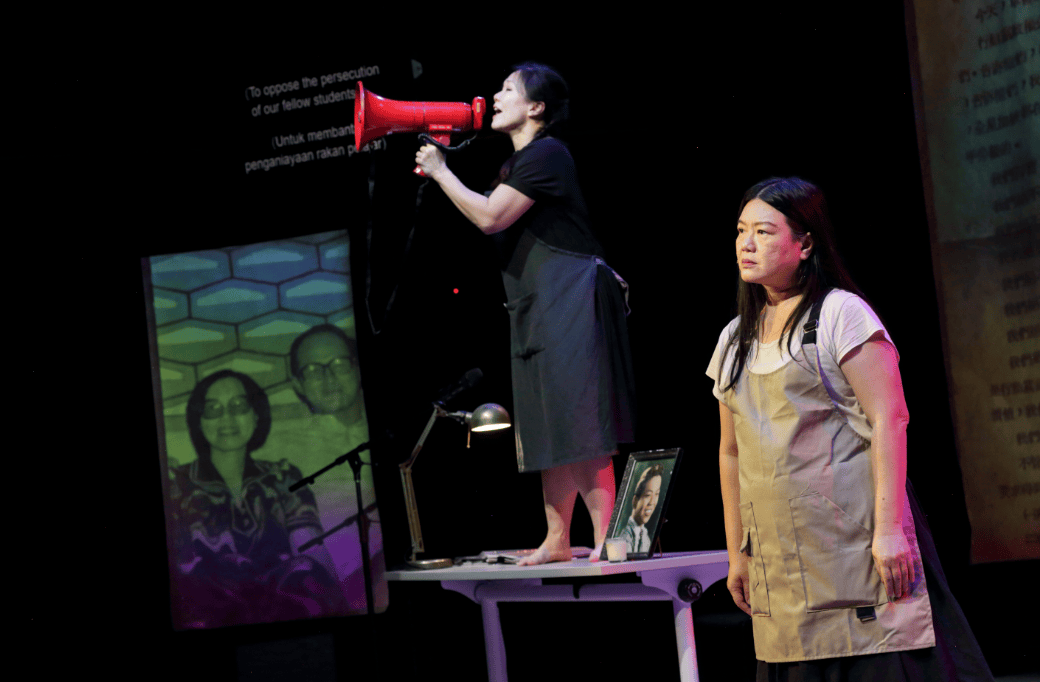
There is a cleverness to The Secret Drawer that becomes apparent almost immediately: the production makes its black-box space feel like somewhere secret. Designed by producer Tan Cher Kian and directed by Jo Kukathas, the stage resembles an underground lair or private archive, with objects and figures surrounding Ling Tang and Lim Tiong Wooi as though they are protecting the stories being unearthed. It is an appropriate setting for a work about things kept out of sight, family secrets, political histories, old loyalties and memories that have survived in fragments.
The premise of this new documentary theatre work sees Tang and Tiong Wooi investigate the histories of their fathers, men whose lives were shaped by theatre, activism and the political upheavals of 1950s and 1960s Malaysia and Singapore. For Tang, the starting point is a drawer her father warned her never to open, telling her that the police would come if she did. For Tiong Wooi, it is a box containing almost 60 documents relating to her father, Lim Yew Meng, including a 1964 detention order, a 1967 banishment order and years of applications, rejections and temporary entry permits. The production is therefore not simply about two fathers. It is about what happens when children finally begin to examine the political lives their parents had largely left unexplained.

Tang’s secret drawer provides the show with one of its strongest opening images. As the forbidden almost metaphorical cabinet is opened, a cassette tape falls from above. Music emerges, and soon notes and pieces of paper appear from around the stage. What was once contained is now spilling everywhere. It is an economical theatrical metaphor for the entire production: once these histories are opened, they refuse to remain neatly filed away.
Tiong Wooi’s archive provides the other half of the structure. She opens a box she has never properly examined and begins reading the official documents inside. The effect is striking precisely because the documents themselves are so untheatrical. A detention order, an application, a medical report or an immigration letter can look dry on paper, but placed in the context of one person’s life, the bureaucratic language becomes devastating. One of the production’s most effective sequences involves Tiong Wooi’s father trying to obtain permission to return to Singapore to see his dying mother. Every possible piece of evidence has to be assembled: medical reports, doctors’ letters and documentation proving the urgency of his request. The papers eventually accumulate across the floor, and the sheer quantity becomes a physical representation of the obstacles he has been forced to negotiate. He did eventually see his mother, but it was the last time.

This is where The Secret Drawer is at its most persuasive. It understands that political history becomes meaningful when it is reduced to the human scale. Detention is not merely a historical term; it means a father missing from his children’s lives. Deportation is not merely a state order; it determines where someone can live, whom they can see and whether they can return home. A political decision eventually becomes a family memory.
The production’s archive is also considerably larger than paper. Objects, music, photographs, screens and re-enactments become evidence of a world that has largely disappeared. The screens, textured like old paper and documents, are particularly effective because they function both as visual scenery and as an extension of the archive. Songs such as Moon Sails Through White Lotus Clouds and Farewell Malaya — We Shall Return play a role that goes beyond the decorative; they are also clues to another hidden political and cultural landscape. The production is interested in the way music itself can become an archive: songs remembered from childhood, songs whose political origins have been forgotten, songs that carry meanings their listeners may no longer recognise.

One of the most pointed examples comes when a familiar Malaysian school song is introduced with its leftist history. The audience is encouraged to sing along, producing the strange sensation of participating in something many may remember from childhood without knowing where it came from. As images of deported people appear on the screens, that familiarity becomes more complicated. The production is effectively asking what else we have inherited without understanding.
This question of inheritance runs through the whole show. Tiong Wooi’s father was an artist and activist who, after imprisonment, could not simply continue pursuing his socialist ideals in the same way. Family responsibilities intervened. Yet as his daughter goes through the archive, she begins to recognise more of him in herself than she expected. The political inheritance is therefore not necessarily a set of beliefs passed from father to daughter. Sometimes it is a temperament, a stubbornness, a commitment to art, or simply the impulse to keep asking questions.

The same attention is given to the generations before them. A grandfather who was too poor to attend school finds ways to learn by going wherever classes are being held. A coconut-shell teapot becomes an object with its own family history. A gold necklace represents a grandfather’s generosity, even when he did not have much to give. These details could easily have become sentimental, but the production generally avoids that trap by allowing the objects to carry the weight themselves.
The most successful theatrical device, however, is the way Tang and Tiong Wooi continually move between telling history and reconstructing it. They re-enact a play, True Lovers, in which the fictional world of political commitment and imprisonment begins to echo the actual lives of the people who performed it. The question of whether art imitates life or life imitates art is not left as an abstract proposition. The production demonstrates the unsettling extent to which the two can bleed into one another.

This is also where The Secret Drawer escapes the limitations of a conventional documentary. Rather than pure documentary where it might have presented archival material accompanied by explanatory narration, Tang and Tiong Wooi elevate it by speaking directly to the audience, challenging the fourth wall and allowing us into the process of discovery itself. At times it feels like we have been invited into the two performers’ private territory. The effect is especially strong during the “Late Night Conversations”, drawn from the collaborators’ own exchanges while developing the work. These intimate discussions about art, home and belonging provide breathing space from the historical material, while also making clear that the questions raised by their parents’ generation are not confined to the past.
The two performers are crucial to this. Tang and Tiong Wooi do not present themselves as neutral vessels for historical information. They are recognisably themselves, with different personalities, rhythms and ways of engaging the audience. Tang’s humour is particularly important because it stops the production from becoming relentlessly solemn. Pain and absurdity frequently exist together here, as they often do in family stories.

The staging also makes intelligent use of the audience. In a farewell scene set around the Singaporean void deck, drink packets are distributed to audience members, turning a theatrical representation of a communal gathering into something closer to an actual one. Elsewhere, songs and direct address draw the audience further into the material. The cumulative effect can feel like being carried through a family reel, moving abruptly between decades, countries, political movements and intimate memories.
That movement is unfortunately also one of the show’s weaknesses. The Secret Drawer contains a remarkable amount of historical and biographical material, and its chronology can become difficult to follow. The production moves rapidly between the 1950s, 1960s and later decades, between Malaysia and Singapore, between grandparents, parents and the performers themselves. Figures such as political activist Said Zahari enter the story alongside student movements, theatre groups, political detention and family events. The density reflects the complexity of the history, but it sometimes comes at the expense of dramatic momentum. There are moments when one wishes the production would stay with a particular story a little longer instead of opening another drawer. But with emotions involved, not being too linear with the timeline might seem like the best solution.

The same is true of the use of language. The production moves between English, Mandarin and Cantonese, with surtitles, but there are stretches where English-speaking audience members may find themselves temporarily outside the precise meaning of a conversation. Yet this is not necessarily a flaw that should be “fixed” completely. There is something valuable about allowing an audience to experience, even briefly, what it means not to have everything translated for them. The performers’ expressions, tone and physical presence often communicate what the words do not. Not every cultural experience needs to be made frictionless.
The political material is similarly strongest when the production trusts the audience rather than instructing it. Lee Kuan Yew’s funeral appears on a screen, for instance, creating a complicated moment in which the same historical figure can carry very different meanings for different people. The performers discuss the student movements and the harsh political environment of the period, but the production does not reduce the past to a simple morality tale. Its intent is not to decide on who was right, but more with recovering the people whose lives were caught inside those conflicts.

That is particularly important because this is a history that remains sensitive. The Secret Drawer deals openly with the Malaysian Left, political detention, activism and the political restrictions of the era. Its approach is not to pretend that the passage of time has made the subject politically neutral. Instead, it insists that these histories are worth examining precisely because they have been difficult to examine. The production’s archive becomes an argument against forgetting, without needing to turn itself into a political rally.
The final sections return to the personal. As her mother passes away. Dementia, death and burial. She recalls her mother, who died in 2023, and the scattering of her ashes in Changi. While another concerns her grandfather buried in a mass grave, leaving the family uncertain even about the precise location of his remains. But with little they have of him, on a stool that symbolises the past, now becomes an altar as joss sticks are lit. The gesture is small, but after the accumulation of documents and political history, it lands with unusual force.

What The Secret Drawer reveals itself to be is a show that explores what documents cannot contain. An official record can tell us when someone was detained, or a letter can demonstrate why someone was desperate to return to Singapore. A deportation order can establish what the state decided. But none of those things can fully explain what it meant to be a child waiting for a father, a mother separated from her home, or a family trying to understand why someone they loved chose the political path they did.
That is why the production’s strongest moments are often its simplest ones: a daughter reading a letter, two performers looking at each other, a song remembered from childhood, an object taken from a box, or a pile of documents slowly covering the floor. The drawer has been opened, the archive has been emptied and the secrets are no longer private.

What The Secret Drawer does particularly well is refuse to treat these recovered histories as dead history. They remain connected to questions of identity, belonging, artistic freedom and political memory that continue to matter. For Instant Café Theatre Company, which has long used theatre to engage with Malaysia’s social and political realities, this feels like a particularly apt continuation of that work: less a lecture about the past than an invitation to sit with its unresolved consequences.
The production is not flawless. Its abundance sometimes makes it unwieldy, and its rapid shifts through time can leave the audience scrambling to place one event before another arrives. But its theatrical imagination, the sincerity of its performers and the sheer power of its archival material give it considerable force.

And more than that, what is encouraging about The Secret Drawer is the sense that there are still many more stories waiting to be told. As the first production in the Jeffrey Cheah Performing Arts Centre’s new space, it also signals a Malaysian theatre scene that remains very much active, willing to dig into its past while creating space for new stories to emerge.
Most importantly, The Secret Drawer understands that history does not stay where governments, families or individuals put it. It leaks through songs, objects, letters and children. It waits in drawers.
And eventually, somebody has to open them.

Photo Credit: Pam Lim
The Secret Drawer played from 2nd to 6th September 2026 at The Studio@JCPAC (Jeffrey Cheah Performing Arts Centre), Sunway Square, Kuala Lumpur.

