
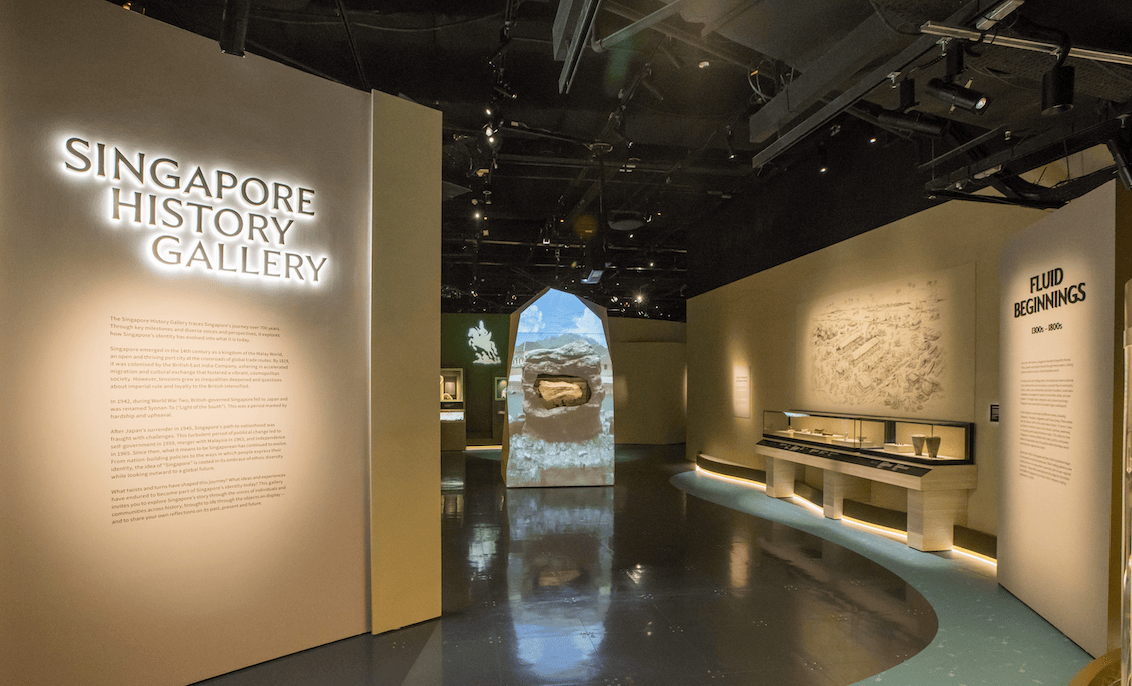

When visitors enter the revamped Singapore History Gallery at the National Museum of Singapore, one of the first objects they encounter is the Singapore Stone. The fragment of the 13th- or 14th-century artefact has had a long journey of its own: originally located at the mouth of the Singapore River, it was blown up by the British in 1843 before the surviving fragment eventually entered the museum’s collection.
Its prominent position in the newly reopened gallery is deliberate. Rather than presenting Singapore’s history simply as a sequence of dates, political milestones and major figures, the museum wants visitors to consider the people who lived through those events — and how their experiences helped shape the country.

The Singapore History Gallery reopens on Oct 10 after its first full revamp since 2006, completing the National Museum’s three-year restoration project. Spanning more than 700 years, the gallery is organised into seven sections, from Singapore’s maritime beginnings to its emergence as a global city.
But the most noticeable change is not simply the new objects or interactive technology. It is the effort to bring more ordinary voices into the story. Curators repeatedly returned to this idea during a walkthrough of the gallery. The team wanted history to be understood as more than “a series of events and dates”, focusing instead on the people and communities who experienced those events. That approach is particularly evident in the section on colonial Singapore.

The gallery’s treatment of the colonial period deliberately contrasts different ways of depicting the people who lived in Singapore. A display of photographs brings together studio portraits produced through what curators describe as a European gaze, where people were categorised according to ethnicity or occupation, alongside portraits commissioned by the people themselves as they became more affluent.
One family portrait, for example, captures three generations dressed for a festival. The juxtaposition highlights something that can easily disappear from historical records: people were not merely members of occupational or ethnic categories. They had families, celebrations and everyday lives of their own.
Nearby is an 1881 census form, displayed publicly for the first time. The thin, two-sided document reflects the colonial administration’s attempts to record the population of Singapore. It contains English, Jawi, Tamil and Chinese, while its classifications also reveal how authorities understood and categorised the people living in the colony.

Another familiar colonial object, the rickshaw, has been given a different treatment. Instead of displaying it simply as an artefact, the gallery surrounds it with historical material about the people who operated and used rickshaws, including the difficult conditions they faced on Singapore’s roads.
Visitors can also try a digital recreation of the experience themselves. Lifting the handles sets a virtual rickshaw moving through Singapore, with the environment changing from morning to afternoon and night. The system responds to how the visitor handles the vehicle, including commenting on particularly enthusiastic “driving”. It is playful, but it also serves a historical purpose: to give visitors a sense of the physical demands and conditions surrounding a form of transport that was once commonplace.

The same approach continues into the section on the Japanese Occupation. Rather than concentrating only on military campaigns and the British and Australian forces, the gallery brings forward local eyewitness accounts.
One of the newly displayed objects is a letter written by Singapore student Andrew Chan in January 1942 to his friend Ralph Bushman in New Zealand. Written during intense Japanese bombing, the letter describes the raids and the commotion within Chan’s family as they considered evacuation. The letter survived the war and offers a glimpse of the conflict through the eyes of a young person experiencing it rather than through the perspective of military strategy.

Nearby is the diary of Lim Bo Seng, which records his anti-Japanese activities before the surrender. The gallery also brings together personal objects and testimony in a space designed to function as both a battlefield and a “memory field”, placing individual experiences alongside military and political history.
The effect is to make the occupation less abstract. The war becomes something experienced by people making decisions, worrying about family members, listening to news on the radio and trying to understand events unfolding around them.

The gallery’s next section, covering the 1950s and 1960s, shifts the focus towards the question of what Singapore should become. One of its starting points is an artist rather than a politician. A woodcut by Choo King Hu captures the May 1954 National Service protests by Chinese middle-school students, who opposed conscription by the British colonial authorities. The artwork depicts riot police confronting student protesters. Choo also inserted himself into the scene, reflecting his own sympathy with the students and his position as an observer and participant in the events.
Woodcut became an important medium for artists seeking to depict social realities, inequality and anti-colonial sentiment in the post-war period. The gallery therefore displays not just the finished artwork but also the tools and process behind woodcut printing, connecting the medium to the social and political environment in which it was produced.

Other displays in the section explore competing visions of Singapore’s future, including the establishment of Nanyang University and the activities of the Malayan Communist Party. A piano provides another, very different entry point into the formation of national identity. The piano was used by Zubir Said in composing “Majulah Singapura”. Visitors can hear an early version of the anthem and learn how the song was subsequently shortened so that it could be more easily sung across Singapore’s different communities.

As the story moves into the post-independence period, the gallery increasingly focuses on ordinary domestic and working lives. One display, titled “Home Front”, centres on sewing machines and the women who used them. One machine belonged to Chu Lai Mo, who received it as a wedding gift. She used it to sew for her family and also earned additional income by making zips and trousers for factories. Another object is a diary kept by Chan Shu Ming in 1979. Her meticulous entries record the details of everyday life, from cleaning the refrigerator to dealing with a headache and taking two Panadols.
Such details may appear mundane, but that is precisely the point. They document the often invisible labour involved in running a household and provide a counterpoint to the more familiar narratives of industrialisation and economic growth. The transition to public housing is similarly told through everyday experience.

At the centre of one section is a late-1970s HDB lift, collected by the museum after a member of the public alerted it that the lift was due to be decommissioned. The lift represents the physical transition from kampong life to high-rise housing, but the gallery also uses it to explore the emotional adjustment that came with that change: learning to share enclosed spaces with strangers, adapting to new forms of neighbourhood life and dealing with both the excitement and anxiety of living in a high-rise environment.
A 1976 poem compares the experience of taking a lift to a journey through space, while visitors can enter the restored lift and hear the poem as part of the installation. The surrounding displays continue the story through the experiences of residents moving into their first HDB flats.

By the 1980s and 1990s, the gallery takes visitors into a space inspired by Orchard Road, exploring how Singaporeans expressed themselves through food, fashion, sport, entertainment and nightlife. A coffee-roasting machine from Ho Tit Coffee Powder Factory points to the way food connects Singapore’s local traditions with global commodities and influences.

Elsewhere, visitors encounter material relating to the Great Singapore Workout, football and the former Kallang Stadium, as well as objects associated with Singapore’s nightlife scene. The emphasis is less on a single definition of what it means to be Singaporean and more on the different ways people experience and express that identity.

That question becomes more complicated in the final section, “Looking Global”. A time-lapse work by Keith Loutit compresses years of Singapore’s physical transformation into a few minutes, showing the city changing as buildings are constructed and demolished and the urban landscape evolves.
But development is not presented as an uncomplicated story of progress. Photographs by Edwin Khoo of crowded MRT trains explore how people create private spaces for themselves even when surrounded by others. Another series documents older housing estates whose residents faced the disruption of redevelopment.

For residents who had spent decades in those estates, moving to new flats could mean better housing but also the loss of familiar neighbours and communities. The gallery uses these experiences to return to its central question: if Singapore is constantly changing, what remains at the heart of its identity?
The answer is left deliberately open. Throughout the gallery, visitors encounter reflection stations asking them to respond to questions about the people, experiences and values explored in each historical period.

Their responses become part of the gallery’s final installation. Digital “fireflies” representing visitors’ contributions move across a visual landscape of Singapore, joining voices from the historical record. At the end, artificial intelligence processes those responses into an evolving representation of a future city.
The image is continuously changing rather than fixed. In this sense, the gallery’s final message is not that Singapore’s identity has been settled by the events of the past. Instead, the museum presents identity as something continually shaped by people and their values.

That brings the visitor back to the Singapore Stone at the beginning of the journey, and to the thousands of individual experiences between then and now. The Singapore History Gallery’s new approach is therefore not simply about adding more objects or digital experiences. It is about shifting attention — from history as something that happened to people, towards history as something people lived, experienced and continue to shape. And, at the end of the gallery, visitors are given a chance to add their own voice to what comes next.
Featured image courtesy of National Museum of Singapore
The Singapore History Gallery reopens on 10th October 2026 at the National Museum of Singapore, while Stories of Everyday runs from 10th to 18th October 2026.

