
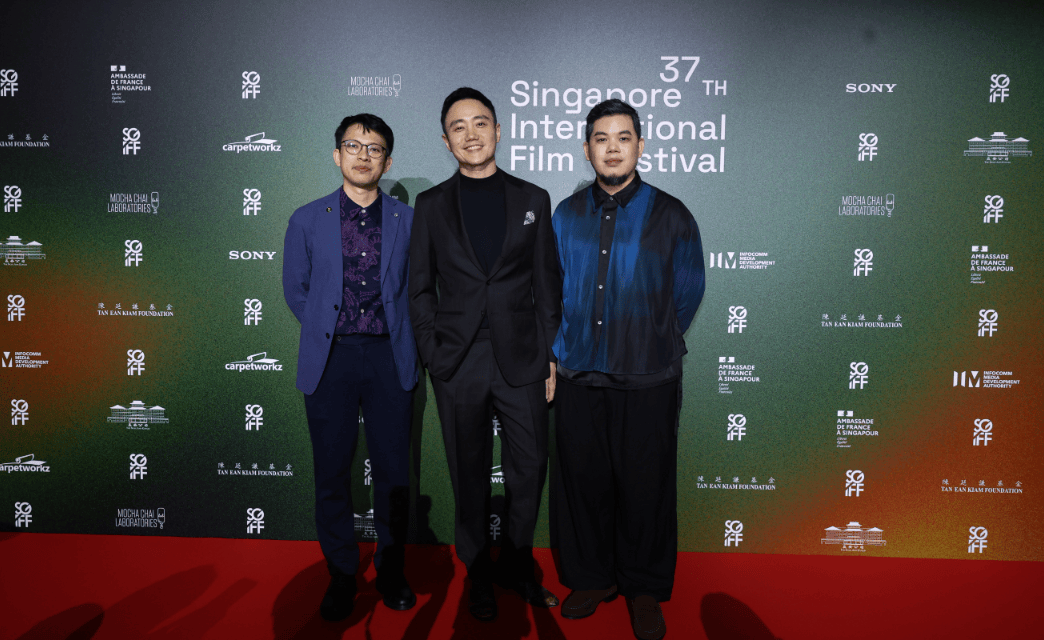
From a star-studded red carpet to a rousing defence of artistic integrity, the 37th Singapore International Film Festival opens on a high note, with sold-out screenings, a renewed commitment to local filmmakers and a reminder of why the cinema-going experience still matters.
The opening night of the Singapore International Film Festival (SGIFF) has always been about more than the films themselves. It is about the people who make them, the audiences who seek them out and the conversations that continue long after the credits roll.
At Sands Theatre, Marina Bay Sands, on Wednesday evening, the 37th edition of Singapore’s longest-running film festival began with all the trappings of a cinematic occasion. Cameras flashed and fans gathered as South Korean director Hur Jin-ho, Bollywood superstar Aamir Khan and Hong Kong filmmaker and producer Peter Chan joined festival ambassador Rebecca Lim and a host of Singaporean screen talents on the red carpet. Among those in attendance were Tan Kheng Hua, Rishi Budhrani, Benjamin Kheng, Nelson Yeo and Ang Geck Geck.
Yet, beyond the star power and opening-night glamour, there was a more consequential story unfolding: one about the freedom to tell difficult stories, the importance of nurturing independent cinema and the enduring value of watching films together.
The festival opened with The Assassin(s), directed by Hur Jin-ho, setting the tone for an edition that has already attracted considerable audience interest. Within three weeks of public ticket sales, 21 sessions had sold out, with demand extending beyond screenings to conversations with some of the industry’s most celebrated figures.
For festival chairperson Boo Junfeng, the excitement of opening night remains undiminished. “The magic of opening night at SGIFF never gets old,” he said ahead of the festival. “This year’s line-up is bold, engaging and has something for everyone, but what makes SGIFF special is the chance to sit in the same room as the biggest names in cinema and hear their stories first-hand.”
It was a fitting sentiment for a festival that brings together established international filmmakers, emerging regional voices and audiences willing to venture beyond the familiar.

Aamir Khan, Indian filmmaker and actor on the red carpet at the 37th Singapore International Film Festival Opening
If there was one moment that gave the evening its emotional weight, it was Boo’s address to the audience. Speaking to filmmakers, industry guests, partners and supporters, the festival chairperson reflected on the principles that have shaped SGIFF over nearly four decades. His remarks took on particular significance in the context of the opening film, which had attracted messages from people in South Korea urging the festival not to screen it.
After considering the concerns raised, the festival decided to proceed, viewing the film as an artistic interpretation of historical events and respecting the filmmakers’ creative vision. Boo made the festival’s position clear: “We have a no-cut policy. We refuse to show anything that has been censored, because we believe films should be seen as the makers had intended, and nothing should alter that vision.”
He continued: “We believe that the sanctity of a film festival is the integrity of the connection between the filmmaker’s vision and the audience that has committed time and money to come and see it.”
It was one of the evening’s defining statements, articulating a conviction that is easy to overlook in an age of increasingly fragmented viewing habits and contentious public discourse. A film festival is not simply a showcase of finished works; it is also a space in which challenging perspectives can be encountered, considered and debated.
Boo acknowledged that holding to such principles is not always easy. “It is not always easy to remain steadfast in the face of pressure,” he said, before reflecting on the persistence required to bring films to the screen. “On a serious note, it requires effort to hold on to principles, to struggle sometimes, to keep caring, and to bring our stories to screen. And sometimes we need to help one another when that happens.”
His remarks were both a defence of the festival’s decision and a broader call for solidarity within the filmmaking community. For independent filmmakers, whose work may challenge prevailing narratives or explore overlooked histories, the ability to present a film as intended can be central to the work itself.

Hur Jin-ho, director of SGIFF opening film on the red carpet at the 37th Singapore International Film Festival Opening
The evening’s opening film also offered a glimpse into the motivations behind such storytelling. Asked what drew him to make The Assassin(s), a political thriller that marks a departure from his previous work, Hur Jin-ho spoke of an incident from his childhood that had left a lasting impression on him. As he grew older, he encountered accounts of the past that he felt had not been adequately reported, prompting his desire to bring the story to light.
What did he hope audiences would take away from the film? His answer returned to the question of truth: the determination of people who seek to uncover it, even when they live in an oppressive society. It was an apt note on which to begin a festival that places Asian cinema and its many perspectives at the centre of the conversation.

Hur Jin-ho, Korean director of the “The Assassin(s)” introducing the opening film screening at the 37th Singapore International Film Festival Opening
For Rebecca Lim, the festival’s appeal lies not in exclusivity, but in its ability to welcome people who might otherwise assume that cinema festivals are not for them. Reflecting on her first involvement with SGIFF two years ago, the actress admitted that she initially felt out of place. She had assumed that film festivals were largely the domain of serious cinephiles and wondered what she, as a television actor with only one leading film role at the time, could bring to the occasion.
She soon discovered that she had misunderstood what the festival was about. “SGIFF isn’t just a place for people in the film industry, but it’s for anybody who loves a good story,” she said.
For Lim, what makes the festival special extends beyond its programme. It is the opportunity to step outside the routines of everyday life and experience something collectively. “Very often, we get so busy with our lives that we live in our own world, but here we get to slow down, sit together, cry, laugh, experience together, and perhaps see the world a little differently,” she said. “I feel that’s something really beautiful.”

Rebecca Lim, Mediacorp Artiste and SGIFF Festival Ambassador giving an introduction at the inaugural 37th Singapore International Film Festival
It is a particularly resonant observation at a time when watching a film is often a solitary activity, squeezed between work, notifications and the demands of daily life. In a cinema, the experience is different: a roomful of strangers sits in darkness, sharing the same images, emotions and moments of silence.
Lim is especially looking forward to Junior Explorers, the festival’s programme for younger audiences and families. As a mother, she is excited by the prospect of experiencing films through her son’s eyes, discovering how stories might resonate differently with a younger viewer.
She also highlighted SGIFF’s efforts to make cinema more accessible, including a special screening of BraveCat in partnership with Cerebral Palsy Alliance Singapore for its students and members. “The magic of film should be available to everyone,” she said, underscoring the importance of widening access to the cinematic experience.
Her message to audiences was simple: arrive with an open heart and an open mind. Somewhere in the festival’s programme, she hopes, viewers will discover a film that stays with them long after the credits have rolled.

Peter Chan, Hong Kong filmmaker walking the red carpet at the 37th Singapore International Film Festival Opening
The festival arrives at a particularly encouraging moment for Singapore filmmaking. More than 25 Singapore productions and co-productions feature in this year’s programme, including works recognised at major international festivals such as Cannes, Sundance, Toronto, Venice and Annecy. The breadth of the selection reflects a local industry increasingly in conversation with the wider world, while continuing to tell stories rooted in its own experiences.
Among the titles drawing attention is Ah Girl, whose 30 October screening has already sold out. Nelson Yeo’s The House on the Moon, which premiered in the main competition at the Locarno Film Festival, will make its Singapore premiere on 24 October, opening the festival’s Foreground section.
Singaporean works also feature in the Asian Feature Film Competition, with Ah Girl, 9 Temples to Heaven, The Burning Giants and Four Seasons in Java among the titles competing. Meanwhile, two of the three Singapore Panorama short-film programmes have already sold out, suggesting that audiences are keen to explore homegrown work across formats and genres.
Boo pointed to the international recognition enjoyed by Singapore films over the past year as a source of pride, with filmmakers bringing their work to audiences and competitions around the world. The growing visibility of local cinema is accompanied by developments closer to home. In his speech, Boo also highlighted the lifting of restrictions on dialect films in cinemas, following discussions involving the Infocomm Media Development Authority, distributors and the wider industry. The change followed renewed attention to the issue and the success of the Chinese-language film Gnu.
For Boo, the development represents more than an industry adjustment. It is an expansion of the stories that can be heard and seen. “Our cultural landscape is all the richer for it,” he said.
The sentiment captures an important dimension of Singapore cinema: the need to create room for the country’s many languages, histories and lived experiences, rather than narrowing them to a single idea of what local film should look or sound like.

(from left to right) Thong Kay Wee and Director Hur Jin-ho, present closing remarks at the opening night of the 37th Singapore International Film Festival
The festival’s ambitions extend beyond its annual screenings. One of the significant developments announced this year is the return of the SGIFF Film Fund, which supports independent filmmakers and helps promising projects move towards production.
The fund has been backed by the Tan Ean Kiam Foundation since 2018. Its expanded support now includes two grants aimed at Southeast Asian filmmakers: a short-film grant offering six projects S$10,000 each per cycle, and a documentary grant offering three feature-documentary projects S$10,000 each. The foundation will serve as lead funder for both grants for the next three years, through 2029.
For filmmakers working outside mainstream commercial structures, such support can make the difference between an idea remaining on paper and a film reaching an audience. It can also give emerging voices the space to experiment, take creative risks and pursue subjects that might otherwise struggle to secure financing.
The grants are intended to champion underserved voices and overlooked realities, as well as films capable of sparking wider public conversations. It is a reminder that a film festival’s influence need not end when its final screening concludes. By supporting filmmakers at different stages of their careers, SGIFF is also investing in the stories that audiences may encounter in the years ahead.
Another new initiative, Junior Explorers, looks to the next generation of moviegoers. Designed for children aged five and above, the programme combines family-friendly films with activities that encourage young audiences to engage with the themes on screen.
Boo described the initiative as a response to concerns about diminishing attention spans among younger people, while making a case for the slower, more attentive experience of cinema. Watching a film together, he suggested, can be part of learning the patience and commitment that life and relationships require. That is an idea that connects the festival’s work across generations: from helping emerging filmmakers find their footing to encouraging children to discover the pleasures of watching and thinking about stories.
For audiences looking to explore the festival beyond its core screenings, SGIFF 2026 has a programme that moves between cinema, live performance, technology and conversation. On 23 October, Aamir Khan will join filmmaker Ashutosh Gowariker for a special presentation and 25th-anniversary screening of Lagaan: Once Upon a Time in India at GV VivoCity. The appearance offers an opportunity to revisit a landmark of Indian cinema with one of its best-known stars.
The festival’s Undercurrent programme brings together seven screenings and three live performances, exploring the relationship between moving images and other art forms. Parallax, meanwhile, offers free talks and demonstrations examining the intersection of filmmaking and immersive technology.
For younger audiences, Junior Explorers provides a more participatory introduction to cinema, while the festival’s filmmaker conversations offer audiences the chance to hear directly from the people behind the work.
Two of these sessions have already sold out: In Conversation With Hirokazu Koreeda, honouring this year’s recipient of the Cinema Honorary Award, and In Conversation With Aamir Khan, recipient of the Screen Icon Award.
The festival will also mark its close with a dedicated closing event for the first time since 2014. On 1 November, the Asian premiere of Vintage Violence will take place at Capitol Theatre, with director Eugene Kotlyarenko and stars Cole Sprouse and Kiko Mizuhara expected to attend. The trio will also take part in an In Conversation With session on 31 October at 11am at the National Museum of Singapore.
The breadth of the programme reflects a festival that is looking to engage audiences in different ways, whether through the intimacy of a screening, the immediacy of live performance or the exchange of ideas with filmmakers.
The early ticket sales suggest that audiences are responding. Following a record-breaking 2025, SGIFF reports that box-office takings are ahead of last year, with ticket-sale volumes continuing to grow. Among the titles with sold-out sessions are All of a Sudden, Possible Love, Minotaur and La Bola Negra, which has seen two screenings sell out, with additional seats snapped up within 15 minutes of release. Look Back sold out within a single day of public sales.
For executive director Jeremy Chua, this response points to the continuing appetite for cinema and Asian stories. “The response after a record-breaking year shows that audiences’ appetite for cinema remains strong and is here to stay,” he said. “Asian stories are reaching audiences around the world, and it is encouraging to see that unwavering support here at home, too.”
The challenge now is to keep that enthusiasm alive, not only through major premieres and headline-making appearances, but also by sustaining the conditions in which filmmakers can take risks and audiences can encounter stories beyond their usual horizons.
As Boo reminded those gathered on opening night, SGIFF has spent decades making room for films that inform, inspire and transform, including those with little chance of being seen elsewhere. That commitment gives the festival its purpose beyond the red carpet. The celebrities may draw the cameras, and the sold-out sessions may signal the strength of audience interest, but the heart of SGIFF remains the encounter between a filmmaker’s vision and the person who comes to watch.
For the next ten days, that encounter will take place across Singapore, one screening at a time.
Photo Credit: Singapore International Film Festival
The 37th SGIFF runs from 21st October to 1st November 2026. More information and lineup available via their website here

