
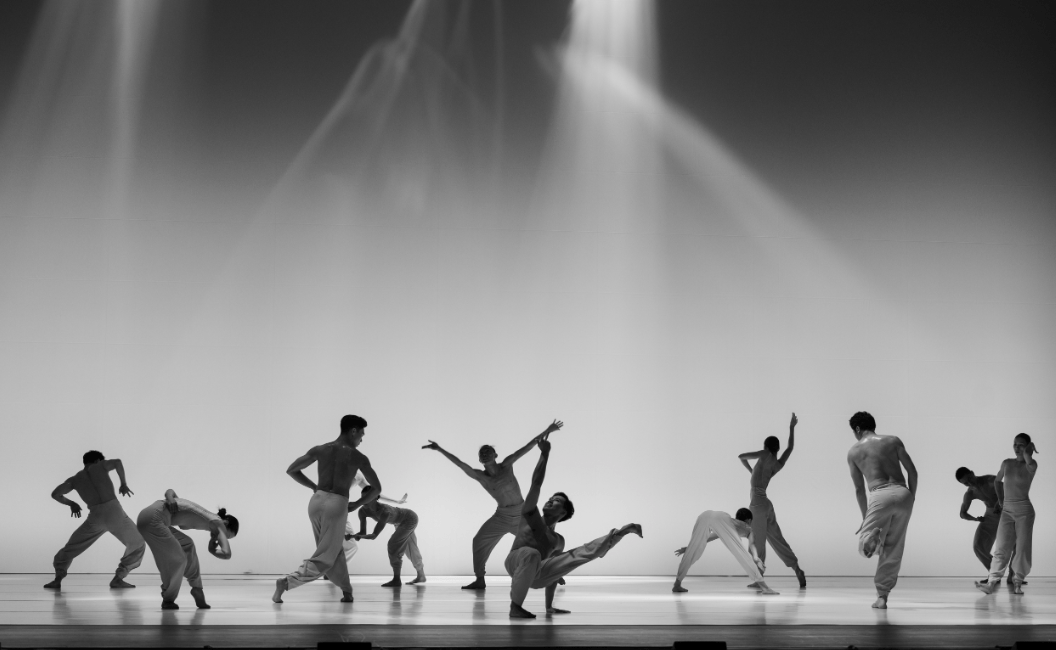

Cloud Gate invites us to pause and appreciate the little things all around us, and to rediscover the wonder and beauty of simply being alive.
Duration: 60 minutes
What if the world has never been quiet, but we have simply forgotten how to listen? In Sounding Light, which played last weekend as part of the 2026 edition of the Esplanade’s da:ns focus: Connect Asia Now (CAN), Cloud Gate Dance Theatre’s choreographer Cheng Tsung-lung invites us to rediscover the life unfolding all around us, whether in a breath, a rustle, a shifting beam of light, a body in motion.
Inspired by the quietude of the natural world, the work draws us into an imagined forest where conventional music gives way to the dancers’ own sounds, and movement becomes a language all its own. The effect is hypnotic, immersive and unexpectedly restorative, and while we were always aware we were watching a dance performance, it simultaneously felt like stepping into nature for a spell of forest bathing.
One of the first things you notice upon the performance’s commencement is how the vast Esplanade Theatre has been transformed. Draped in white cloth, with white flooring extending across the stage, the space becomes an enormous white box that seems to welcome and hold light. It is a strikingly minimal setting, leaving the dancers, their movements and the interplay of light and sound to create the world before us.

Inspired by the natural world, Sounding Light traces the passage of a day, from the awakening of a forest to the gradual arrival of twilight. But rather than offering a literal depiction of nature, Cheng creates something more elusive. We are never quite told what these dancers are. Forest creatures? Plants stirring beneath a canopy? Something else entirely? The beauty of the work is that it doesn’t need to answer the question.
The dancers wear sheer tops, or simply perform topless, paired with understated beige and off-white trousers. Costume designer Chen Shao-yen’s understated approach also complements the work beautifully. The natural tones of the dancers’ clothing and the coloured pigments painted across their backs become part of the visual landscape, gradually smearing and spreading with sweat as the performance progresses. Even the bodies themselves seem to register the passage of time, carrying traces of the movement and effort that have come before.

As such, there is little to conceal the physical effort behind their movements, making their grace all the more remarkable. But what may appear effortless is clearly the product of extraordinary control, strength and precision. The ensemble movements see them flowing in remarkable synchrony, bodies rippling through formations and patterns like wind passing through foliage or water flowing around obstacles. When individual dancers step forward, their supple, lithe bodies unfold into fluid leaps, jumps and intricate gestures that seem to defy the effort required to execute them.
There is a wonderful paradox at the heart of Cheng’s choreography: the movements are complex, intricate and physically demanding, yet appear entirely natural, rather than imitating birds, trees or the elements. Through subtle shifts of weight, delicate gestures and constantly evolving formations, they seem to inhabit the natural world, capturing its rhythms and qualities from within. Individual bodies emerge from and dissolve back into the ensemble, just as a creature might appear momentarily among the undergrowth before disappearing again. Everything feels alive, interconnected and in constant motion.

Equally captivating is the absence of conventional music for much of the performance. Instead, the dancers become musicians themselves, using breath, voice, clapping, stamping and other percussive sounds to conjure a living soundscape. Bird calls and insect-like chirps emerge from human mouths, while feet striking the floor evoke the patter of rain. The collaboration with sound/voice composer Chang Shiuan is especially effective here: movement and sound seem to arise together, as though the dancers are responding to an environment only they can hear. When Lim Giong’s music enters, it adds another layer to the experience without overwhelming the organic rhythms already established onstage.
The lighting, designed by Lulu W. L. Lee, is another marvel. Beams of light twist and shift across the white stage, at times appearing almost three-dimensional. They evoke sunlight filtering through a forest canopy, casting dappled rays across the ground. There is a warmth and delicacy to the effect, and the light seems to move and breathe alongside the dancers. It is not merely illumination but an essential part of the choreography, shaping the atmosphere and making the stage feel like a living landscape. The simplicity of the set allows Lee’s work to shine, and the result is genuinely magical.

What makes Sounding Light so absorbing is the way all these elements come together. Cheng’s choreography, the dancers’ extraordinary physicality, Chang Shiuan’s vocal soundscape, Lim Giong’s music and Lee’s shifting light are not competing for our attention. They feel like parts of the same ecosystem, each responding to and enriching the others. The artistry is remarkable, but what is perhaps most impressive is how completely inhabited it all feels. Nothing seems imposed upon the dancers or pasted onto the stage; the world of the performance seems to grow organically from their bodies, their breath and their relationships with one another.
Watching it, one easily falls into the lull of its rhythm, drawn in by the hypnotic movements and subtle changes in sound and light. It brings to mind the idea of forest bathing, and beyond touching grass, one imagines surrendering the urban stress, and allowing ourselves to be immersed in this natural world, to notice the small things, and to let the experience settle into us. Sounding Light offers something similar within the theatre. For a while, we are freed from the need to interpret, respond or rush towards whatever comes next. We can simply watch, listen and be present.

In our busy, noisy lives, so much happens just beneath our noses that we no longer notice. The movement of a body, the sound of a breath, the shifting quality of light, the quiet rhythms of life continuing all around us. Cheng reminds us that there is wonder in these things, if only we slow down enough to see it.
As the light gradually fades and the dancers leave the stage, the experience feels less like having watched a story unfold than having been allowed a glimpse into another way of being. I left feeling soothed, absorbed and quietly restored, as though I had stepped out of the forest and back into the world with my senses gently reawakened. Beautifully conceived, exquisitely performed and mesmerising in its interplay of bodies, light and sound, Sounding Light is a reminder that sometimes the most profound experience is simply to stop, pay attention and let the world come alive around us.
Sounding Light played from 16th to 17th October 2026 at the Esplanade Theatre. More information available here
da:ns focus – Connect Asia Now ran from 15th to 18th October 2026 at the Esplanade. More information available here
Production Credits
| Choreography/Concept Cheng Tsung-lung Music Lim Giong Cast Chan Pui-pui, Chang Hung-mao, Chen Tsung-chiao, Chou Chen-yeh, Fan Chia-hsuan, Hsu Chih-hen, Huang Mei-ya, Huang Po-kai, Huang Yen-cheng, Lin Sin-yu, Shao Hsing-wen, Yen Hsueh-hsin Sound/Voice Chang Shiuan Lighting Design Lulu W.L. Lee Costume Design Chen Shao-yen Music Director of Cloud Gate Liang Chun-mei Production Director Richard Lee Stage Manager Chen Chia-ju Lighting Supervisor Tseng Yen-min Stage Supervisor Kao Tang-chieh Sound Supervisor Liou Yun-chang Wardrobe Mistress Lin Yen-jung Co-Production National Performing Arts Center – National Theater & Concert Hall (Taiwan), National Kaohsiung Center for the Arts Weiwuying (Taiwan), National Taichung Theater (Taiwan) |

