
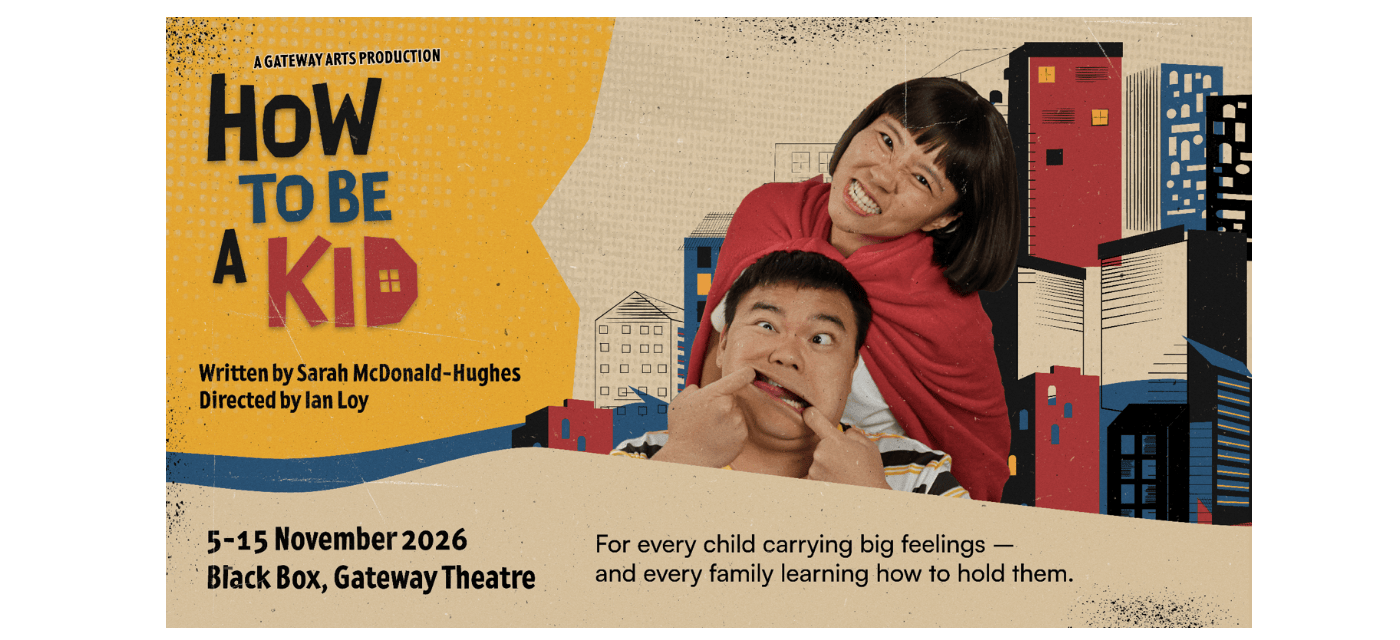
Gateway Arts’ How To Be A Kid follows a 12-year-old girl who tries to hold her grieving family together, inviting children and adults to explore loss, difficult emotions and the importance of leaning on one another.
When a family experiences a loss, everyone grieves differently. Some may retreat into silence, others may try to keep life running as normally as possible, while children might struggle to understand what has happened, or feel that they need to be strong for the adults around them.
These differences can make it difficult for families to find their way through grief together. For parents, there is the added challenge of managing their own emotions while helping their children make sense of theirs.
It is this delicate territory that Singapore theatre company Gateway Arts explores in How To Be A Kid, an award-winning coming-of-age play running from 5 to 15 November 2026 at Gateway Theatre’s Black Box.
Written by UK playwright Sarah McDonald-Hughes and localised for Singapore audiences by director Ian Loy, the approximately 60-minute production follows 12-year-old Molly, who attempts to become the family’s self-appointed “Supergirl” after the death of her grandmother. As her mother struggles with grief, Molly takes on household chores and looks after her six-year-old brother, Joe, trying to keep everything together while suppressing her own feelings.
Intended for children aged seven to 12, as well as the parents, caregivers and educators who support them, the play explores how people of different ages experience loss and what can happen when everyone tries to cope alone.
For Molly, being capable and caring comes at a cost. Although she appears mature and resourceful, her determination to look after everyone else leaves little room for her own vulnerability. Actress Genevieve Tan, who plays Molly, sees the character as a child caught between understanding more than she may be ready to handle and still needing the care and reassurance that children deserve. “My first impression of Molly is that she’s really headstrong. One might call her ‘mature’, but maturity is subjective and non-linear. I think she is highly empathetic and intelligent,” she says.
These qualities can also leave Molly vulnerable, Tan adds, particularly when a child learns to imitate adult behaviours such as caretaking, masking their emotions and becoming overly independent. “If left unnoticed, these children may decide that their genuine feelings are not constructive or important,” she says.
Tan hopes young audiences who recognise themselves in Molly will understand that they do not have to carry difficult experiences by themselves. She hopes they will seek out and be met by loving adults and safe spaces where they can express their feelings and ask for help.
Molly’s younger brother Joe, played by Jeremy Leong, offers a contrasting perspective. At six, he knows that his grandmother is gone but is still grappling with what death and loss mean. Leong draws on his own experience of losing his grandmother at the age of eight to connect with Joe’s emotional world. For him, the character illustrates how grief can be complicated even when a child does not yet have the words to explain it. “Some of us acknowledge them, while others avoid them. Even though we express ourselves differently, what’s most important is that we are there for one another,” he says of difficult feelings.
Through the siblings’ different responses, How To Be A Kid reminds audiences that there is no single way to grieve. A child who returns to play after a moment of sadness is not necessarily unaffected, just as a child who seems unusually capable may still need support.
The play’s exploration of family grief has a personal resonance for Loy, whose own childhood informed his connection to the story. He grew up in a single-parent family after his father was involved in an accident when he was 10. Like Molly, he helped care for a younger brother who was six at the time, and remembers feeling that he needed to be strong for his mother. “At Primary Four and Five, I did odd jobs to relieve my mum of her financial burden. We didn’t talk about this enough: Do I need to be strong, since I’m the older one? That was my mentality,” he recalls.
His experience shaped his desire to bring the play to local audiences, particularly families who may find it difficult to speak openly about painful experiences. “All my shows are about single parents. I hope this play empowers them to talk openly, so the child does not carry the weight alone,” he says.
For Loy, the story is also a reminder that adults’ responses to difficult situations can shape how children learn to cope. Giving children space to ask questions and express their emotions, rather than assuming they are too young to understand or need to be shielded from everything, can help families navigate loss together.
Gateway Arts executive director Priscilla Khong shares a similar hope. “As parents, we often feel that we need to hold everything together for our children, especially when we are going through something difficult ourselves. But we must remember that our children are experiencing those emotions as well, and giving them the space to ask questions, express themselves, and grieve in their own way can help families navigate loss together,” she says.
Despite its difficult subject matter, How To Be A Kid is not without humour and playfulness. Molly and Joe’s nighttime adventure brings lighter moments into the story, including an encounter with a cleaner whose comic antics are played by Misha Paule Tan. “I love playing her, and finally in the show, I get to do something silly and comical,” Tan says with a laugh.
She also plays Mum and Taylor, allowing her to explore different facets of the family’s emotional journey. As Mum, she approaches the character through a mother’s love for her children and her desire to find a way to stand up again.
The play’s shifts in tone are deliberate, says Loy. Humour and more energetic scenes offer moments of release, allowing audiences to experience lightness without diminishing the seriousness of the story. For families, these moments can make difficult subjects easier to approach. The play does not promise a simple solution to grief; instead, it creates an opportunity to recognise different feelings and consider how family members can support one another.
Gateway Arts is extending the experience beyond the performance with post-show discussions after every public and school show. For public performances, Singapore Children’s Society will facilitate discussions and interactive activities around grief, loss and emotional expression. The aim is to help caregivers and children develop a shared language for difficult feelings, listen to one another without judgement and recognise when additional support may be helpful.
“Children often take their cues from the adults around them, and when difficult emotions such as grief are left unspoken, they may feel that they have to hold those feelings in too,” says Toh Pei Yi, Social Programme Senior Executive at Student Service, Singapore Children’s Society.
“Theatre can create a shared point of reference for children and caregivers to recognise, name and talk about emotions that may otherwise be difficult to express directly,” she adds. School performances will feature post-show discussions in partnership with the Singapore Association for Mental Health, providing students with a space to reflect on difficult emotions, explore coping strategies and learn where to seek support.
There will also be a new parent-child workshop, Leaning On Each Other, designed by actor, drama educator and applied theatre practitioner Renee Chua. The one-hour interactive workshop will take place after the 2pm performances on 7 and 15 November, at 3.15pm.
Through facilitated conversations, role play and drama games, children and caregivers will revisit moments from the play, explore different perspectives and practise ways of listening and supporting one another without feeling the need to immediately fix a problem. With two tickets purchased, a parent-child pair can attend the workshop for $10. Places are limited and available on a first-come, first-served basis.
Ultimately, How To Be A Kid asks families to reconsider what it means to be strong. Rather than expecting one person to hold everyone together, it offers a gentler possibility: that children and adults can acknowledge their feelings, make room for one another’s experiences and learn to face difficult moments as a family.
How To Be A Kid runs from 5th to 15th November 2026 at the Gateway Theatre Black Box. More information and tickets available from Gateway Arts and SISTIC.

