
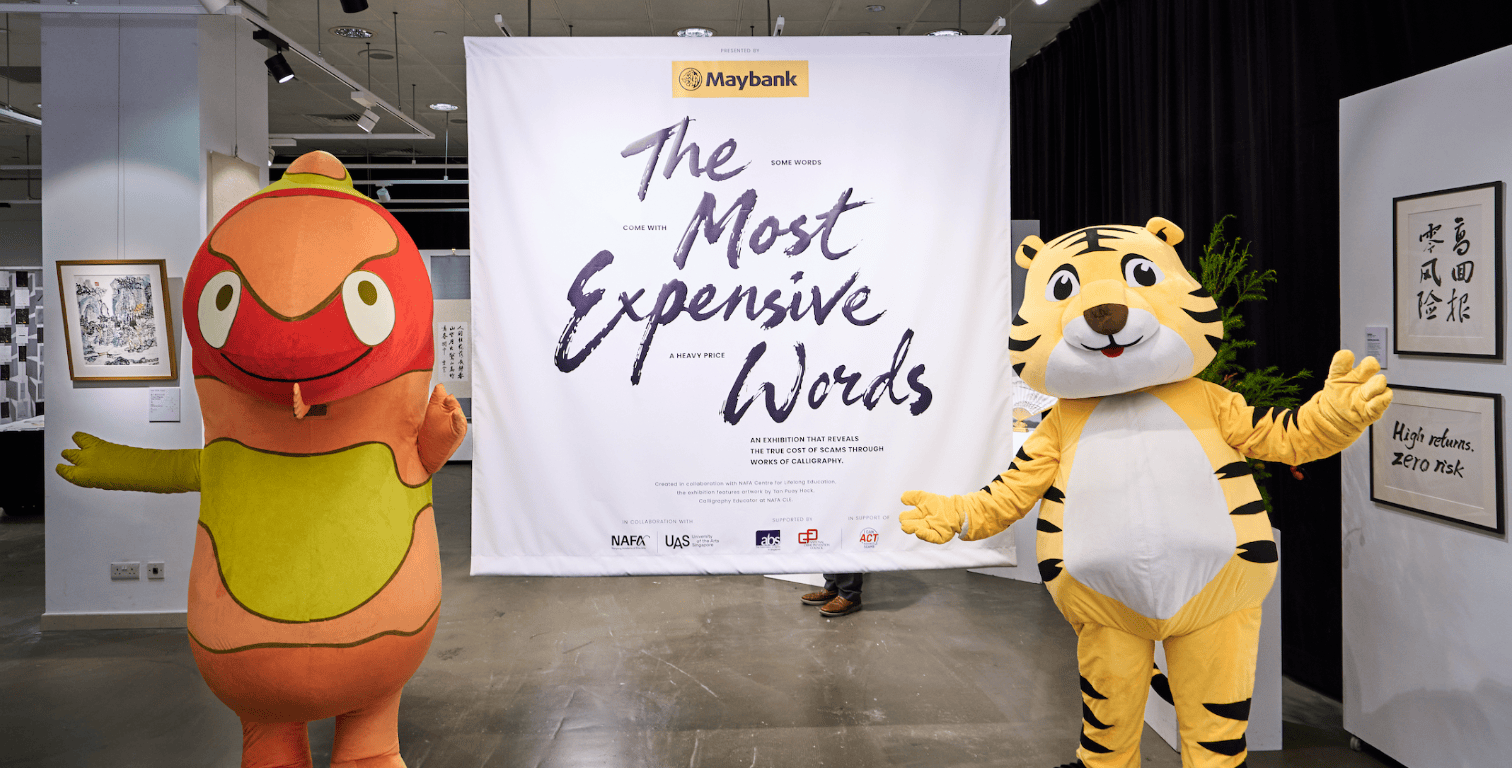
From promises of risk-free returns to urgent messages supposedly sent by the bank, familiar phrases take on a different meaning in a calligraphy exhibition that invites visitors to look closer, think twice and recognise the real cost of scams.
Some words are easy to overlook. A message from someone claiming to be a bank officer, an old acquaintance asking for help, or an investment opportunity promising unusually high returns can seem convincing precisely because the language feels familiar. But behind these seemingly ordinary phrases can lie a costly deception.
What if these words were taken out of our messages and phone screens and placed on a gallery wall instead? And what if each phrase came with a price tag reflecting the losses suffered by victims of scams?
That is the premise behind The Most Expensive Words, a free public exhibition by Maybank Singapore that transforms familiar scam phrases into calligraphy artworks. Launched on 23 October 2026 at the Nanyang Academy of Fine Arts (NAFA), the exhibition uses the traditional art of calligraphy to bring a contemporary concern into sharper focus: how the words we encounter every day can influence our decisions, sometimes with devastating financial consequences.
The scale of the problem is significant. According to the Singapore Police Force’s Annual Scam and Cybercrime Brief 2025, Singapore recorded 37,308 scam cases in 2025, with reported losses amounting to approximately S$913.1 million. While both the number of cases and total losses declined compared with 2024, scams remain a pressing concern for individuals, families and the wider community.
For Maybank Singapore, the exhibition offers a different way to approach scam awareness. Rather than relying solely on conventional warnings, it invites visitors to encounter the language of scams through art, encouraging them to pause and consider what might lie behind a seemingly harmless message.

The Most Expensive Words is all about the transformation of everyday language into something more confronting. Phrases that might ordinarily appear in a text message, phone call or online advertisement are rendered in calligraphy and paired with the reported financial losses associated with the corresponding scam category.
Among the featured works are “Your bank seeks your assistance”, associated with impersonation scams that accounted for S$242.9 million in losses, and “High returns, zero risk”, associated with investment scams that accounted for S$336.2 million.
The contrast is striking. Calligraphy encourages the viewer to pay attention to the form, rhythm and expression of written language. Here, that same attention is directed towards the words themselves — and the consequences they can carry.
The exhibition also highlights how scams do not necessarily depend on elaborate deception. Often, they exploit trust, familiarity, fear or the excitement of a seemingly irresistible opportunity. An urgent request can pressure someone into acting before checking its legitimacy, while an attractive promise can make the prospect of financial gain seem worth the risk.
Mr. Adam Tan, Head of Community Financial Services, Maybank Singapore, said: “Scammers do not always need sophisticated methods. Often, they rely on a familiar name, an urgent request or a promise that sounds too good to miss. By putting these words on the wall and attaching their real-world cost, we hope people will recognise the warning signs and pause before making a transfer. Helping customers and the wider community protect what they have worked hard for is part of how Maybank Humanises Financial Services.”
The message is particularly relevant given that 81.8% of scam cases in 2025 involved self-effected transfers, in which victims were manipulated into making transactions themselves through deception and social engineering. Recognising a suspicious message is therefore not simply about identifying an obvious threat. It is also about understanding how language can be used to create urgency, establish false trust or discourage someone from thinking independently.
By making these phrases visible in a different context, the exhibition creates an opportunity to reconsider the words we might otherwise read and respond to without a second thought.

Presented in collaboration with the NAFA Centre for Lifelong Education (NAFA CLE), The Most Expensive Words forms a special installation within Breath & Brush (一息一笔), an exhibition celebrating Chinese ink and calligraphy through the works of NAFA CLE learners.
Held at the Fashion Gallery at NAFA Campus 2, Breath & Brush also features live demonstrations, collaborative art-making and hands-on activities, offering visitors an opportunity to engage with these art forms beyond simply viewing finished works.
Within this setting, The Most Expensive Words introduces a contemporary subject into a traditional artistic practice. The calligraphy becomes more than a means of presenting language beautifully; it invites viewers to examine the meaning and intent behind the words.
The project also marks the first time Mr. Tan Puay Hock, Calligraphy Educator at NAFA CLE, has worked in English calligraphy. Mr. Tan Puay Hock, Calligraphy Educator, NAFA Centre for Lifelong Education, said: “Calligraphy invites us to slow down and pay closer attention to the meaning and expression behind every stroke. Breath & Brush celebrates this spirit through Chinese calligraphy and ink paintings by NAFA CLE learners. Within the exhibition, familiar phrases used by scammers take on new significance when paired with the losses they represent. I hope the works encourage visitors of all ages to pause, question what they are told and share that awareness with others.”
The pairing of art and public education gives visitors a reason to linger. Calligraphy traditionally rewards patience and close observation, asking the viewer to consider each stroke rather than rushing past the words. In this exhibition, that deliberate act of looking becomes an invitation to adopt the same care when confronted with unexpected requests, enticing offers or instructions involving money. The result is an exhibition that brings together artistic expression and a practical message, making scam awareness part of a broader cultural experience.

Scams can have consequences that extend beyond financial loss. They can affect relationships, undermine confidence and leave victims feeling embarrassed or reluctant to speak about what happened. Raising awareness, therefore, also means creating opportunities for people to discuss the warning signs openly and look out for one another.
The National Crime Prevention Council (NCPC), which supports Maybank Singapore’s initiative, sees the value in communicating these messages through a creative format. Mr. Gerald Singham, Chairman, National Crime Prevention Council, said: “By turning phrases commonly used by scammers into art, The Most Expensive Words exhibition brings crime prevention messages to life in a creative way that captures attention and stays with people. We hope the exhibition will help members of the public recognise these warning signs, pause before acting on them, and protect themselves and their loved ones from falling victim to scams. NCPC is pleased to support Maybank in this meaningful initiative, as protecting our community from scams is a responsibility we all share.”
That emphasis on collective responsibility is central to the exhibition’s message. A suspicious message may arrive on one person’s phone, but the knowledge needed to identify it can be shared with parents, partners, friends and colleagues. A conversation today could help someone else avoid making an irreversible decision tomorrow.
Maybank Singapore’s wider scam-prevention efforts encourage the public to follow the ACT approach: Add ScamShield, Check with official sources, and Tell the authorities, family and friends. Those who suspect a scam can also contact the ScamShield Helpline at 1799.

In a world of constant notifications, immediate replies and decisions made on the go, taking a moment to stop and question a message can feel like a small act. Yet that moment can make a significant difference. The Most Expensive Words gives visitors a visual reminder of why that pause matters. By bringing the language of scams into an artistic setting, it encourages people to look beyond the surface of a message and consider the intentions behind it.
The exhibition also demonstrates how art can create an entry point into conversations about issues that affect everyday life. A phrase that might once have been dismissed as an ordinary message becomes something to examine, discuss and remember.
Ultimately, the most expensive words are not necessarily the most dramatic. They may be the familiar ones that arrive when we are distracted, the promises we are eager to believe, or the urgent requests that leave us little time to think. By turning these phrases into art, Maybank Singapore invites the public to reconsider the power of language, and to remember that sometimes, the most valuable response is simply to pause.
The Most Expensive Words runs from 23rd October to 1st November 2026 at the Fashion Gallery, NAFA Campus 2, Level 1, 38 Bencoolen Street, Singapore 189654. Admission is free.

