
Drag legend Sammi Zhen’s debut live talk show is a reminder to live, laugh and love before it’s too late.
After 27 years in Singapore’s Chinese drag scene, Sammi Zhen has earned the right to have the stage all to herself. A familiar face to those who frequent the clubs and events she has hosted over the years, she is something of a local legend, with a distinctly Singaporean sensibility and a career built on entertaining audiences in spaces where she knows how to work a room. The Sammi Zhen Show: Love Cannot Wait 爱,不能等, her first public ticketed solo show, is an opportunity to bring that experience into a different setting and to tell a more personal story.
The show is built around a simple, resonant idea: life is too short to keep putting things off. A health scare in 2023 appears to have brought that lesson home for Sammi, prompting her to think about what she wants to do while she still can. The result is an evening that mixes personal anecdotes, musical performances, jokes and audience participation, all loosely orbiting the themes of love, mortality and making the most of one’s time. It is an idea with plenty of potential, especially coming from a performer who has spent decades making other people laugh without necessarily putting her own life at the centre of the conversation.
The venue itself is rather unusual. Tucked away on the fourth floor of a largely quiet mall in Little India, Inspire Space is an event venue that doubles as a church on Sundays. The auditorium-style arrangement, with a stage and rows of seats on a single level, is functional rather than glamorous. Strands of incandescent bulbs add a little warmth, while a gaming and trading-card shop just outside lends the surroundings an incongruously countercultural feel. It is a suitably unconventional space for a drag show, even if it takes a moment to adjust to the idea of watching one in what feels more like a multipurpose hall than a nightclub, and is relatively cosy.

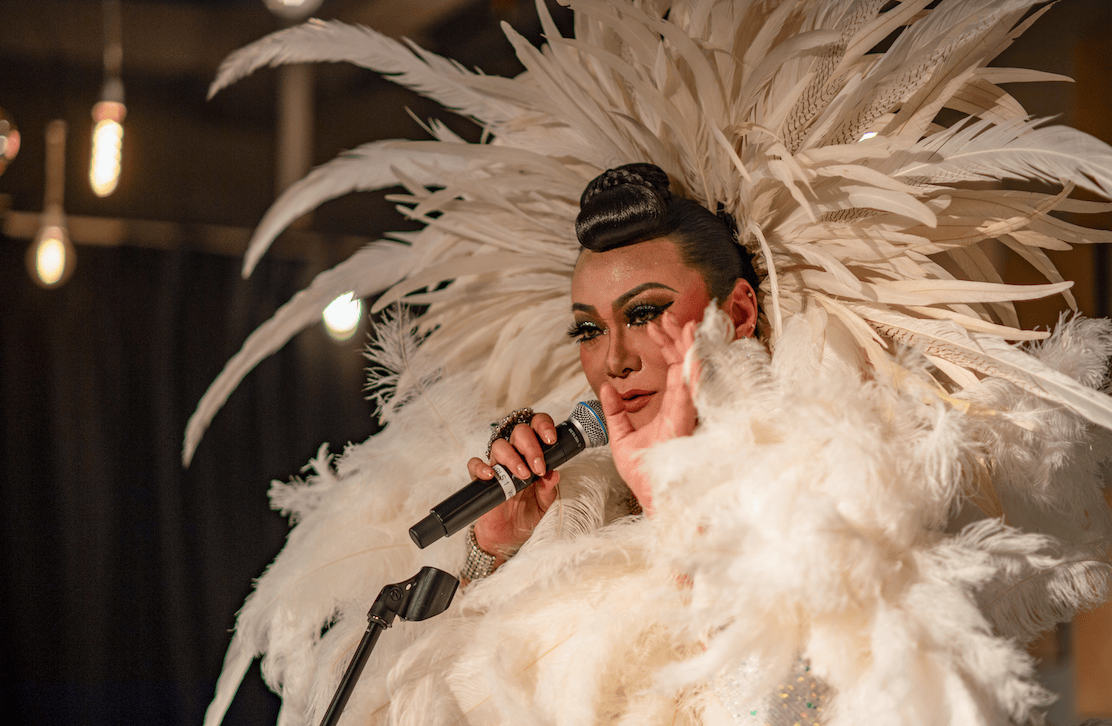
The evening begins with guest performer DAKI lip-syncing to Lady Gaga’s “Vanish Into You”. The transition into the performance is rather sudden, leaving little time for the audience to settle into the show, and DAKI initially seems not entirely at ease with the space. The opening feels tentative rather than inviting. Sammi makes a much more commanding entrance, appearing in a white feathered dress and an elaborate headpiece that fans out like a halo, before launching into a lipsync to “I Will Survive”. The angelic styling is an effective visual touch, and she has an undeniable presence when she steps onto the stage. For a moment, the show seems ready to take flight.
But once the opening numbers give way to the talking, the evening struggles to find its footing. Sammi attempts to warm up the audience with questions about who has travelled from overseas, and the audience hesitates to respond. These exchanges might work more naturally in a familiar club setting, where regulars already know the performer and are primed to play along. Here, with a mixed audience still finding its bearings, the interactions feel awkward. There is a sense of a performer reaching for the easy rapport she has cultivated over years of working rooms, without quite finding the same connection in this new environment.
The central story is Sammi’s near-death experience, which took her to hospital for the first time and left her reflecting on the fragility of life. There are interesting details in the telling: her commentary on the repeated needles and procedures leaves her feeling “holey” like Jesus, while her experiences moving between different hospital wards offer opportunities for observations about the indignities and absurdities of being a patient. These are the sorts of everyday details that could become funny, affecting or both in the hands of a performer who knows how to shape them.

More importantly, the stories offer glimpses of a compelling character. Sammi comes across as headstrong, accustomed to getting her way and not especially inclined to accept an answer she doesn’t like. There is something recognisable and potentially very funny in this personality, especially when set against the vulnerability of being seriously ill. The tension between a woman who insists on doing things her own way, even if it’s smoking against doctor’s orders, and the realisation that life is not entirely within her control could have been the emotional and comic backbone of the show.
Yet the material rarely develops far enough to make the most of these possibilities. Anecdotes surface, observations are made, and then the show moves on before the ideas have fully landed or been explored. Jokes can feel random and scattershot rather than building towards a satisfying punchline or a larger point. The pacing consequently feels uneven, with little sense of how one story connects to the next. By the end of the first half, the message to don’t wait too long to do the things that matter is clear enough, but the material has not quite accumulated into a fuller understanding of what that means to Sammi, beyond the experience that first prompted her to say it.
The problem is not that the show needs to be conventional stand-up comedy. There is room here for sincere storytelling, camp spectacle, musical interludes and the occasional exchange with the audience. Indeed, the combination could be a natural fit for Sammi, whose background spans drag performance, emceeing and comedy. What is missing is a stronger sense of cohesion: a way for the jokes, personal reflections, lip-syncs and audience participation to complement one another, rather than feeling like separate items loosely arranged around a theme.

After the intermission, DAKI returns in a striking black ensemble with dramatic sleeves and a glittering phoenix headpiece, performing Sun Yanzi’s “我要的幸福”. This is a much stronger turn than the opening Gaga number, as DAKI seems more expressive and comfortable, using the costume and movement to better effect. It is one of the evening’s more visually satisfying moments, and a reminder of how much a well-executed performance can communicate without needing to explain itself.
Sammi follows in a honey-blonde wig and black dress for an extended Adele medley, drawing on several of the singer’s best-known hits. The costume change gives the second half a fresh visual start, but the medley suffers from a similar lack of focus. The song transitions are abrupt, and the sequence feels more like an attempt to fit in as many familiar songs as possible than a musical number with a clear arc. There is spectacle, but not much momentum.
At this point, while the audience is sufficiently warmed up, the talking that follows does little to give the evening renewed direction. Sammi shares details about deciding to get multiple tattoos within a month, as well as observations about nightlife and the world she has inhabited for so long. These are potentially rich subjects. Her interjection about her new tattoo sleeves within the span of a month in particular, fits neatly into the show’s broader idea of acting on one’s desires rather than postponing them indefinitely. Her recollections of nightlife could also provide a window into the particular culture she has helped shape over the years.

Instead, the material continues to meander. Sammi touches on the idea that drag performers occupy a space outside the mainstream, including the fact that this show does not qualify for the Culture Pass, and that this gives them a certain licence to be irreverent. Yet the show’s humour remains relatively restrained, with little of the dirtiness or provocation that might be expected from that positioning. There is nothing wrong with a performer choosing not to be vulgar, of course. But the show never quite clarifies what kind of irreverence it wants to embrace, or what its position outside the mainstream allows it to say that it could not say elsewhere.
This leaves the evening in an uncertain place. It is not quite a comedy show, although one keeps waiting for the jokes to arrive; and with no guests, not quite a talk show, despite the conversational format; and not quite a cabaret, despite the musical performances and costumes. It need not fit neatly into any one category, but its various elements need to feel as though they belong together. Too often, the impression is of Sammi moving from one thought or item to the next without enough development, transition or payoff to give the whole thing shape.
The presence of Nirvana, an afterlife-services company, as the primary sponsor adds another curious dimension. Staff in distinctive purple polo shirts are stationed around the auditorium, and the audience is told about a complimentary tour of the company’s facilities on 31 October, which Sammi will lead. Given that the show is explicitly concerned with mortality and preparing for the inevitable, the partnership is not inherently out of place. There is even a potentially interesting conversation to be had about how people confront death, and the uncomfortable practicalities that accompany it.

But the sponsorship is so conspicuous that it becomes difficult to ignore, while the show does little to explore the connection beyond the broad theme of death. Rather than deepening its central message, the promotion feels like a separate event happening alongside it. Sponsorship is a practical reality for productions of this scale, and there is nothing wrong with securing support. Still, when a commercial partnership occupies such a visible place in the room, it helps if the artistic connection feels more considered.
The final stretch does not quite pull everything together. A lucky draw based on audience members’ handwritten notes about what they would dedicate themselves to before they die should, in theory, bring the show’s message into the room and give the audience a chance to participate in it. Instead, there are difficulties deciphering some of the handwriting, many of which are instead dedicated to congratulating Sammi, and the prizes are handed out in a seemingly haphazard order, beginning with the first prize rather than building up from the third. It is a small but telling example of the evening’s broader problem: an idea that could have worked, let down by execution that feels underprepared.
The arrival of a three-tier cake from sponsor Bob the Baker offers a pleasant visual finale. Topped with a tiara, it is wheeled out to applause, and Sammi blows out the candles. It is a celebratory moment, but not quite a conclusion. The show ends without the various threads, from the health scare, the call to live more fully, the jokes, the music and the audience’s own reflections, converging into a final thought or emotional payoff.

There are recurring references to the haze, invitations to join the after-party, and jokes about CDC vouchers standing in for tips. These touches give the evening flashes of local colour, and Sammi’s distinctly Singaporean perspective remains one of her most appealing qualities. But local references and an established stage persona can only do so much. They need material to support them, and a show needs more than a collection of potentially amusing observations to sustain its audience over an entire evening.
It is worth remembering that this is a debut, and that the production reportedly came together in just 30 days. That is a short runway for a full-length solo show, particularly one that attempts to balance personal storytelling, comedy, music and audience interaction. Sammi’s decades of experience are not in question; what she is attempting here is a different kind of performance, one that requires her to do more than entertain a room in short bursts. It asks her to shape an evening, manage its rhythm and decide which stories deserve space, which jokes need more work, and how each element contributes to the whole.
Behind the flaws, there is a show worth developing here. Sammi has presence, a distinctive voice and a life that offers more than enough material. Her health scare gives the evening a meaningful starting point, while her experiences in Singapore’s nightlife and drag scene could provide a perspective that few others can offer. The next step is not necessarily to become a sharper stand-up comedian or to make the show more provocative. It is to give these elements more room to breathe, to find the connections between them, and to build an evening in which the humour and the sincerity strengthen one another, and overall, a much tighter structure and creative direction to make it land.

After 27 years in the business, Sammi Zhen has finally made time for a show of her own. The irony is that Love Cannot Wait itself feels as though it could have used a little more time: not necessarily more spectacle or more stories, but more shaping, rehearsal and thought about how they fit together. Its message is a worthwhile one. The show still needs to find the form to do it justice.
Photo Credit: @jaycstudios
The Sammi Zhen Show: Love Cannot Wait played on 23rd October 2026 at The Inspire Space, Sam Leong Rd, #04-01 11 TRIO, Singapore 207903

