

An astoundingly sensitive debut feature about a broken childhood glimpsed through the eyes of a spunky millennial girl with strong performances and attention to detail.
Duration: 140 minutes
If you grew up in Singapore in the ’90s, then you’ll find the world of Ah Girl all too familiar, with old taxis making the rounds, payphones still a familiar sight, and school uniforms looked a little different. It is a nostalgia bomb that hits you from its opening scenes, making Ang Geck Geck Priscilla’s debut feature film an especially evocative time capsule, recreating a world that feels increasingly distant but remains remarkably warm. Yet, beyond its period trappings and autobiographical undertones, there’s a much more affecting story here: a portrait of a broken family slowly unraveling through the eyes of a child, and an exploration of how childhood innocence can coexist with an increasingly painful awareness of the adult world.
We are introduced to seven-year-old Ah Girl (Ong Xuan Jing) on her first day of primary school, where she is officially introduced as Eileen Ang Swee Swee, much to her displeasure. She doesn’t even seem to recognise Eileen as her own name, insisting instead on being called Swee Swee. At home, however, she is simply known as Ah Girl, an affectionate, if rather generic, term of endearment used by the entire family. It’s an amusing introduction to a character who is already beginning to establish her own identity, and an interesting detail that her younger sister Ah Tian (Sydney Wong) similarly takes little ownership of her English name. It’s a small reflection of their parents’ aspirations for their daughters, giving them English names in the hope of preparing them for a more modern and successful future. But for the girls, these names are hardly what define them.

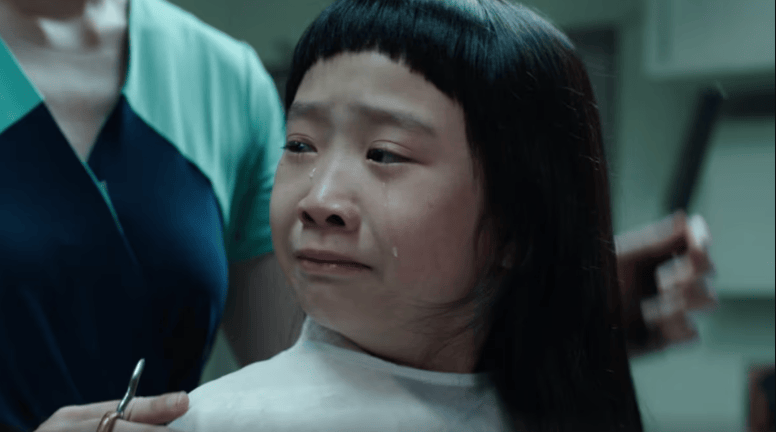
What makes Ah Girl such a wonderful film is just how fully realised its young protagonist feels. Ang doesn’t simply construct a story about a child caught in the middle of her parents’ separation; she gives Ah Girl an entire childhood to inhabit, complete with its own preoccupations, ambitions, insecurities, mischief and little triumphs. She has a crush on a schoolmate, Shawn, who loves catching spiders. Eager to impress him, Ah Girl is fearless, and manages to catch an even better spider and presents it to him. When he subsequently reveals that he likes girls with long hair, she is devastated when a haircut leaves her with a short bob, and discovers that Shawn is now paying more attention to other girls. It’s a seemingly inconsequential childhood episode, but one that carries the sort of disproportionate emotional significance that only a first crush can have. Eventually, she decides that she has no time for boys and should concentrate on herself instead. There’s something wonderfully earnest about it all, and it feels like the sort of story one might have encountered in a beloved children’s novel growing up, brought to life by a filmmaker who genuinely understands how children see and experience the world.
Ah Girl is also quite the little entrepreneur, selling the chewing gum her mother brings back from Japan to her classmates at school, complete with a menu of flavours and an eye for profit. She’s enterprising and commercially savvy, but always honest in her dealings. At the same time, she’s mischievous and impulsive, drinking her sister’s hot milo when she’s not looking, playing with her grandmother’s wig and imitating her, or cutting up her father’s calendar because of a particularly attractive woman pictured in it. Yet beneath all that cheekiness is a fiercely protective older sister. When she discovers that her father intends to send Ah Tian to live with a friend in Australia, the two girls attempt to run away together, even hailing a taxi in the middle of the night in their desperate attempt to escape. On another occasion, Ah Girl gets her sister to hide inside a rubbish bin. These are the sorts of schemes that make perfect sense within a child’s understanding of an increasingly confusing world, and they speak to just how deeply she feels responsible for her younger sister.

There is an especially affecting moment when Ah Girl brings out her piggy bank and smashes it in front of her father, hoping that the little savings she has accumulated might somehow help him with his financial troubles. It isn’t much, but the gesture is enormous. She has an almost childlike understanding of the problems confronting her family, yet possesses an extraordinary determination to do something about them. Her love is often expressed through these little acts of desperation, even as the adults around her repeatedly let her down.
Ong Xuan Jing is simply remarkable in the role, and full deserving of her recent Golden Horse nomination. Ang has drawn an astonishingly complete performance from her, one that never feels like a child being coached to deliver particular emotions. There’s the cheeky glint in her eyes, the wry smiles, the unrestrained delight of playing with her sister and wasting water together in the bathroom, and the heartbreaking vulnerability when she breaks down in tears. One particularly quiet moment sees her sitting in a taxi with her mother, who has clearly been hurt by her new boyfriend. Ah Girl notices the bruises and welts on her mother’s wrist, but neither says anything. Instead, she simply holds her mother’s wrist throughout the journey. It’s a beautifully understated moment, and one that demonstrates just how much Ah Girl is beginning to understand without necessarily having the words or maturity to articulate it. Elsewhere, she earnestly prays that her mother will be happy. For all her resourcefulness and stubbornness, she is still very much a little girl who wants the people she loves to be happy. It’s an extraordinary performance, and one that makes Ong a genuine star in the making.

Sydney Wong is equally lovely as Ah Tian, whose personality provides an interesting contrast to her older sister’s. Frequently dressed in blue and wearing shorts, she is often mistaken for a boy and occasionally insists that she is one, although the people around her largely take it in their stride. She’s a little more impulsive and less guarded than Ah Girl, often expressing herself immediately and without the same degree of consideration. Wong has some particularly memorable moments, from blankly watching her mother get into an altercation with one of her father’s girlfriends while continuing to eat her snacks, to mimicking her older sister and bursting into tears over the smallest things. There’s an endearing vulnerability to her performance, and she is every bit as convincing as a young child navigating a world she doesn’t quite understand. The chemistry between the two girls is essential to the film, giving their relationship a warmth and authenticity that makes Ah Girl’s protectiveness all the more affecting.
The rest of the family forms an equally fascinating constellation around the two girls. Doreen Toh’s grandmother is perhaps the most quietly interesting of the adults, serving as the children’s primary caretaker while their father works night shifts and their mother goes about her own life. She picks them up from school, prepares their meals, gives them pocket money and dispenses the occasional white lie, such as insisting that they shouldn’t buy ice cream because there’s already some at home. Toh brings a wonderful deadpan quality to the character, particularly in a scene where she produces a collection of knives in front of the mother and one of the father’s girlfriends, essentially telling them to hurry up and kill each other if that’s what they intend to do. Yet beneath her rather resigned demeanour is someone who has become accustomed to simply allowing things to happen. When Ah Girl eventually accuses her of being passive and merely taking money from her mother, it seems to prompt a moment of reflection. Her subsequent decision to shoulder the expensive hospital bill for Ah Girl is a small but meaningful indication that she is finally taking a more active role in the children’s lives. Even her eventual opportunity to travel to Japan, something she has always wanted to do, feels like a little victory for someone who has spent so much of her life putting everyone else first.

Carrie Wong and James Seah are similarly effective as the girls’ parents, two people whose complicated relationship and inability to provide a stable family life form the central conflict of the film. Wong’s mother is a particularly interesting character. She is affectionate and indulgent in her own way, bringing her daughters little treats, taking them out for and preparing their meals and carefully removing the bones from their fish. Yet she is also demanding, fiercely berating Ah Girl over her English grades and insisting that academic performance will determine her future. It’s a familiar parental anxiety, particularly for anyone who grew up in Singapore, and one that exists alongside her less admirable decisions. Her relationship with a new boyfriend initially appears to offer some prospect of stability, but his short temper and abusive behaviour soon become apparent. Even then, the film doesn’t simply reduce her to a bad mother. She is a woman with her own vulnerabilities and difficulties, trying to find happiness while repeatedly making decisions that affect her daughters, and genuinely hopes for their success.
Seah’s father is similarly flawed, seemingly more interested in horse betting and his string of plus-sized girlfriends than in establishing any meaningful stability. Yet he can also be genuinely charming and affectionate with the girls, whether going out of his way to buy them an expensive set of poster paints or simply playing with them at home. His relationship with ‘Japan Auntie’ briefly offers the possibility of a happier arrangement, particularly when all four of them do a lovely dance sequence together. But that happiness proves fleeting when she disappears after discovering that he has gotten ‘Malaysia Auntie’ pregnant. It’s a rather extraordinary turn of events, and one that reinforces how quickly the children’s circumstances can change without their having any say in the matter.

What one particularly appreciates is that Ang doesn’t construct a straightforward story of heroes and villains. The adults are messy, sometimes selfish and frequently irresponsible, but they are also capable of tenderness and affection. Their shortcomings are not necessarily born out of a lack of love for their children; rather, they are people who struggle to manage their own lives, leaving the girls to navigate the consequences. Ah Girl gradually develops the belief that all adults are liars, and it’s difficult to argue with her when we see how frequently the promises made to her are broken. Yet the film also gives considerable credit to the resilience of the children themselves. One of the earlier scenes sees the girls rummaging through a rubbish bag for discarded toys, happily salvaging whatever they can find. It’s a small detail, but one that captures their ability to make something out of very little, finding joy and companionship even when the circumstances around them are far from ideal.
A considerable part of the film’s charm also comes from its meticulous recreation of 1990s Singapore. The old taxis and buses, payphones, school buildings, uniforms, HDB interiors and open-air hawker centre where the father works all contribute to a remarkably lived-in sense of time and place. Even the radio broadcasts, with references to Michael Fay and the chewing gum ban, are little reminders of a very specific period in Singapore’s history. There is an almost overwhelming amount of attention paid to the details, and I found myself wondering just how much location scouting and effort went into finding and recreating all these things. The 4:3 aspect ratio further reinforces the nostalgic atmosphere, while the archival television footage, particularly the Miss Universe beauty pageant broadcasts that Ah Girl watches so enthusiastically, adds another layer of period authenticity.

Admittedly, Ah Girl does lean rather heavily on nostalgia, and much of its immediate appeal comes from recognising the textures and everyday details of a Singapore that no longer quite exists. For those of us who grew up in the 1990s, this is an especially potent part of the experience. But the film ultimately works because it doesn’t rely on nostalgia alone. Its setting may be distinctly Singaporean, but its understanding of childhood is far less geographically confined. The anxieties of wanting your parents to stay together, worrying about being separated from your sibling, having your first crush, or slowly discovering that the adults you depend on are not always capable of looking after themselves are hardly unique to any one generation.
There are also some wonderfully unexpected touches of humour throughout, ranging from dry one-liners and misunderstandings to genuinely outrageous moments involving the adults. Ang has a good eye for the absurdity of family life, and the film is often much funnier than its rather sombre premise might suggest. A fever-dream sequence following Ah Girl’s illness after playing in the rain is another highlight. Imagining herself in a children’s beauty pageant inspired by the television broadcasts she has been watching, she is asked about her ambitions and simply declares that she wants to be Ah Girl. She doesn’t win, with the crown instead going to another child whose ambition is to become a mermaid. It’s a wonderfully strange, almost surreal sequence that feels like a genuine amalgamation of a child’s dreams, observations and subconscious thoughts, and one that doesn’t necessarily need to be interpreted beyond its sheer imaginative charm.

By the end, Ah Girl gives Ah Tian a protective charm from the temple that their grandmother had previously given her, telling her that it will keep her safe. It is a small gesture, but one that brings the sisters’ relationship full circle. Whatever happens around them, Ah Girl remains determined to look after her younger sister. The final image of her sitting alone on a public bus, deep in thought, is similarly understated. There is no grand resolution, nor does the film attempt to suggest that all the problems surrounding her family have suddenly disappeared. Instead, we are left with a little girl who has already had to grow up in certain ways, but who has also retained so much of the innocence, imagination and determination that make childhood what it is.
Some childhoods are messier than others, and not every memory is necessarily a happy one. But there is something rather wonderful about a film that manages to capture all of it: the mischief, the innocence, the disappointments, the little victories and the resilience it takes to grow up. The nostalgia certainly brought back plenty of memories for viewers, but what lingers most was the sheer fullness of Ah Girl’s character and the remarkable performance that brings her to life.
Ah Girl is ultimately a lovely, bittersweet coming-of-age story that understands how childhood can be both wonderfully carefree and unexpectedly cruel. It is a film about the things children notice, the things they misunderstand, the things they are never told, and the enormous emotional burdens they sometimes find themselves carrying. Ang’s achievement lies in allowing all these experiences to coexist without reducing Ah Girl to either a victim or an impossibly precocious child. She is simply a little girl trying to make sense of her family, finding happiness where she can and learning to fend for herself along the way.
Ah Girl opens in cinemas islandwide on 19th November 2026. Follow @ahgirlfilm for the latest updates and upcoming screenings.

