

A thoughtful exploration of grief through the eyes of a child that occasionally loses its emotional footing.
Duration: 65 minutes
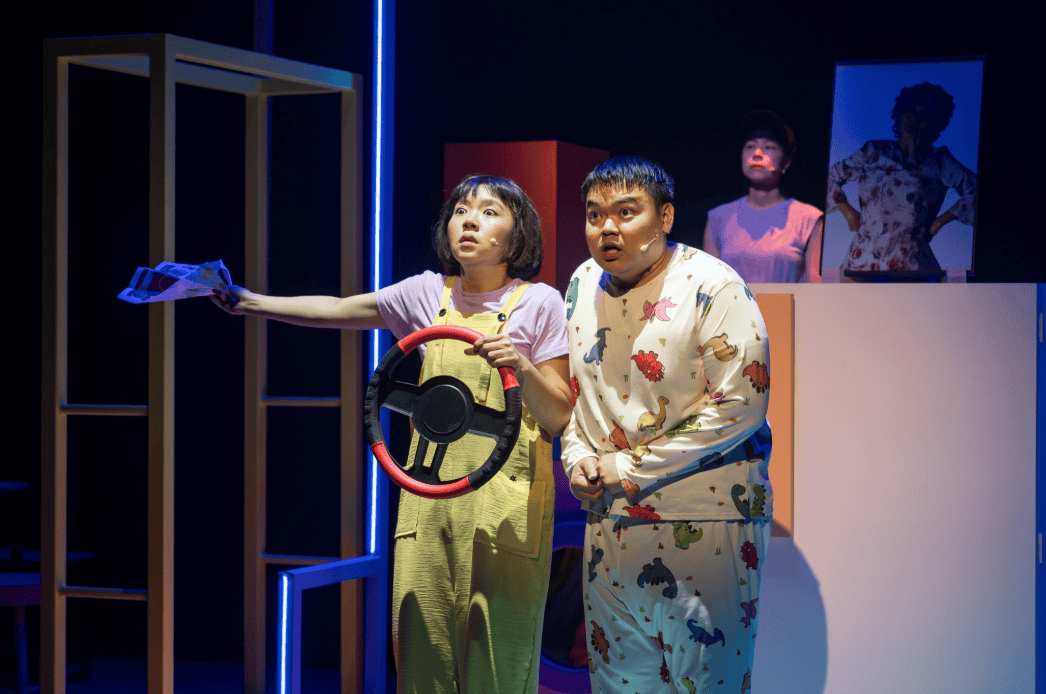
In Gateway Arts’ latest production, How To Be A Kid asks audiences to remember what it means to be a child, and the struggles that come with it. Written by British playwright Sarah McDonald-Hughes and directed by Ian Loy, the play follows 12-year-old Molly (Genevieve Tan), who assumes the role of the family’s self-appointed Supergirl after the death of her grandmother. With her mother (Misha Paule Tan) overwhelmed by grief, Molly takes it upon herself to look after the household and her six-year-old brother Joe (Jeremy Leong), determined to keep things together while suppressing her own feelings. It is only when she returns to the foster care centre she took refuge at during her mother’s breakdown that Molly begins to recognise that being strong does not mean having to run away from her emotions.
One of the production’s biggest challenges is its casting. Having adults portray children, particularly at the distinctly different ages of 12 and six, is always a theatrical gamble. There are moments when the exaggerated mannerisms and vocal inflections become rather comical, tipping the performances towards something almost skit-like rather than entirely believable. Both Genevieve Tan and Jeremy Leong do their best to inhabit their respective characters, and there are flashes when the artifice falls away and we genuinely see the children beneath the performances. Tan, in particular, continues to demonstrate her growing range as a rising actor, finding moments of convincing vulnerability beneath Molly’s headstrong exterior. Leong, meanwhile, brings an endearing silliness to Joe, even if the character’s overall dramatic purpose remains somewhat unclear. While his presence offers occasional comic relief and a contrasting perspective on grief, one wonders whether the story would have been substantially different without him.

The writing itself is another mixed bag. McDonald-Hughes has an interesting understanding of child logic, particularly in the way Molly tries to rationalise her circumstances and convince herself that she can manage everything. However, the dialogue can be surprisingly wordy, with lengthy exchanges that sometimes feel more adult than childlike. This can be overwhelming for younger audiences, especially when the emotional shifts are rather abrupt. There were moments when children in the audience appeared uncertain about Molly’s reactions, raising the question of whether the play’s emotional transitions are sufficiently contextualised. There is a difference between presenting children with complex feelings and expecting them to follow an emotionally overwrought narrative without enough room to process it.
Indeed, the play sometimes feels like an aftermath without quite giving us the buildup. Grandma’s death is the catalyst for the family’s circumstances, yet her presence is not developed sufficiently for us to fully appreciate the extent of the loss experienced by Molly and Joe. Similarly, while we understand that Mum is struggling with grief and that Molly feels compelled to take care of her, the relationship between mother and daughter could have been more meaningfully established. The production asks us to invest in Molly’s emotional burden, but doesn’t always give us enough of the familial context from those she’s lost to feel its full weight, especially when she starts off with so many shields and barriers to protect herself to begin with.

That said, the production is not without its moments of genuine insight. Molly’s later encounter with her friend Taylor, whether understood as a real friend or something closer to an extension of her own conscience, provides an important moment of self-realisation. Molly begins to recognise that her determination to be a Supergirl is also a way of avoiding her feelings, and that she cannot simply outrun grief. It is a turning point that gives the story’s emotional journey greater clarity, allowing Molly to understand that acknowledging her vulnerability is not the same as giving up.
The ending is arguably where this idea comes together most effectively. Molly’s emotional progression from laughter, to wanting to cry, and finally allowing herself to break down captures the contradictory nature of grief rather well. Her eventual conversation with Mum becomes possible only when she stops trying to be the strong one and allows herself to be vulnerable. It is a quietly affecting moment, releasing much of the tension the play has been building towards. There is a certain sophistication in allowing a child to experience such conflicting emotions, even if younger audience members may not necessarily grasp all the nuances of Molly’s response.

The production is at its most engaging when it moves away from its more naturalistic scenes and embraces theatrical imagination. The car adventure involving Vera, Grandma’s old car, brings a welcome sense of mischief and possibility, as do the nighttime escapades that take Molly and Joe to a swimming complex. There is an amusing sequence involving a cleaner, played by Misha Paule Tan, whose attempts to chase the children are cleverly realised through physical comedy, with Tan running backwards to create the illusion of being outrun. These moments have a looseness and playfulness that the more grounded scenes sometimes lack. The lighting also works particularly well here, helping to establish an atmosphere that moves between reality, fantasy and the workings of a child’s imagination. Molly’s eventual return to the care home, meanwhile, leaves some room for interpretation: whether it is magic realism, an imagined adventure or a coping mechanism through which she processes her separation from Taylor, the ambiguity is one of the more interesting aspects of the storytelling.
There are also some charming contemporary touches. The opening sees Molly and Taylor dancing to the familiar sound of a washing machine cycle, before their friendship is later underscored by Taylor Swift’s Opalite. These musical references give their relationship a recognisable texture, and the ease with which the two characters share these moments makes their connection feel particularly genuine. In fact, their friendship emerges as one of the more convincing relationships in the play, perhaps because it is allowed to revisited and develop through shared playfulness rather than lengthy explanations.

Misha Paule Tan is another bright spot, demonstrating an impressive ability to differentiate her various roles, from a grieving young mother to the eccentric cleaner and Taylor. She brings distinct physical and vocal qualities to each character, making her transitions considerably more convincing. Live musician and composer Zee Ang is also incorporated into the production’s playful visual language, dressed in a bear costume and surrounded by an assortment of colourful instruments, including xylophones and even using the familiar recorder that many Singaporean children will recognise from their primary school music lessons.
The set follows a similarly colourful approach, with its segmented playing areas providing a functional environment for the action, although it does not particularly distinguish itself beyond its child-friendly aesthetic. One side is reserved for the musician, while the use of a digital image of Grandma is intended to provide a visual reminder of her presence, and even used when she makes a surprise appearance. Unfortunately, the transitions between images are not always smooth, with occasional lags leaving the portrait looking rather more haunted than nostalgic. It is a small technical distraction, but one that draws attention away from the intended emotional effect.

Ultimately, How To Be A Kid is a well-intentioned exploration of childhood grief, resilience and the importance of allowing children to express difficult emotions. Its strongest moments arrive when it embraces the absurdity and imaginative freedom of childhood, rather than attempting to articulate every feeling. There is a good story here, and some genuine emotional understanding in its writing, but the uneven performances, wordy dialogue and insufficiently developed family relationships prevent it from reaching the emotional depth it seeks. Its heart is very much in the right place; one only wishes its theatrical execution had been a little more imaginative, and its storytelling a little less reliant on explanation.

Photo Credit: Gateway Arts
How To Be A Kid runs from 5th to 15th November 2026 at the Gateway Theatre Black Box. More information available from Gateway Arts.
Production Credits
| Cast Genevieve Tan, Misha Paule Tan, Jeremy Leong Musician Zee Ang Director Ian Loy Playwright Sarah McDonald-Hughes Lighting Designer Genevieve Peck Composer/Sound Designer/Musician Zee Ang Sound Designer (System) & Sound Engineer Vick Low Executive Producer Priscilla Khong Assistant Producer Natalie Low Production Manager Juraidah bte Rahman Production Coordinator Joshua Gareth Seow Stage Manager Anne Lee Assistant Stage Manager Mara Karma Phase 1 & 2 Rehearsal Assistant Stage Manager Ann Yeo Phase 1 Rehearsal Stage Manager Goh Xin Yi Set Assistant & Props Master Hairi Cromo Audience Engagement Designer Renee Chua Post-show Facilitator: Sharon Mah Special Thanks Fanny Kee as Grandma, Dr. Geraldine Tan (The Therapy Room), Cat Scratch SFX, The Presenting Company (TPC), Tai Zi Feng from Doodle Productions LLP, Delight.com.sg for the E-Poster, Adriel Foo |

