
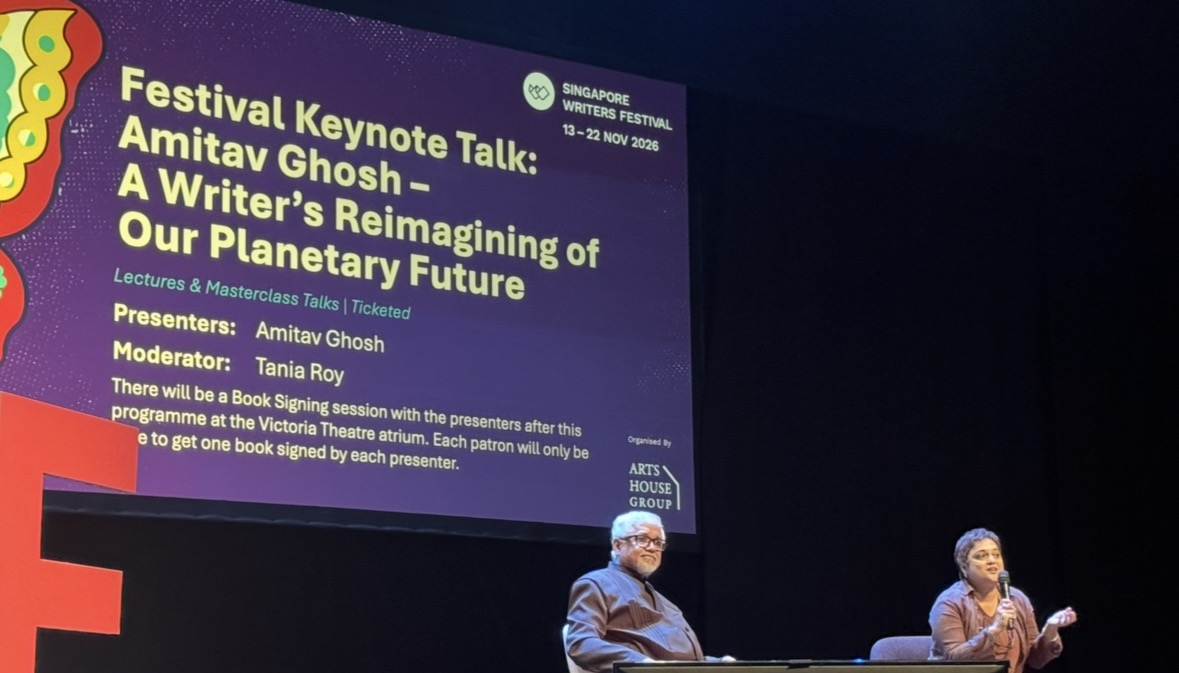

At a time when the language of crisis has become almost commonplace, Amitav Ghosh offered the Singapore Writers Festival audience something more challenging than another warning about climate change. He invited us to reconsider how we imagine the future, whose fears dominate our understanding of planetary catastrophe, and what it might mean to survive in a world undergoing profound environmental and social upheaval.
Ghosh’s reflections ranged across literature, colonial history, migration, technology and the growing culture of private survivalism. What connected these seemingly disparate subjects was a fundamental question: what kind of future are we imagining, and for whom?
One of the most memorable ideas in his talk was his rejection of the familiar choice between hope and despair. Both, he suggested, are inadequate foundations for action. Hope can depend on the assumption that things will eventually improve; despair can leave us paralysed by the scale of what is happening. Instead, he proposed that we think in terms of duty and responsibility: we must act not because we are certain of success, but because action is required of us.
And in a time when climate anxiety can become overwhelming, Ghosh shifts the emphasis away from how we feel about the future towards what we are obliged to do in the present. We do not need to be optimistic to take responsibility.
Ghosh also questioned the dominance of Western narratives of apocalypse. He observed that a pronounced sense of impending doom has become increasingly visible in Western societies, particularly among younger people. He connected this mood not only to environmental and technological anxieties but also to a longer history in which the West has occupied a position of geopolitical and cultural centrality. The erosion of that position, he suggested, may be contributing to a wider sense of disorientation and foreboding. His point was not that societies outside the West are free from fear or environmental danger. Rather, it was that the Western imagination of apocalypse should not automatically be treated as universal. Different societies understand crisis through different histories and experiences.
For many communities in the Global South, environmental disruption is not an abstract prospect of some distant future. Floods, droughts, displacement, ecological degradation and economic insecurity are already part of everyday life. Catastrophe may be experienced not as one dramatic event that brings the world to an end, but as a series of disruptions that have been unfolding over generations.
This distinction also helps explain Ghosh’s reluctance to give his novels conventionally apocalyptic endings. In regions with enormous populations exposed to environmental and social disruption, apocalypse can be a material reality rather than a literary device. To turn it into a neat, dramatic conclusion risks obscuring the complexity of how people actually live through catastrophe.
One of the most arresting sections of the talk concerned the contemporary business of preparing for the end of the world. Ghosh recalled growing up in the 1970s, when the possibility of nuclear annihilation was a prominent subject in popular culture. Today, despite the accumulation of existential threats ranging from nuclear conflict, pandemics, climate change, artificial intelligence and geopolitical instability, public attention often seems strangely fragmented.
At the same time, a new culture of private survival planning has emerged among some of the world’s wealthiest individuals. Luxury bunkers, fortified retreats and elaborate preparations for what is sometimes called “the Event” have become part of a growing commercial landscape. Drawing on Douglas Rushkoff’s book Survival of the Richest, Ghosh explored the idea of “the Event” as something more than one identifiable disaster. It describes a convergence of crises: environmental breakdown, social unrest, financial instability, war, cyberattacks, disease and other disruptions that could combine into a systemic collapse.
What is revealing is the worldview behind these preparations. The imagined future is one in which those with sufficient money, technology and security can retreat from the consequences of collapse and eventually emerge to rebuild a world from which much of humanity has disappeared. Ghosh drew attention to the disturbing assumptions embedded in this vision. Mass death and social disintegration are treated almost as inevitable, while a privileged minority is imagined as capable of surviving beyond the systems on which everyone depends. It raises an uncomfortable question: when survival becomes a private project, what happens to our sense of responsibility towards everyone else?
Colonial thinking was among the most provocative parts of Ghosh’s argument. He suggested that contemporary survival fantasies can echo assumptions from colonial history. Earlier imperial projects often treated the destruction or displacement of indigenous populations as an unfortunate but acceptable consequence of progress and civilisation. Today, the vocabulary may be different, be it wealth, technology, data, security and preparedness rather than race or civilisation, but the underlying hierarchy can remain recognisable.
The question is who is considered capable of surviving, who is imagined as having a future, and whose disappearance is quietly accepted as part of the cost of progress. Ghosh contrasted two broad ways of understanding the planetary crisis. One is a gradualist approach, which sees it principally as a problem of governance: reducing emissions, negotiating international agreements, developing cleaner technologies and pursuing climate justice. This approach is indispensable, but it can also make the crisis appear manageable through policy adjustments and incremental change.
The other is a more troubling vision in which environmental disruption becomes part of a struggle over who will live and who will be left exposed. In this account, the crisis is not merely a technical or administrative problem. It is also a political and moral conflict over the distribution of vulnerability and the protection of particular ways of life.
Ghosh’s concern was not that every wealthy person investing in a bunker consciously wishes for catastrophe. It was that a belief in private escape can make collective disaster seem acceptable, or even inevitable. It may also weaken the incentive to prevent the collapse in the first place. The familiar political slogan “drill, baby, drill” becomes particularly revealing in this context: it expresses a determination to preserve an existing way of life even when its consequences are increasingly difficult to ignore.
Perhaps the most interesting reversal in Ghosh’s argument came when he questioned the assumption that wealth and advanced technology necessarily confer the greatest capacity to survive. The wealthy may be able to build elaborate shelters, but those shelters depend on complex supply chains, specialised equipment, maintenance, replacement parts, energy, chemicals, security and human cooperation. In a genuinely systemic breakdown, these dependencies may become vulnerabilities. A fortified bunker is not necessarily a self-sufficient world.
By contrast, communities often described as poor, marginal or underdeveloped may possess forms of resilience that modern societies have overlooked. People who farm, fish, hunt, gather food, repair things, understand local ecosystems and depend on community networks may have practical knowledge that becomes invaluable when industrial systems falter.
Ghosh pointed to the long history of Indigenous Australians, whose communities have adapted to environmental changes over tens of thousands of years. Such examples challenge the assumption that the most technologically sophisticated societies are automatically the best equipped to face an uncertain future. This is not an argument for romanticising poverty or suggesting that vulnerable communities should simply be left to cope. Their exposure to environmental harm is often severe, and their resources are frequently inadequate. Rather, Ghosh asks us to recognise that knowledge, adaptability, ecological understanding and social relationships are also forms of wealth, even if they are not measured by conventional economic indicators.
The people who know how to live with the land, maintain local networks and manage with fewer industrial dependencies may possess capacities that a highly connected, consumption-dependent society has allowed to atrophy. Ghosh’s challenge is to reconsider what we mean by preparedness. Perhaps it is less about building a fortified refuge than about recovering the ability to live within, understand and adapt to the natural world.
Ghosh’s discussion of migration added another dimension to his argument about inequality and the imagination of the future. Drawing on interviews with young migrants travelling to Italy in 2015 and 2016, he challenged explanations that reduce migration to poverty or climate displacement.
Migration, he argued, is shaped by a complex mixture of economic circumstances, aspirations, social networks and the influence of mobile phones and social media. These technologies help people discover routes, make connections and organise journeys, but they also expose them to images of lives elsewhere. The desire to migrate may arise not only from hardship but from the attraction of a different kind of life.
Here Ghosh invoked the idea of mimetic desire: our desires are often shaped by what we see others possessing or enjoying. The West’s image of itself as prosperous and desirable continues to influence how people around the world imagine their own futures.
This produces a striking contradiction; the West remains a destination of aspiration for many, even as some of its wealthiest citizens imagine withdrawing from a shared future and securing their own survival. The same societies that have projected an image of prosperity to the world may now be investing in ways to insulate themselves from the consequences of the systems that produced it.
Ghosh’s reflections on Bengali literature and language offered a further reminder of the importance of looking beyond dominant cultural perspectives. His engagement with Bengali has given him access to literary traditions, archives and histories that might otherwise remain outside mainstream accounts of the modern world. The language itself, carried across borders by migration, has become international in ways that challenge narrow ideas of national literary cultures.
For a festival devoted to writers and the written word, Ghosh’s challenge to literary culture was particularly pertinent. He has long questioned the reluctance of mainstream literary institutions to engage seriously with the planetary crisis. Publishers, reviewers and literary festivals can be slow to recognise writing that places environmental disruption at the centre of human experience.
Yet writers have been exploring these questions for decades. Ghosh invoked the importance of earlier speculative and visionary writers, including Octavia Butler, whose work anticipated many of the social and political consequences of environmental and technological upheaval.
The challenge for contemporary literature is not simply to produce more stories about climate change or catastrophe. It is to rethink the narrative conventions through which we imagine the future. If the dominant story is one of technological rescue, private escape or the sudden end of civilisation, other possibilities disappear from view.
Literature can make visible the experiences of people who are usually pushed to the margins of global narratives. It can recover forms of knowledge that modernity has dismissed, explore the connections between environmental change and human movement, and question the assumptions that shape our understanding of prosperity and aspiration.
This is also why Ghosh’s own approach matters. His work crosses the boundaries between history, ecology, politics and fiction. It asks readers to see the planetary crisis not as a separate environmental subject, but as something woven into the histories, inequalities and relationships that shape human life.
What gives Ghosh’s talk its force is the way these different strands converge. His critique of Western apocalyptic narratives, his examination of elite survivalism, his recovery of marginalised knowledge and his discussion of migration all point towards a common question: how do we imagine a future that is not organised around the survival of a privileged few?
His answer is not a simple programme of solutions. It is an invitation to change our perspective and to question the assumptions through which we understand progress, recognise the unequal distribution of risk, and take seriously forms of knowledge and resilience that dominant systems have undervalued.
There is a productive tension in this argument. Ghosh is sceptical of easy optimism, but he does not advocate surrender. He is critical of technological fantasies of escape, but not dismissive of the need for practical responses. He challenges the idea that the future can be secured by individual wealth, while reminding us that collective survival depends on forms of cooperation and knowledge that already exist in many communities.
The most enduring contribution of his appearance at the Singapore Writers Festival may be this reversal of perspective. Those who appear most powerful today may not necessarily be best equipped for tomorrow. Those dismissed as poor or backward may possess knowledge and adaptability that the rest of the world urgently needs to recover.
Ultimately, Ghosh asks us to move beyond the fantasy that the future can be privately purchased or secured behind fortified walls. The planetary crisis demands a broader sense of responsibility — one grounded not in the promise that everything will turn out well, but in the recognition that our actions matter even when the outcome is uncertain.
We may not know what the future holds. But, as Ghosh’s reflections suggest, uncertainty is no excuse for inaction. The task is to imagine a future in which survival is not the privilege of a few, but a shared responsibility.
Singapore Writers Festival 2026: Hidden In Plain Sight runs from 13th to 22nd November 2026. Tickets and more information available here.

