

The Amélie director’s latest film is a realistic, non-liner narrative about the complexity of emotional healing, though hints of the magic and whimsy remain in the world around its grieving protagonist.
Duration: 132 minutes
French director Jean-Pierre Jeunet has described Violette as his most realistic film yet, which is an interesting proposition from the director of Amélie. One might reasonably expect him to double down on the eccentricities and whimsical flourishes that have come to define his filmmaking, but instead he seems rather determined to restrain them. The result feels like a mature, somewhat melancholic successor to Amélie, retaining much of its fondness for life’s little absurdities while finding considerably less room for fantasy. It’s still quite quirky and occasionally very cute, but there’s a sadness that permeates almost everything.
Violette (Leïla Bekhti) is a cemetery caretaker in a small town in Burgundy, where much of her time is spent tending to graves and listening to the confidences of visitors. Her own history, however, is considerably more complicated. Abandoned as a baby and nearly frozen to death before being rescued by a nurse, she was given her name because of the colour of her skin at the time. It’s a rather darkly whimsical introduction, and one that initially suggests a much stranger film than the one Jeunet eventually settles on. We soon move past her childhood and into her marriage to Philippe (Matthias Schoenaerts), a motorcycle-riding charmer whose appeal is rather quickly undermined by his penchant for drinking, womanising and general irresponsibility. Their work as railway crossing keepers is particularly quaint, although Philippe’s nonchalant attitude means Violette is frequently left to shoulder the responsibility herself. He’s hardly a sympathetic presence when he initially objects to taking up work at the cemetery once they’re replaced by an automated system – there is no good reason why, initially at least.
What makes Violette particularly interesting is the way it chooses to tell its story. Rather than proceeding chronologically, it jumps between different periods of Violette’s life, gradually filling in the gaps and revealing the circumstances behind her present unhappiness. It’s occasionally confusing, but there’s a thematic purpose to this fractured approach. Grief rarely follows a straight line, after all. Memories surface in fragments, certain moments become disproportionately significant, and the past has a habit of intruding upon the present without any particular regard for chronology. The film’s structure seems designed to reflect this, allowing us to piece together Violette’s history in much the same way she is forced to confront it herself.
Indeed, Violette is someone who seems to have physically absorbed her grief. She rarely smiles, carries herself with a perpetual tension, and has an anger that seems to simmer just beneath the surface. Her relationship with death is especially complicated: she refuses to attend a funeral, lashes out at those she believes responsible for her suffering, and struggles to accept that life can continue for everyone else when hers has effectively stopped. Her visits and subsequent work at the cemetery becomes a means of processing that pain, particularly as she learns to care for the grounds, its inhabitants, and finds some solace in gardening. There’s something rather lovely about the idea that someone who spends her days tending to the dead might eventually rediscover an interest in nurturing the living.
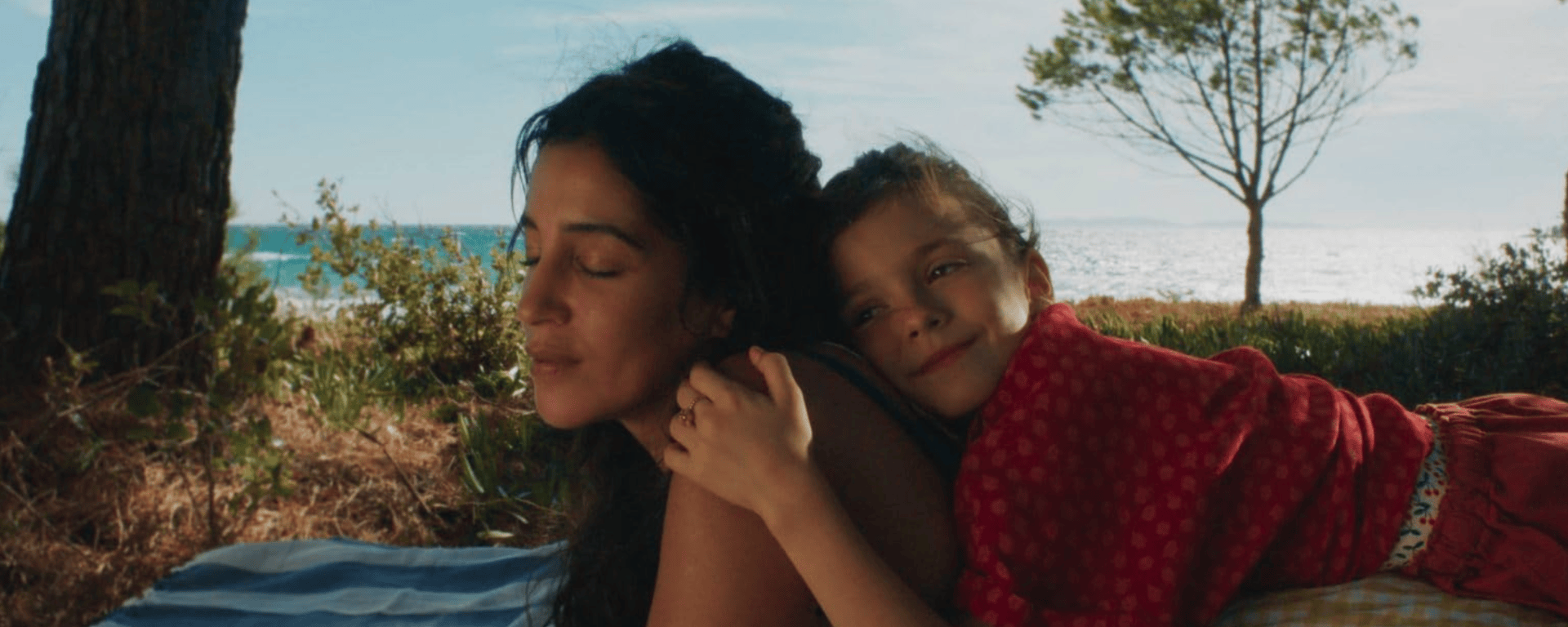
Much of the film’s emotional weight comes from the gradual revelation of what Violette has lost, and the extent to which she has allowed that loss to define her existence. Her daughter Léonine is clearly the light of her life, and one of the film’s loveliest passages takes us back to a family holiday in Marseille, where, for a brief moment, the three of them seem genuinely happy. These glimpses of domestic contentment are all the more affecting when set against the misery that follows. What’s particularly tragic is how the film ultimately approaches the circumstances of her loss. We spend so much time anticipating some deliberate act of cruelty, some identifiable culprit upon whom all this suffering can be pinned, only for the truth to be considerably more mundane and heartbreaking. Life, as it turns out, can be terribly unfair without anyone actually being at fault.

Philippe’s own storyline adds another dimension to this, particularly as we discover that he, too, has been trying to get to the truth. He’s hardly absolved of his many shortcomings, but the film does make an effort to complicate our initial impressions of him, revealing a man who is considerably more troubled than his charming exterior suggests. There’s something sad about how two people can experience the same devastating loss and yet become so estranged that they cannot even properly grieve together. At times, one might actually find his self-destructive story more compelling than Violette’s, and wonder whether the film might have benefited from giving it greater prominence earlier on. Jeunet seems keen to give everyone their own history and emotional baggage, even minor cemetery workers, occasionally at the expense of narrative focus, but knowing his style, one appreciates the attempt to make its characters feel like people with lives extending beyond the immediate concerns of its protagonist.
For all its melancholy, however, Jeunet hasn’t entirely abandoned his old sensibilities. There are still plenty of those quaint little observations and unexpected moments of sweetness that make his films so distinctive. The cemetery itself becomes an unlikely gathering place for all sorts of eccentric characters, while the railway crossing keeper’s job feels like something lifted from a more old-fashioned, whimsical world. There’s also a recurring preoccupation with death, both physical and metaphorical, that extends beyond the obvious setting, with several near-death encounters and the gradual replacement of human crossing keepers by automated systems. Even the film’s romantic moments retain some of that old Jeunet magic, particularly a rather joyous encounter against the backdrop of New Year’s Eve fireworks. Yet these moments feel more fleeting than transformative. The Marseille sequence and a vision of Léonine in the water are among the few occasions where the film seems to allow itself to drift into something approaching fantasy. Otherwise, the whimsy is more subdued due to. the subject matter of the film – grief prevents us from enjoying or even seeing these moments.
But as a result, the eccentricities don’t always cohere as naturally as they did in Amélie, perhaps because Violette herself is such a fundamentally unwhimsical character. The world around her might be full of oddities, but she’s far too consumed by guilt and sadness to participate in them in quite the same way. She’s an interesting character to follow, and occasionally allowed to exist beyond her suffering, but for the most part, is lacking in a clearer character not defined by her circumstances. There’s also a rather cumbersome quality to the storytelling, with its constant shifts in chronology and repeated fade-to-black transitions that seem intended to divide the film into chapters. These were distracting to an extent, and while meant to signal the non-linear nature of memory while grieving, the visual punctuation becomes tiresome after a while. The film could certainly also have benefited from a little trimming, especially when its various narrative threads threaten to pull it in too many directions.
Still, there’s something genuinely affecting about Violette and its understanding of grief as something that changes shape over time. It’s not a particularly tidy journey towards healing, nor does it offer the sort of cathartic resolution one might expect. Instead, it recognises that sometimes the hardest part of letting go is accepting that sometimes, there is nobody to blame, and that the world has simply continued moving in the meantime. Jeunet may have toned down the fantasy, but his affection for life’s peculiarities remains intact. It’s a little less charming than his best work, occasionally rather overextended, but there’s enough warmth, sadness and unexpected beauty here to wrap it up as an overall satisfying experience. A lovely, if rather heavy-hearted, film.
Violette plays at various cinemas till 29th November 2026 as part of the 2026 Voilah! French Film Festival. Tickets and screenings available here
The 2026 Voilah! French Film Festival runs till 29th November 2026. Full film lineup and schedule available here

