
What would a writer’s bookshelf reveal about them? A carefully curated collection of literary classics, perhaps, or an eclectic assortment of books that reflect a lifetime of curiosity, contradictions and changing perspectives?
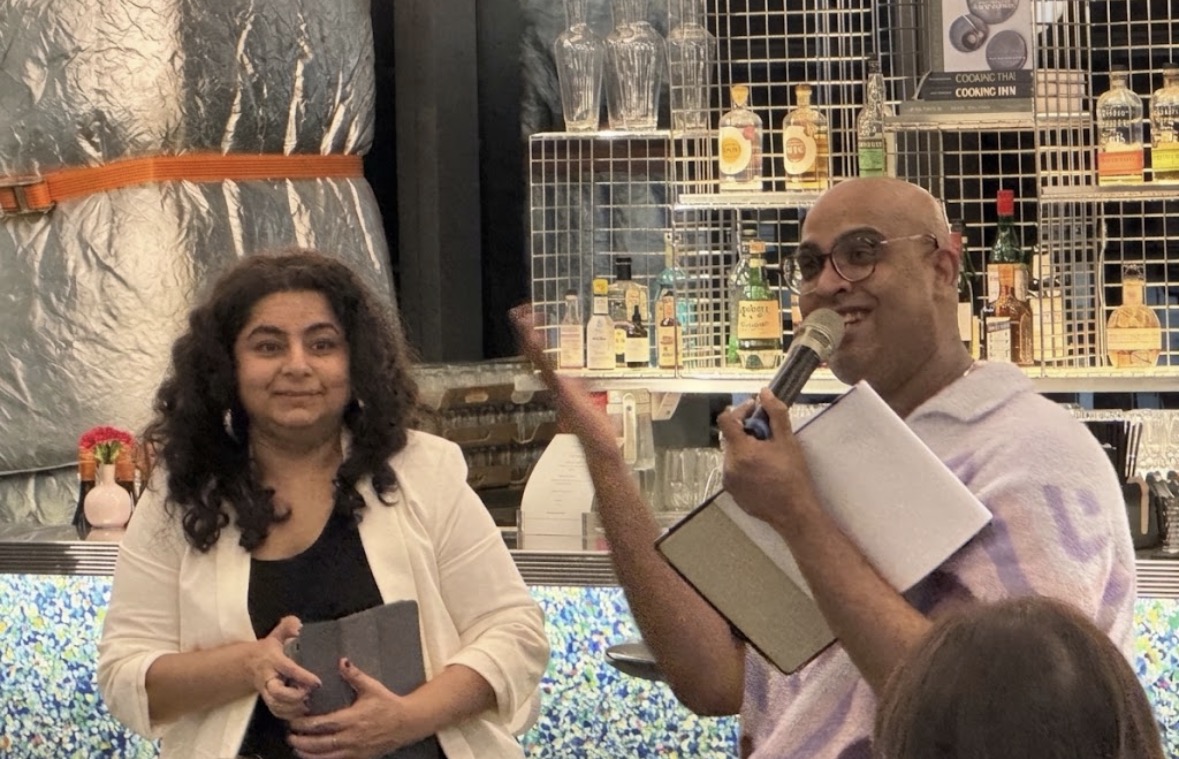
As part of her salon session at COMO Cuisine in Orchard for the 2026 Singapore Writers Festival, poet, performer, educator, and former Singapore Writers Festival director Pooja Nansi invited us to consider just that. In an intimate evening of literary conversation, moderated by writer Jaryl George Solomon, Nansi took us through the women writers who have shaped her life and work, the books she has loved and revisited, and those she has learned to look at differently over time.
The setting was as inviting as the conversation itself. With its cosy, stylish interiors and canapés served before and after the programme, there was room to settle in, exchange thoughts and mingle with fellow book lovers. But beneath the relaxed atmosphere was an intellectually stimulating discussion that asked us to think more deliberately about what we read, why we read, and who gets to decide what is worth reading in the first place.
For Nansi, her ideal bookshelf would be a reflection of her many interests and contradictions. It would hold literary theory, poetry, fiction, and even what she described as her more indulgent reading choices. She enjoys books that challenge her intellectually, but also those that simply offer pleasure. It would be, in her words, a collection of things that make her “dream work in many different ways”.
One of the evening’s more compelling discussions explored the complicated relationships we can have with books and their authors. Nansi spoke about Enid Blyton’s The Magic Faraway Tree, a childhood favourite she has recently begun sharing with her daughter. While recognising its dated and problematic representations of gender and race, she is reluctant to turn to revised editions that remove these elements. Instead, she reads the original stories with her daughter, using their more troubling passages as opportunities for conversation.
Her approach is not to erase the uncomfortable aspects of a beloved book, but to acknowledge them. There is a distinction, after all, between recognising the limitations of a text and denying the personal meaning it has held for us.
This question became even more pertinent when the discussion turned to J.K. Rowling and the Harry Potter series. Can we continue to love a work of literature while rejecting the views of the person who created it? Nansi believes we can. Drawing on Roland Barthes’ idea of the death of the author, she reflected on how meaning is created not just through the writer’s intentions, but through the reader’s encounter with the text. “Our experience with the text remains ours,” was the sentiment at the heart of her argument.
She was also clear that literature should not be reduced to a simple exercise in moral judgement. “We’re not in the business of certainty,” she observed. “We’re in the business of complication.” It was a refreshing reminder that reading need not be an all-or-nothing exercise. We can love a story, recognise its shortcomings, disagree with its author and still acknowledge what the work has meant to us. The question of where we choose to spend our money may be a different matter, but our emotional relationships with books are rarely so straightforward.
The conversation also touched on how our relationships with books evolve as we grow older. Nansi spoke particularly fondly of Jane Austen’s Persuasion, a novel she had revisited at different stages of her life. In her twenties, she found herself frustrated by its protagonist, Anne Elliot, whose quiet acceptance of life’s disappointments seemed less appealing than the spirited defiance of Elizabeth Bennet.
Returning to the novel in her forties, however, she found herself moved by Anne’s restraint and quiet resilience. She had come to appreciate a woman who did not need to perform intelligence or defiance to know who she was. It was a particularly sharp illustration of how the books we return to can reveal as much about ourselves as they do about the stories on their pages. Sometimes, the text remains the same, but the reader has changed.
Nansi’s defence of Austen was equally spirited when the conversation turned to the familiar criticism that her novels are preoccupied with the romantic concerns of wealthy, privileged women. She argued that beneath their domestic settings are deeply political questions about women’s economic vulnerability, class, property, desire and ambition. Austen’s world may be specific, but the human concerns at its centre remain remarkably resonant.
Indeed, Nansi questioned why women writers have so often been dismissed for writing about supposedly smaller or more domestic concerns. She cited the disparaging remarks made about Austen by male literary figures such as Ralph Waldo Emerson and Mark Twain, pointing out the disproportionate hostility directed at a writer whose novels continue to inspire readers and adaptations more than two centuries later.
This led naturally to a wider discussion about the literary canon and who gets to decide what constitutes literary value. Nansi suggested that the canon is never neutral: it is shaped by questions of class, access and cultural power. Rather than simply calling for a few more women writers to be added to the existing list, she provocatively suggested that we might do better to dismantle the idea of a fixed canon altogether. “I think it’s much more fun to, in your reading life, figure out what your canon is,” she said.
It is an idea that shifts the responsibility and pleasure of reading back to the individual. We need not wait for institutions, educators or literary gatekeepers to tell us what deserves our attention. We can build our own canons, discover writers outside the familiar lists and allow those collections to change as we do.
The discussion of female characters offered another pointed observation. Nansi challenged the increasingly familiar label of the “strong female character”, questioning why women in fiction are so often expected to demonstrate extraordinary resilience or moral conviction to be considered worthwhile characters.
Male characters, she noted, are frequently celebrated for being flawed, indecisive, self-destructive or morally compromised. Women, by contrast, are often expected to be exemplary. So why can’t female characters be messy, unlikeable, mediocre or simply human? It was clear reminder that the freedom to be complicated should extend to women in fiction as much as it does to women in real life.
Nansi also shared the women writers who have helped her articulate aspects of her own experience. Anne Sexton’s poetry, particularly her willingness to write about female loneliness and experiences that were rarely spoken about openly in the 1960s, gave her courage as a writer. Lucille Clifton’s celebration of the ageing female body offered another way of thinking about womanhood. And Jia Tolentino’s writing, including her reflections on anger, identity and contemporary life, helped Nansi reconsider her relationship with her own emotions. One line, in particular, stayed with her: “Anger is loaded with information and energy.” It was a sentiment that changed how she understood her own irritation, not as something to suppress, but as something worth listening to.
Perhaps the most useful takeaway from the evening, however, was Nansi’s encouragement to read widely and deliberately, especially beyond our usual interests and comfort zones. She likened reading challenging material to going to the gym. If we only exercise the muscles we already use, we cannot expect to grow stronger. Similarly, we should occasionally choose books that stretch our comprehension, unsettle our assumptions or leave us a little bewildered. Not every book needs to be immediately accessible. Not every difficult work needs to be fully understood on the first reading. And not every book we encounter needs to become a favourite.
There is also no shame in enjoying something considered frivolous, popular or unfashionable. A book that meets us at the right time can be meaningful, regardless of whether it satisfies someone else’s definition of literary merit. Reading should not become another performance of being well-read, nor a competition to demonstrate that we have worked our way through the right list of classics. What matters is the active choice to read: to be curious, to explore, to question and sometimes to struggle with what is on the page.
As the evening at COMO Cuisine drew to a close, that seemed a particularly fitting thought to take away. A bookshelf need not be a monument to our literary credentials. It can instead be a record of the things that have moved us, challenged us, irritated us and changed our minds. Perhaps the best reading life is not one spent trying to read all the right books, but one spent remaining open to the possibility that the next book might change us in ways we never expected.
Singapore Writers Festival 2026: Hidden In Plain Sight runs from 13th to 22nd November 2026. Tickets and more information available here.

