
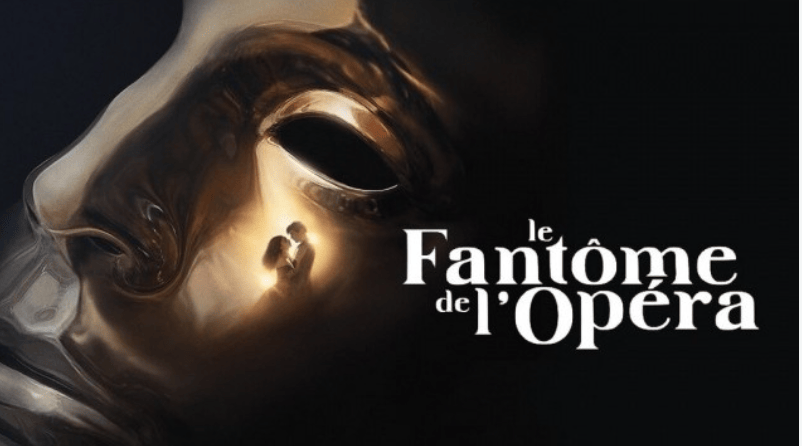
For French filmmaker Alexandre Castagnetti, adapting Gaston Leroux’s enduring tale was more than an opportunity to revisit a much-loved classic. With an opera-singer father, childhood dreams of becoming a musician and filmmaker, and a lifelong fascination with the performing arts, his contemporary reimagining is perhaps his most personal film yet.
There are few stories as enduring as The Phantom of the Opera. Gaston Leroux’s tale of a mysterious figure haunting the Paris Opera House has inspired countless adaptations across film, theatre and musical productions. Yet for French filmmaker Alexandre Castagnetti, returning to the familiar legend was never about simply retelling a story audiences already knew. It was about bringing something deeply personal to the screen.
His latest interpretation moves the story into present-day Paris, placing a young dancer, Anastasia, at the centre of the narrative. She encounters Ernest, a mysterious composer connected to a cursed piece of music from the 19th century. Their relationship begins through their shared connection to art, gradually developing into a love story intertwined with mystery, obsession and the supernatural.
The film also takes audiences into the magnificent Palais Garnier, the historic opera house that inspired Leroux’s original novel. For Castagnetti, the setting, the music and the world of performance are not merely atmospheric details. They are part of the very reason he wanted to make the film.
“This story is very special and intimate to me because my father was an opera singer. I’ve been living with opera music and performances since I was a boy. I grew up dreaming of opera and cinema, and I always wanted to adapt this story one day.
“Then, two years ago, the dream came true. The producers called me and asked if I would be interested in adapting it. It was quite an incredible coincidence because I had actually started writing something inspired by the story in January, and they approached me in July. I remember thinking it was extraordinary. I had already started writing, and suddenly this opportunity came along.
“I had wanted to do this for a long time. I also wanted the film to tell something about my own story. In many ways, it is very close to me.”

One of the most significant departures from the familiar Phantom narrative is the decision to make Anastasia a dancer rather than an opera singer. It gives Castagnetti an opportunity to explore the relationship between two different artistic disciplines, while allowing the romance to develop through music and movement.
“There were several reasons for this. First, I wanted the two main characters, the dancer Anastasia and the composer Ernest, to meet through their own art forms. I introduced this cursed music, composed by Ernest in the 19th century, while making the ballet and dance contemporary. She is the girl who dances, and he is the man who composes. Their love story begins through art, and then it becomes a real love story when they meet.
“I also wanted to reinterpret the real story that was behind Gaston Leroux’s novel. Leroux was a writer, but he was also a journalist. He had heard several legends about a man who supposedly existed. This man was a pianist who was believed to have died in a fire at the opera house, although some people claimed that he was still living in the underground passages beneath it.
“Leroux built his novel around that story. I took that idea and reinterpreted it, imagining that Ernest was now a ghost inside the opera. The film explores what his real story might have been. You discover that as you watch the movie.”
For Castagnetti, the passion for artistic expression is also central to the original story. Behind the mystery and romance lies a portrait of the dedication, sacrifice and uncertainty involved in pursuing a creative life. “I think this is the very heart of the novel. It’s probably one of the reasons so many prestigious directors have wanted to tell the story in their own way. It speaks about passion for art, the difficulties you have to overcome to build a career, the sacrifices you make and the betrayals you sometimes encounter along the way.
“I wanted to tell it from my own point of view, too, because I’ve always dreamed of becoming a director and a musician. Those were my dreams when I was a child. I played the piano and the oboe, and I still play the piano every weekend at my wife’s bar in Paris. I get people to sing famous songs together. It’s something I really enjoy. For me, it’s all connected: art, life and love. That’s what the film is about.”

Bringing this world to life also depended on finding actors who could embody its contrasting characters. Castagnetti began with Romain Duris, whose personal connection to dance made him an appealing choice, before turning his attention to the younger leads.
“I started with Romain Duris because I knew he loved dance. His mother was a dancer, and he enjoys it himself. I thought he might be interested in the story, and it worked. That was the first point of the casting process.
“Then I had to find the younger characters, Anastasia and Ernest. For Deva Cassel, I first saw a video audition. She wasn’t in France at the time, so she sent it to us. I was immediately impressed. She had this combination of beauty, dreaminess and sensitivity, and there was a sweetness in her voice.
“After that, I met her in Paris and we started working on scenes together. I realised that she was someone who loved to search and experiment. She wanted to try different things within the same scene, to explore the character and see what was possible. I thought she was the right person for Anastasia.
“For Ernest, it was a more traditional casting process. I was impressed by his charisma, even when he wasn’t saying anything. Just through his movements and the way he looked, he had a very strong presence on screen. He had a deep look, great technical experience and he knew how to work on a role. He also asked good questions. I felt that I had found the perfect couple for the movie.”
Perhaps the film’s most extraordinary achievement is its use of the Palais Garnier. While the opera house has appeared in various screen adaptations of the Phantom story, Castagnetti says filming an entire movie within its walls was a very different undertaking. “Nobody had ever shot an entire movie there in the way we did. There had been some scenes and short sequences filmed at the Palais Garnier, but not a whole film. Getting permission was a real battle.
“The logistics were extremely complicated. We had to shoot at night, move all our technical equipment and props in and out, and organise everything around the opera house’s requirements. It was a real challenge, but we were the first to do a film of this scale inside the opera house where Gaston Leroux’s story takes place.
“I think it was a great opportunity for the movie because, when you watch it, you get to visit the entire opera house. It’s unique. The world inside is magical. You enter this magic box where the boundaries between time and space seem to disappear, and you feel as though all these ghosts are living inside it.
“The opera house is a character in the film. You can feel its beauty and its mystery. I wanted to give the audience those feelings, the mystery, the magic and this disappearance of time. Everything was already inside the building.”
Castagnetti was particularly fascinated by the way the architecture itself prepares visitors to leave the outside world behind. The grand entrance and staircase are not simply functional spaces; they are part of the theatrical experience.
“You notice that the architect, Charles Garnier, thought a lot about this. He designed the entrance and the stairs to create that feeling. As you walk up, you are gradually leaving the real world and entering another one. The natural light disappears progressively, and you have these two statues welcoming you into the theatre, into the magic.
“The staircase itself is almost like a stage. Everybody can see what is happening there. By the time you enter the auditorium, you are already part of the experience. You are inside the story. That’s why it was so important for me to have the Palais Garnier in the film. The atmosphere was already there. It helped create the world I wanted audiences to experience.”
Of course, working within such a historic building came with considerable restrictions. Every practical decision, even something as seemingly simple as moving a light, required careful coordination. “There were thousands of challenges. Even moving a light bulb required a discussion and the presence of a special technician from the opera house. Everything had to be protected because it is such an old and precious building.
“We weren’t allowed to touch anything. We couldn’t go onto certain parts of the stage or onto the roof, and we weren’t allowed to stay in the building after 6pm. There were so many rules that we had to respect. But everybody on the team was excited about making this film in the opera house. Everyone wanted to do it, so we worked very hard to make it happen.”

The scale of the production also marks a new chapter in Castagnetti’s filmmaking career. Although his previous films have explored romance, comedy and coming-of-age stories, this adaptation offered him the resources and creative possibilities to realise something he had imagined since childhood.
“This film is very different from my previous work because I had never had such a budget, such sets, such tools or such possibilities to make a real movie in the way I dreamed of when I was young.
“For me, it’s a dream film. It has music, dance, spectacle and sets. Everything is what I imagined as a child. I have always tried to put a little magic into every film I make, and I’ve always been drawn to love stories, coming-of-age stories and fantasy. I think these are the worlds that inspire my imagination.”
His interpretation is also informed by a wide range of cinematic and artistic influences. Rather than looking only at previous versions of The Phantom of the Opera, he revisited films that explored the intensity of artistic ambition, the demands of performance and the sometimes blurred line between an artist’s work and personal life.
“Of course, I watched many adaptations of The Phantom of the Opera. But I also looked at many films that I felt were connected to the story. The Red Shoes was a major reference for me. I was also inspired by stories about mentors, artists and the world of ballet, such as Whiplash and Swan Lake.
“I looked at more contemporary stories, too, such as Perfect Blue. It explores obsession with art and the question of whether what you are experiencing is a dream, your work or your life. I found that very interesting for telling the story of a young artist.
“I also revisited films by Jean Cocteau and many other filmmakers. I wanted to tell the story of a young artist within a magical atmosphere, so I went back to all the references I had in mind and allowed myself to be inspired by other artists. In a way, it’s a summary of many of the films I love. I took little pieces from different places and made my own recipe. That’s how this new Phantom of the Opera came about.”

Having grown up around opera, Castagnetti is also keen to challenge the perception that these art forms are inaccessible, old-fashioned or reserved for an older, wealthier audience. “In France, people still associate opera with wealthy people. But I think the people who work inside the opera houses are actually very young and creative. I know dancers personally, and I’ve seen how much energy there is in that world.
“I think ballet is more popular than opera, but people don’t always realise how contemporary these performances can be. I’ve seen shows in different countries and in Paris that prove how innovative they are, and how they continue to say something about our time.
“For the final performance in the film, I was inspired by two productions I had seen. One of them was Alexander Ekman’s Swan Lake, where the dancers perform on water. I wanted to bring that kind of visual experience into the film. I wanted young people to understand that live performances at the opera aren’t old and dusty. They can be very modern, very inventive and emotionally powerful.”
His connection to opera is, of course, deeply rooted in his childhood. One of his favourite works is Verdi’s Rigoletto, a particularly meaningful choice because of his father’s career. “My favourite opera is probably Rigoletto. It’s especially meaningful because my father was a baritone, and it was one of the operas in which he had a leading role. I watched him perform throughout my childhood, on stages everywhere.
“That’s why opera made such a strong impression on me. For me, cinema was almost like a new form of opera. They share so many things: music, storytelling, very deep emotions and wonderful sets. I wanted The Phantom of the Opera to feel like a modern opera on screen. That was my obsession. It’s also why this film is closer to my personal story than any other film I’ve made.”
As the film makes its way to audiences beyond France, Castagnetti hopes viewers will respond to the same sense of beauty and emotion that inspired him to make it. He says the early response has been encouraging, with audiences appreciating the film as both a cinematic experience and a celebration of the arts. “Many people have told me that it’s a beautiful film and a beautiful show, especially towards the end. I think that, at least, is a success. Of course, we still have to wait and see how many people come to watch it, but I’m proud of the movie.
“I’ve been happy to see people responding to its beauty and its artistic qualities. I feel that we share this desire for beautym a desire for something bigger, more beautiful and more sensitive than what we sometimes find in our everyday lives. I hope that feeling travels around the world. The film will be shown in many countries, and I hope audiences everywhere will connect with this new Phantom of the Opera. It’s a film with a lot of feeling in it, and a desire for beauty and art.”
That desire for a collective emotional experience is something Castagnetti believes remains essential, particularly in an age when streaming platforms have made entertainment increasingly personal and artificial intelligence is beginning to reshape creative industries.
“I think we need to disconnect from our individual, little lives and feel that we are part of something bigger, something that belongs to the soul of humanity. That’s why people continue to go to theatres and cinemas. We want to share feelings with other people, with the artists on stage and with the audience around us. We want to feel that we are part of something bigger than ourselves. It’s a shared experience, and I think that’s something we will always need.
“We want to experience something together. As artists, we are here to create those moments — to make people feel something that perhaps comes from somewhere we cannot quite explain. There is a kind of magic in that. I love cinema and music for that reason. I also love performing on stage, feeling the audience and singing with them. Those are some of the great moments in life.
For a filmmaker whose earliest memories are bound up with the music, spectacle and emotion of opera, the idea that art should bring people together is more than a philosophical position. It is the thread that runs through his latest film, and perhaps the clearest explanation for why he was drawn to The Phantom of the Opera in the first place, and why the film brims with love, passion and magic.
The 42nd vOilah! French Film Festival runs from 12th to 29th November 2026 at Shaw Theatres, Alliance Française de Singapour, Filmhouse and participating community venues. Tickets and more information available at www.voilah.sg.

